The Effects of the Resuscitation Training Program on Knowledge, Attitude and Resuscitation Skills among Village Health Volunteers in Pathum Thani province
Keywords:
Resuscitation, Knowledge, Attitude, Resuscitation Skills, Village Health VolunteersAbstract
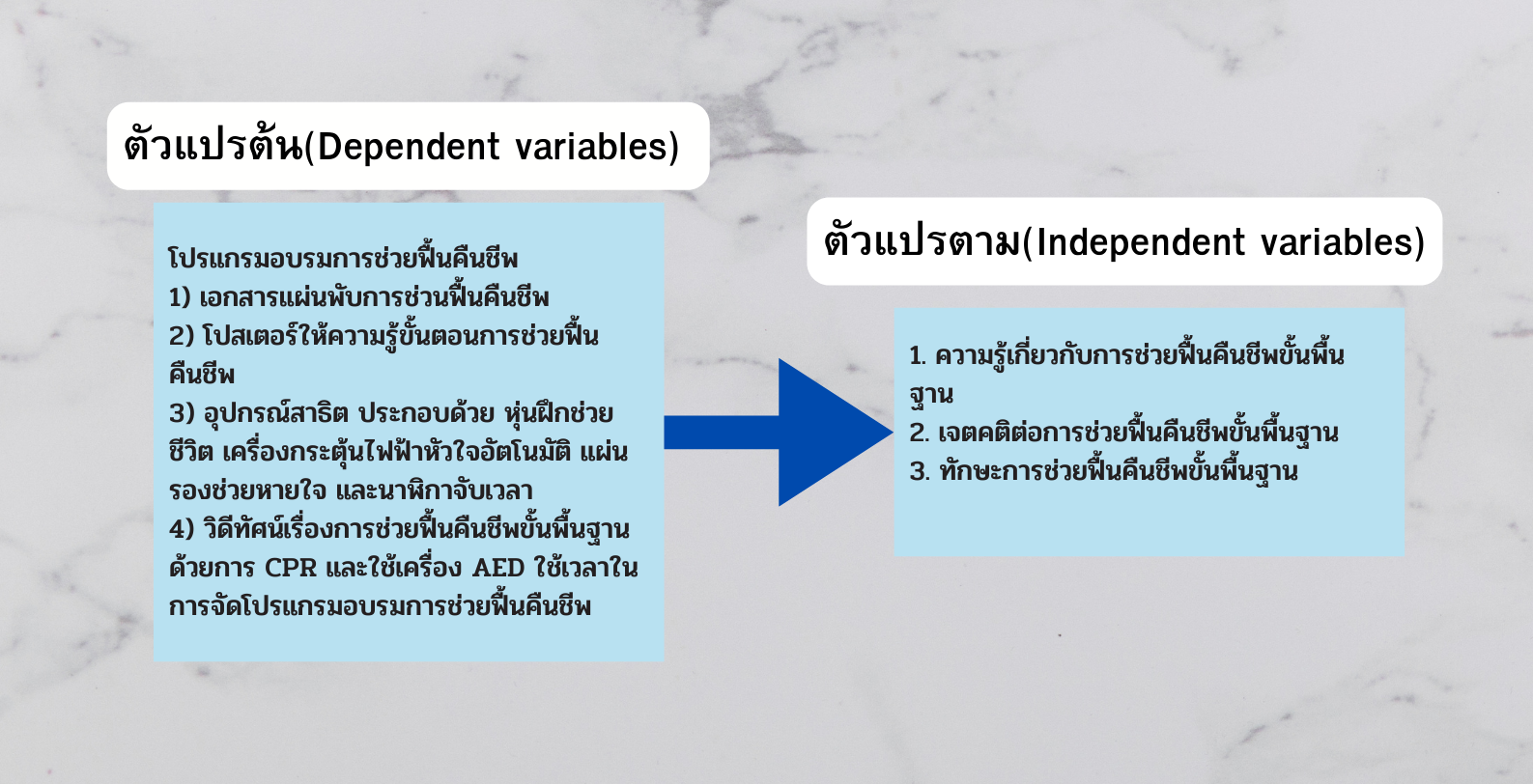
This quasi-experimental research study aimed to compare the average scores on knowledge, attitude, and cardiopulmonary resuscitation skills among village health volunteers in Pathum Thani province, Thailand. We used a one group pre-test, post-test design for 37 village health volunteers who participated in this study. A multi-stage sampling strategy was used to recruit participants. The research instrument was a resuscitation training program, and a questionnaire to collect personal data, knowledge, attitude, and cardiopulmonary resuscitation skills assessment form. The questionnaires which were validated. They had an index of item objective congruence ranging from 0.70-1.00, and a content validity index of 0.81. The data were analyzed by using descriptive statistics (frequency, percentage, mean, standard deviation, maximum and minimum), and a paired t-test. The results showed the resuscitation training program affected the knowledge, attitudes, and cardiopulmonary resuscitation skills (p < 0.001). The average scores for the pre-test and post-test for the knowledge variable were 4.91 and 12.16, respectively. The average scores for the pre-test and post-test for the attitude variable were 3.25 and 3.82, respectively. The average scores of pre-test and post-test on the cardiopulmonary resuscitation skills variable were 1.68 and 2.72, respectively. Therefore, the resuscitation training program promoting a high level of knowledge level, the right attitude, and right skills that can be applied in real situations by village health volunteers.
References
American Heart Association. (2021). CPR & First Aid Emergency Cardiovascular Care. [cited 2021 Nov 29], Available from https://cpr.heart.org/en/.
Best, J. (1981). Research in Education. (4th ed). London: Prentice- Hall International.
Bloom, B. S. (1986). Learning for Mastery. Evaluation comment. Center for the Study of Instruction Program. University of California at Los Angeles.
Department of Health Service Support. Ministry of Public Health. (2021). Village Health Volunteers report at the provincial level, Pathum Thani. Retrieved 29th November, 2021 from https://www.thaiphc.net/new2020/manual. (In Thai)
Department of Health Service Support. Ministry of Public Health. (2011). New Era Hand book for Village Health Volunteers. Bangkok: Agricultural Cooperative Association of Thailand. (In Thai)
Hisham A, Natenapha K, and Jintana D. (2020) Effect of a Self-Efficacy Enhancement Program on Capability of Trauma Patient Care on Scene and During Transfer by Emergency Medical Technician Personnel. Songklanagarind Journal of Nursing: 40(3), 15-25. (In Thai)
Napaporn L, Yothaka P and Pregamol R. (2015). Effectiveness of a Capacity Building Program for Village Health Volunteers on Knowledge and Attitude Toward Emergency Medical Services of People in Nongsua District, Pathumthani Province. Nursing Journal: 42(3), 106-118. (In Thai)
Natnapa S Thassaporn C and Aree S. (2020). Effect of The Resuscitation Training Program on Knowledge and Skills and Perceived Self-Efficacy of Resuscitation Village Health Volunteers in Khlong Chik Subdistrict, Bang Pra in District, Phra Nakhon Si Ayutthaya Province. Journal of The Royal Thai Army Nurses: 21(3): 283-293. (In Thai)
Pimradar S. (2018). A Development on Knowledge and Understanding of the Department of Disease Control’s Employee towards the Cardiopulmonary Resuscitation and the use of the Automated External Defibrillator. Journal of Interdisciplinary Research: Graduate Studies: 7(2), 35-41. (In Thai)
Praphai B, Patcharee P, Nattaporn P. Caring for cardiac arrest patients in the Accident and Emergency Department Jainad Narendra Hospital. [Internet]. 2017 Retrieved 11th January, 2021 from http://www.chainathospital.org/chainat/web/assets/ research/research1.pdf 3-4. (In Thai)
Sasithon T. (2021). Effectiveness of Basic Life Support Program on perception of Knowledge, Perceived Self-Efficacy and Skills toward Basic Life Support among High-School Students in Amphoe Khlong Luang, Pathumthani Province. Journal of Prachomklao College of Nursing, Phetchaburi Province: 4(2), 111-126. (In Thai)
Siamrathonline. (2020, 3rd November). Police provide basic life support training. Siamrath Newspaper. Retrieved 29th November,2021 from https://siamrath.co.th/n/194500. (In Thai)
Thayuta I, Phawinee P, and Doonsopa C. (2018). Relationships Between Knowledge, Attitude, Perceived Self-Efficacy and Capabilities for Basic Life Support among Cardiovascular Disease Caregivers. Journal of The Royal Thai Army Nurses: 19(พิเศษ), 139-148. (In Thai)
Woravut K and Hathaikarn K. (2021). The project to expand the community capacity development project to help the primary resuscitation in the area of San Sai District Chiang Mai Province. Chaing Mai: Siampimnana Company Limited. (In Thai)
Downloads
Published
How to Cite
Issue
Section
License
Copyright (c) 2022 Thai Journal of Public Health and Health Sciences

This work is licensed under a Creative Commons Attribution-NonCommercial-NoDerivatives 4.0 International License.
บทความทุกบทความที่ได้รับการตีพิมพ์ถือเป็นลิขสิทธิ์ของ วารสารสาธารณสุข