Factors Related to the Behavior of Using Herb for Self-Care of People in Prachinburi Province in the Pandemic Situation of Coronavirus Disease 2019
Keywords:
Behavioral health, herbal medicine, self-Care, Coronavirus Disease 2019Abstract
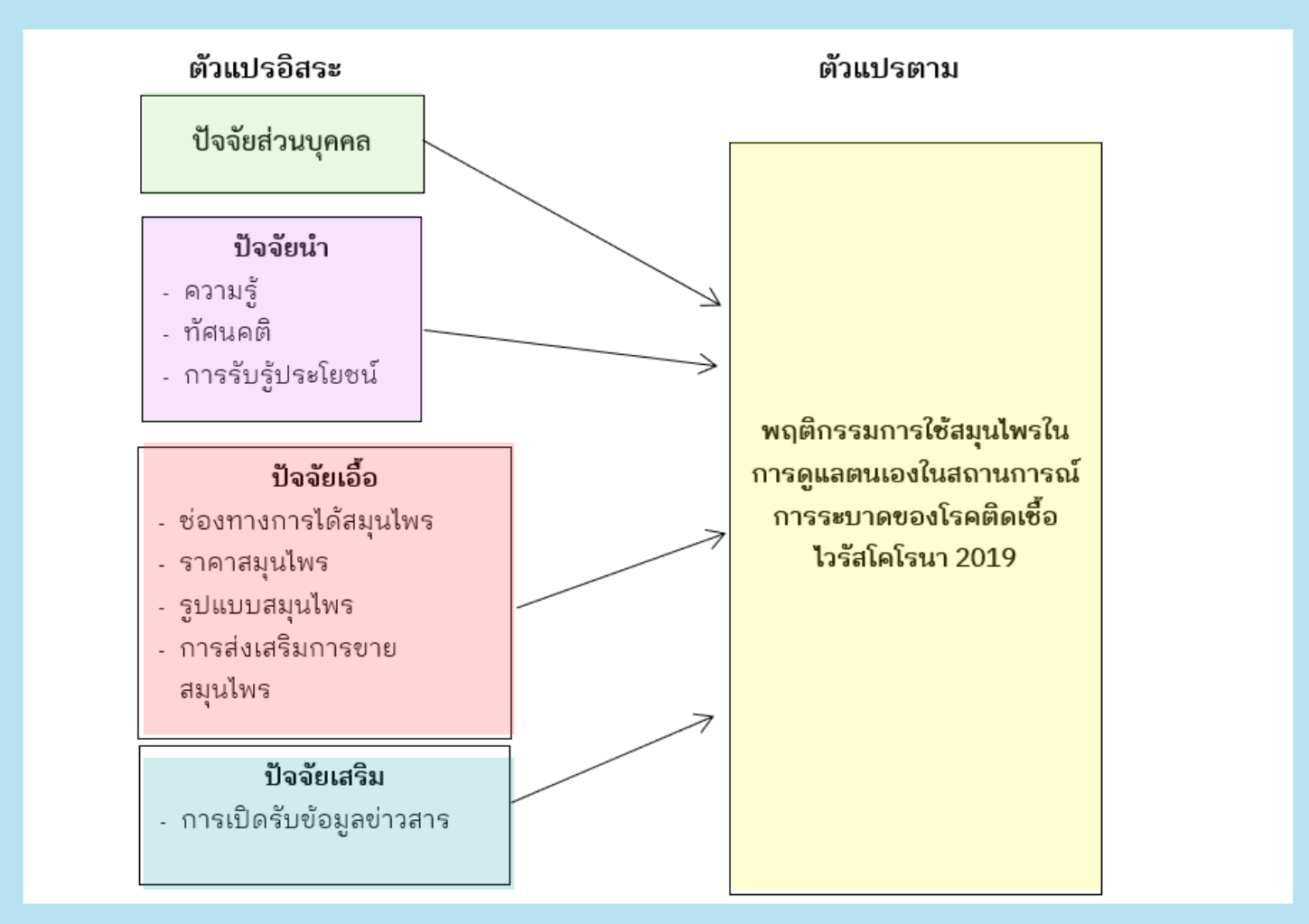
Recently, around the world and Thailand have faced the problem of the Coronavirus Disease 2019, continuously. This has impacted on people’s health for a long-time and more for self-care behavior learning. This survey research aims to assess the behaviors of herb using for self-care among people during the Coronavirus Disease 2019 pandemic and the relationships between behaviors and associated factors in Prachinburi province. The samples of 400 participants were using a Multi-stage Sampling method. The study questionnaires related to relationships between factors and the behaviors of herb using for self-care were verified the content for validity and reliability by the Cronbach’s alpha method (confidence coefficient= 0.923). The data were collected during January - April 2022. This data was analyzed by descriptive statistics, Chi-square test and Pearson’s correlation coefficient. The results showed that the most people had the behaviors of herbs using at a low level in both pre- and post- infection periods and at a moderate level in the infection period. For personal factor, the education level was statistically significant correlated with behaviors at the 0.05 level. For predisposing factor, educational levels were correlated negatively with behaviors at a low level. The attitude and perceived benefits were significantly positive correlated with behaviors at a low level (p < 0.001). For enabling factors, the herbal accessible, price and sales promotion were positively correlated with behaviors at a low level. For reinforcing factors, information receiving from personal media and mass media were positively correlated with behaviors at a low level (p < 0.001). We suggest for long-term sustainability to promote and educate in self-care for herbal uses for Coronavirus Disease 2019 pandemic.
References
Center for COVID-19 Situation Administration. (2021). Cases of COVID-19 in Thailand. Retrieved 10 September 2021, from https://www.facebook.com/informationcovid19. (in Thai)
Department of Disease Control. (2021). Thailand Situation of COVID-19. Retrieved 13 September 2021, from https://ddc.moph.go.th/covid19-dashboard. (in Thai)
Department of Thai Traditional and Alternative Medicine. (2021). Guidelines of Thai Traditional and Alternative Medicine on the Prevention of the Spread of COVID-19. Nontaburi: Ministry of Public Health.
Khumsaen, N. (2021). Knowledge, Attitudes, and Preventive Behaviors of COVID-19 among People LivinginAmphoeU-thong, Suphanburi Province. Journal of Prachomklao College of Nursing, Phetchaburi Province, 4(1), 33-48. (in Thai)
Likert, R., (1967). Attitude Theory and Measurement. (Ed.). New York: Wiley & Son.
Mattavangkul, C., Kawitu, K., Deenoo, S., Sinwannakool, S. (2019). Factor Related to Herbal Use Behavior for Self-care among People in Phasi-Chareon District. Journal of Nursing, Siam University, 20(39), 99-109. (in Thai).
Ministry of Public Health. (2016). Herbal City. Retrieved 13 September 2021, from https://nph.dtam.moph.go.th. (in Thai)
Mueangchang, W., (2016). Factors Related to Self Treatment with Herbal Remedies of People in Mea Chai District, Phayao Province. Pathumthani: Thammasat University. (in Thai)
National Statistical Office. (2010). Population Statistics Prachinburi Province. Retrieved 10 September 2021, from http://statbbi.nso.go.th. (in Thai)
Pharmaceutical Division and Thai Traditional and Alternative Medicine Division. (2021). Guidelines Using Herb for Health Care in the Pandemic Situation of Coronavirus Disease 2019. Prachinburi: Chaophraya Abhaibhubejhr Hospital. (in Thai)
Soltani, A., Jaam M., Nazar Z., Stewart D. & Shaito A. (2022). Attitudes and beliefs regarding the use of herbs and supplementary medications with COVID-19. Elsevier Public Health Emergency Collection, 20(7): 1-13.
Waedueramae, R., Kaewsuksai, R., Kongkun, P., Suwankanjana, A., Chaiprasit, K. (2021). Relationships between Knowledge, Perception and "New Normal Behaviors" on COVID-19 Prevention among Nursing Students, Faculty of Nursing, Princess of Naradhiwas University. The Southern College Network Journal of Nursing and Public Health, 8(2), 80-92. (in Thai).
Wetchakul, P., Mueangchang, W., Poobantad, J., (2021). Factors Related Local Herbal Use Behavior Towards Self Care among Village Health Volunteers in Mae-Rai, Mae-Jan District, Chiang-Rai. Rajabhat Chiangmai research journal, 22(3), 159-173. (in Thai).
Worapisuttiwong, N. (2011). Factors Relating Self – care Behaviors concerning ThaiTraditional Medicine of Suan Sunandha Rajabhat University Personnel. Bangkok: Suan Sunandha Rajabhat University. (in Thai)
World Health Organization. (2021). Global Situation of Coronavirus (COVID-19). Retrieved 13 September 2021, from https://covid19.who.int.
Downloads
Published
How to Cite
Issue
Section
License
Copyright (c) 2023 Thai Journal of Public Health and Health Sciences

This work is licensed under a Creative Commons Attribution-NonCommercial-NoDerivatives 4.0 International License.
บทความทุกบทความที่ได้รับการตีพิมพ์ถือเป็นลิขสิทธิ์ของ วารสารสาธารณสุข