Factors associated with Stress among Older Persons Living in Highland and Remote Communities, Chiang Mai Province
Keywords:
Stress, older persons, highland and remote community, factorsAbstract
Stress can compromise quality of life and daily living of older persons, especially among disadvantaged group. This cross-sectional analytical study aimed to assess level of stress among older persons living on highland and remote area in Chiang Mai Province and to analyse factors associated with stress. The sample consisted of 174 older persons. Data were collected using ST-5 for stress screening and a questionnaire for associated factors of stress. Descriptive statistical analysis and multiple linear regression analysis were performed.
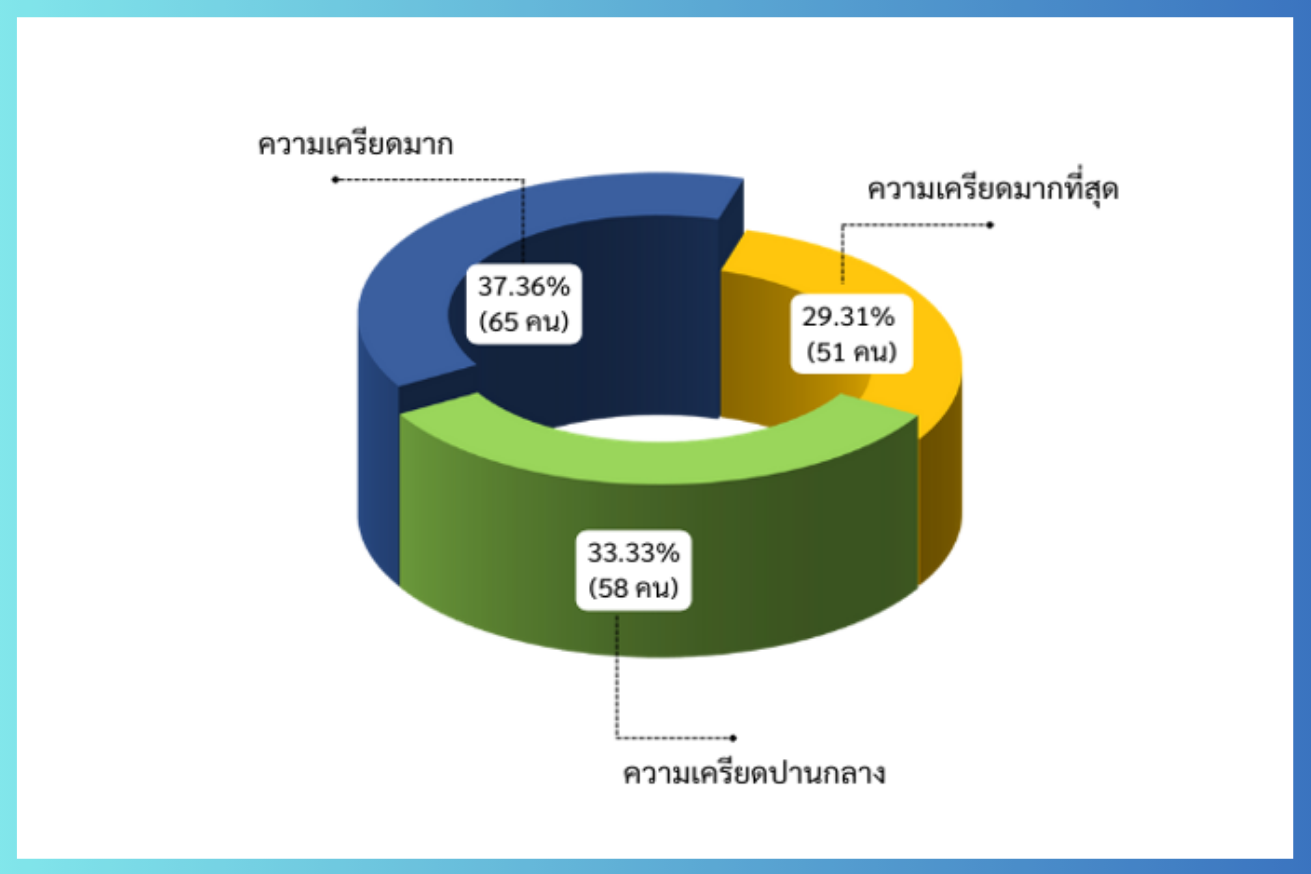
The results showed that the mean age of the participants was 71.20 years (60 – 100 years), 33.33%, 37.36% and 29.31% of older persons living on highland and remote area experienced moderate, high, and extreme levels of stress respectively. Stress of the older dwellers of highland and remote area was associated with sex, age, income, smart phone use and group participation (p <.05). Together, sex, age, income, smart phone use and group participation predicted 17 % of stress score (p-value < .001). High rate of stress among these highland and remote older residents warranted further in-depth studies in order to better plan for responsive health and social services.
References
Akila, G. V., Arvind, B. A., & Isaac, A. (2019). Comparative assessment of psychosocial status of elderly in urban and rural areas, Karnataka, India. Journal of family medicine and primary care, 8 (9), 2870–2876.
Busch, P.A., Hausvik, G.I., Ropstad, O.K. & Pettersen, D. (2021). Smartphone usage among older adults. Comput Human Behav, 121: 1-12.
Chai, X. & Kalyal, H. (2019). Cell Phone use and happiness among Chinese older adults: does rural/urban residence status matter? Research on Aging, 41 (1): 85-109.
da Cruz, W.M., D' Oliveira, A., Dominski, F.H., Diotaiuti, P. & Andrade, A. (2022). Mental health of older people in social isolation: the role of physical activity at home during the COVID-19 pandemic. Sport Sci Health, 18 (2): 597-602.
Daniel, W.W. & Cross, C.L. (2013). Biostatistics: a foundation for analysis in the health sciences (10th ed.) Hoboken: JohnWiley & Sons, Inc.
Foundation of Thai gerontology research and development institute. (2022). Situation of the Thai older persons 2021. Nakhon Pathom: Institute for Population and Social Research, Mahidol University.
Galiana, L., Tomás, J. M., Fernández, I., & Oliver, A. (2020). Predicting well-being among the elderly: the role of coping strategies. Frontiers in psychology, 11, 616. https://doi.org/10.3389/fpsyg.2020.00616
Issalillah, F., & Aisyah, N. (2022). The elderly and the determinants of stress. Journal of Social Science Studies, 2(1), 9-12.
Jaichuai, C. (2008). Lisu’s gender role in daily life: A case study of Baan Paekzam, Wiang Haeng district, Chiang Mai province (Master of Science in Geosocial Based Sustainable). Chiang Mai: Maejo University. (in Thai)
Jang, H.-Y. (2020). Factors associated with successful aging among community-dwelling older adults based on ecological system model. International Journal of Environmental Research and Public Health, 17(9), 3220. https://doi.org/10.3390/ijerph17093220
Khamluang P. (2022). A Model of Stress Management Among Tai Lue Aging People in Nan Province by Participation of network Partners (Thesis Doctor of Public Health). Phitsanulok: Naresuan University. (in Thai)
Khamluang, P., Sudnongbua, S. (2020). The elderly Tai Lue ethnic group and stress that should not be overlooked. Sukhothai Thammathirat Open University Journal, 33(2): 19-34. (in Thai)
Li, Y.T. & Tung, T.H. (2020). Effects of protective factors on the depressive status of elderly people in Taiwan. Medicine, 99(1): e18461.
Luo, M., Ding, D., Bauman, A., Negin, J. & Phongsavan, P. (2020). Social engagement pattern, health behaviors and subjective well-being of older adults: an international perspective using WHO-SAGE survey data. BMC Public Health, 20:99.
Méndez-Chacón, E. (2022). Gender differences in perceived stress and its relationship to telomere length in Costa Rican adults. Front. Psychol. 13:712660.
Miguel, P. & Vicerra, M. (2022). Mental stress and well-being among low-income older adults during COVID-19
pandemic. Asian J Soc Health Behav, 5(3): 101-7.
Muhammad, T., Srivastava, S. & Sekher, T.V. (2021). Association of self-perceived income status with psychological distress and subjective well-being: a cross-sectional study among older adults in India. BMC Psychol, 9: 1-13.
Nualsithong, N., Phuchongchai, T., Buajan, A. & Phattarasirisomboon, P. (2021). Stress and depression of the elderly with chronic diseases in Na Siew sub-district, Muang Chaiyaphum district, Chaiyaphum province. The public health journal of Burapha university, 16(2): 79-89. (in Thai)
Ong, F.S., Phillips, D.R. & Chai, S.T. (2013). Life events and stress: do older men and women in Malaysia cope differently as consumers? J Cross Cult Gerontol, 28: 195-210.
Pegthong, D., Rakwong, D., Seasahet, N., Pantusah, A., Woradat, S. & Chaimay, B. (2020). Health promotion among elderly people in community: stress and stress management approaches. Academic Journal of Community Public Health, 6(1): 1-11. (in Thai)
Salleh, M.R. (2008). Life event, stress and illness. Malaysian Journal of Medical Sciences, 15(4): 9-18.
Seangpraw, K., Auttama, N., Kumar, R., Somrongthong, R., Tonchoy, P., Panta, P. (2020). Stress and associated risk factors among the elderly: across-sectional study from rural area of Thailand. F1000Res, 8:655.
Sirichayanukul, B. & Khutmuang, S. (2018). Male-Female roles and beliefs in ethnic folktales. Journal of Social Academic,11(3): 293-301. (in Thai)
Thapa, D.K., Visentin, D.C. Kornhaber, R. & Cleary, M. (2020). Prevalence and factors associated with depression, anxiety, and stress symptoms among older adults: a cross-sectional population-based study. Nursing and Health Sciences, 22(4): 1139-1152.
Thomas, P.A., Liu, H. & Umberson, D. (2017). Family relationships and well-being. Innovation in Aging, 1(3): 1-11.
Tian, H. & Wang, Y. (2023). Mobile phone addiction and sleep quality among older people: The mediating roles of depression and loneliness. Behav Sci, 13(2):153.
Vannini, P., Gagliardi, G. P., Kuppe, M., Dossett, M. L., Donovan, N. J., Gatchel, J. R., Quiroz, Y. T., Premnath, P. Y., Amariglio, R., Sperling, R. A., & Marshall, G. A. (2021). Stress, resilience, and coping strategies in a sample of community-dwelling older adults during COVID-19. Journal of psychiatric research, 138, 176–185.
Vasunilashorn, S., Glei, D.A., Weinstein, M. & Goldman, N. (2013). Perceived stress and mortality in a Taiwanese older adult population. Stress, 16(6): 600-6.
Wang, L., Yang, L., Di, X. & Dai, X. (2020). Family support, multidimensional health, and living satisfaction among the elderly: a case from Shannaxi province, China. Int. J. Environ. Res. and Public health, 17, 8434.
Xu, Y., Zeng, K., Dong, L., Zheng, X., Si, Y. (2023). Understanding older adults' smartphone addiction in the digital age: empirical evidence from China. Front Public Health, 11:1136494.
Yoon, S. & Choi, S. (2022). Stress-related to COVID-19, anxiety, and protective factors among middle-aged and older adults in the largest outbreak areas in South Korea. Aging Ment Health, 26(10): 2090-9.
Zhang, C., Qing, N. & Zhang, S. (2021). The impact of leisure activities on the mental health of older adults: The mediating effect of social support and perceived stress. J Healthc Eng;Article, ID 6264447: 1-11.
Downloads
Published
How to Cite
Issue
Section
License
Copyright (c) 2023 Thai Journal of Public Health and Health Sciences

This work is licensed under a Creative Commons Attribution-NonCommercial-NoDerivatives 4.0 International License.
บทความทุกบทความที่ได้รับการตีพิมพ์ถือเป็นลิขสิทธิ์ของ วารสารสาธารณสุข