Phenolics, Flavonoids, and Antioxidant activity of Piper sarmentosum, Polygonum odoratum, Ocimum Americanum, Ocimum basilicum, and Ocimum tenuiflorum Leaves
Keywords:
Antioxidant, Flavonoid, Herb, Ocimum Americanum, PhenolicAbstract
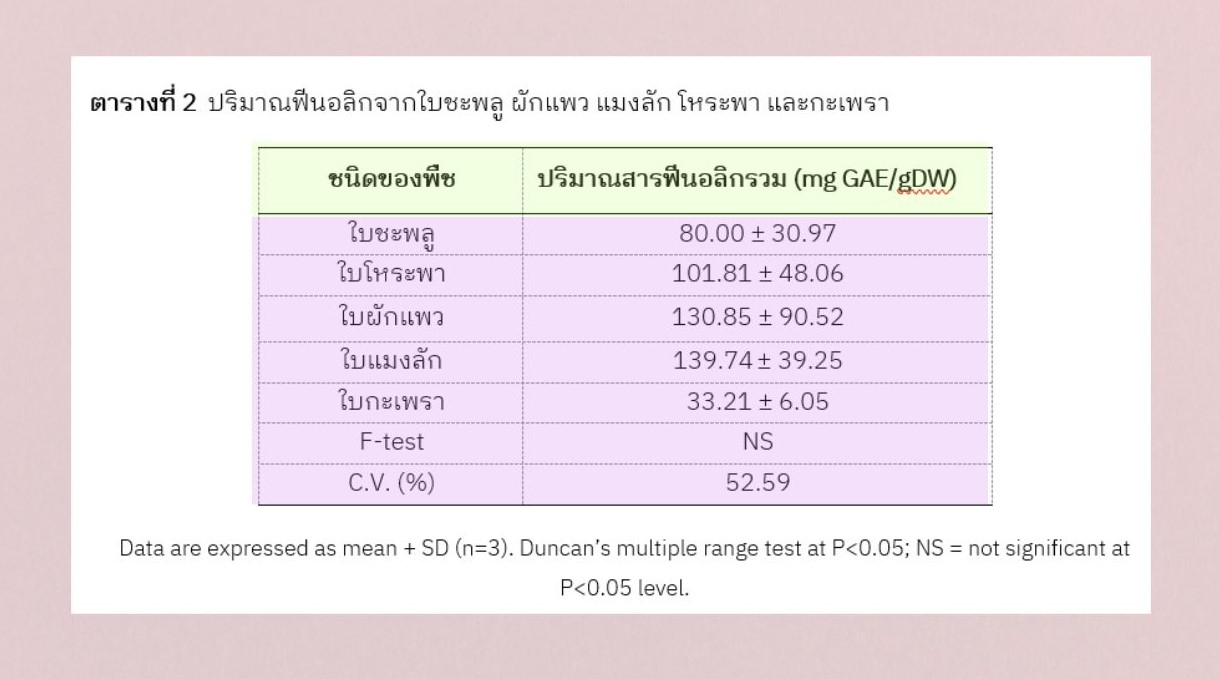
Piper sarmentosum, Polygonum odoratu, Ocimum Americanum, Ocimum basilicum, and Ocimum tenuiflorum are vegetables in the spicy group. Phenolics and flavonoids are secondary metabolites of plants that are beneficial to the body through their antioxidant properties. It will help prevent the occurrence of various chronic diseases in the body such as high blood pressure, diabetes, etc. The objective of this study was to compare the phenolic, flavonoid, and antioxidant activity of Piper sarmentosum, Ocimum basilicum, Polygonum odoratu, Ocimum Americanum, and Ocimum tenuiflorum, providing information on choosing foods for their health benefits. Food is medicine and provides information for selecting and developing dietary supplements that contain the highest amount of biologically active substances in the phenolic group. Phenolic content was analyzed using Folin's Ciocalteau reagent. Flavonoid content was analyzed using the Aluminum chloride colorimetric method. Antioxidant activity was analyzed using the DPPH radical scavenging activity method using gallic acid, quercetin, and trolox as standard substances, respectively. It was found that Ocimum Americanum leaves had the highest amounts of phenolics (139.74 mg GAE/gDW), flavonoids (411.40 mg QE/gDW), and antioxidant activity (37.27 %inhibition). In addition to the deliciousness of the food, its value for health is another important issue to consider when choosing to eat.
References
Azmi, N., Zulkurnain, E. I., Ramli, S., James, R. J., and Halim, H. (2021). The Phytochemical and Pharmacological Properties of Persicaria odorata: A Review. Journal of Pharmaceutical Research International, 33(41B): 262-279. http:// DOI: 10.9734/jpri/2021/v33i41B32366.
Butsat, S., & Siriamornpun, S. (2010). Antioxidant capacities and phenolic compounds of the husk, bran and endosperm of Thai rice. Food Chemistry, 119(2), 606-613. https://doi.org/10.1016/j.foodchem.2009.07.001
Kiraman, N. A. S. and Yusof, H. (2022). A mini review on the methods for the extraction, isolation, and determination of P. odorata's bioactive compounds. Healthscope, 5(2): 38-44. https://ir.uitm.edu.my/id/eprint/70596/1/70596.pdf.
Kunihiro, K., Kaneshima, T., Myoda, T. (2022). Antiglycative effect of extract and phenolic compounds from holy basil (Ocimum tenuiflorum). Glycative Stress Research, 9 (3): 175-185. https://www.toukastress.jp/webj/article/2022/GS22-33.pdf?20221025.
Mbegbu, N. N., Nwajinka, C. O., Amaefule, D. O. (2021). Thin Layer Drying Models and Characteristics of Scent Leaves (Ocimum Gratissimum) and Lemon Basil Leaves (Ocimum Africanum). Heliyon, 7(1): 1-9. https://doi.org/10.1016/j.heliyon.2021.e05945.
Omoikea, G. O., Georgea, B. O., Ugwua, E. O., and Okpoghono, J. (2022). Changes in the antioxidant properties of Ocimum africanum leaves aqueous extract from the southeastern region of Nigeria after in vitro gastrointestinal digestion. International Journal of Food Properties. 25(1): 2000-2008.https://www.tandfonline.com/doi/epdf/10.1080/10942912.2022.2120494?needAccess=true
Pawłowska, K.A., Strawa, J., Tomczyk, M., Granica, S. (2020). Changes in the phenolic contents and composition of Persicaria odorata fresh and dried leaves. Journal of Food Composition and Analysis, 19(103507). http:// DOI:10.1016/j.jfca.2020.103507.
Qin, W., Ketnawa, S., Ogawa, Y. (2021). Effect of Digestive Enzymes and pH on Variation of Bioavailability of Green Tea during Simulated in Vitro Gastrointestinal Digestion. Food Science and Human Wellness. 11(3): 669–675. http:// DOI:10.1016/j.fshw.2021.12.024.
Ridzuan, P., Hairul Aini, H., Mohd Hassan, N., Hairul Aini, H., Norazian, M. H., Shah, A., Aminah, K. S. (2013). Antibacterial and Antifungal Properties of persicaria odorata Leaf Against Pathogenic Bacteria and Fungi. In Proceedings Journal (Issue 4). https://www.researchgate.net/publication/348740094
Romano, R., Luca, L.De., Aiello, A., Pagano, R., Pierro, P.D.,Pizzolongo, F., & Masi, P. (2022). Basil (Ocimum basilicum L.) Leaves as a Source of Bioactive Compounds. Foods, 11(20): 1-13. http://doi:10.3390/foods11203212.
Shahrajabiana, M.H., Suna, W., Cheng, Q. (2020). Chemical components and pharmacological benefits of Basil (Ocimum basilicum): a review. International Journal of Food Properties, 23(1): 1961-1970. http:// DOI:10.1080/10942912.2020.1828456.
Silva, A. P. de. S, Camargo, A. C. de., Lazarini, J. G., Franchin, M., Sardi, J. de. C. O., Rosalen, P. L., and Alencar, S. M. de. (2023). Phenolic Profile and the Antioxidant, Anti-Inflammatory, and Antimicrobial Properties of Açaí (Euterpe oleracea) Meal: A Prospective Study., Foods, 12(86). https://doi.org/10.3390/foods12010086.
Sim, O. P., Rasid, A. R., Daud, N. H. A., David, D., Borhan, A. H., Saibeh, K., Silip, J. J., Milan, Abd. R., & Alimon, A. R. (2019). Preliminary Investigation on the Chemical Composition of Local Medicinal Herbs (Curcuma longa L., Persicaria odorata L. and Eleutherine palmifolia L.) as Potential Layer Feed Additives for the Production of Healthy Eggs. Transactions on Science and Technology, 6(2): 221– 227.https://tost.unise.org/pdfs/vol6/no2-2/6x2-2x221-227.pdf
Singh, D., Chaudhuri, P.K. (2018). A review on phytochemical and pharmacological properties of Holy basil (Ocimum sanctum L.). Industrial Crops and Products, 118: 367-382. http:// DOI:10.1016/j.indcrop.2018.03.048
Sultana, B., Anwar, F., & Ashraf, M. (2009). Effect of extraction solvent/technique on the antioxidant activity of selected medicinal plant extracts. Molecules, 14(6), 2167-2180.https://doi.org/10.3390/molecules14062167
Sun, X., Chen, W., Dai, W., Xin, H., Rahmand, K., Wang, Y., Zhang, J., Zhang, S., Xu, L., Han, T., (2020). Piper sarmentosum Roxb.: A review on its botany, traditional uses, phytochemistry, and pharmacological activities., Journal of Ethnopharmacology, 263 (112897). http:// DOI:10.1016/j.jep.2020.112897.
Ugwu, E. O., George, B. O., Omoike, G. O., Okpoghono, J. (2021). Bioaccessibility of Polyphenols and Flavonoids in Ocimum Africanum Leaves Extract. Uniport Journal of Engineering and Scientific Research. 6(1): 78–84. https://www.ujesr.org/images/vol6/Article-10.pdf.
Williams, W. B., Cuvelier, M. E., & Berset, C. (1995). Use of a free radical method to evaluate antioxidant activity. LWT-Food Science and Technology, 28(1), 25-30. https://doi.org/10.1016/S0023-6438(95)80008-5.
Downloads
Published
How to Cite
Issue
Section
License
Copyright (c) 2024 Thai Journal of Public Health and Health Sciences

This work is licensed under a Creative Commons Attribution-NonCommercial-NoDerivatives 4.0 International License.
บทความทุกบทความที่ได้รับการตีพิมพ์ถือเป็นลิขสิทธิ์ของ วารสารสาธารณสุข