Effectiveness of the Development Program of Village Health Volunteers (VHVs) in Screening for Oral Precancerous Lesions with Artificial Intelligence Devices
Keywords:
Oral Screening, Precancerous lesion, Oral Potentially Malignancy Disorders (OPMDs), Oral cancer Artificial intelligence Risk factorAbstract
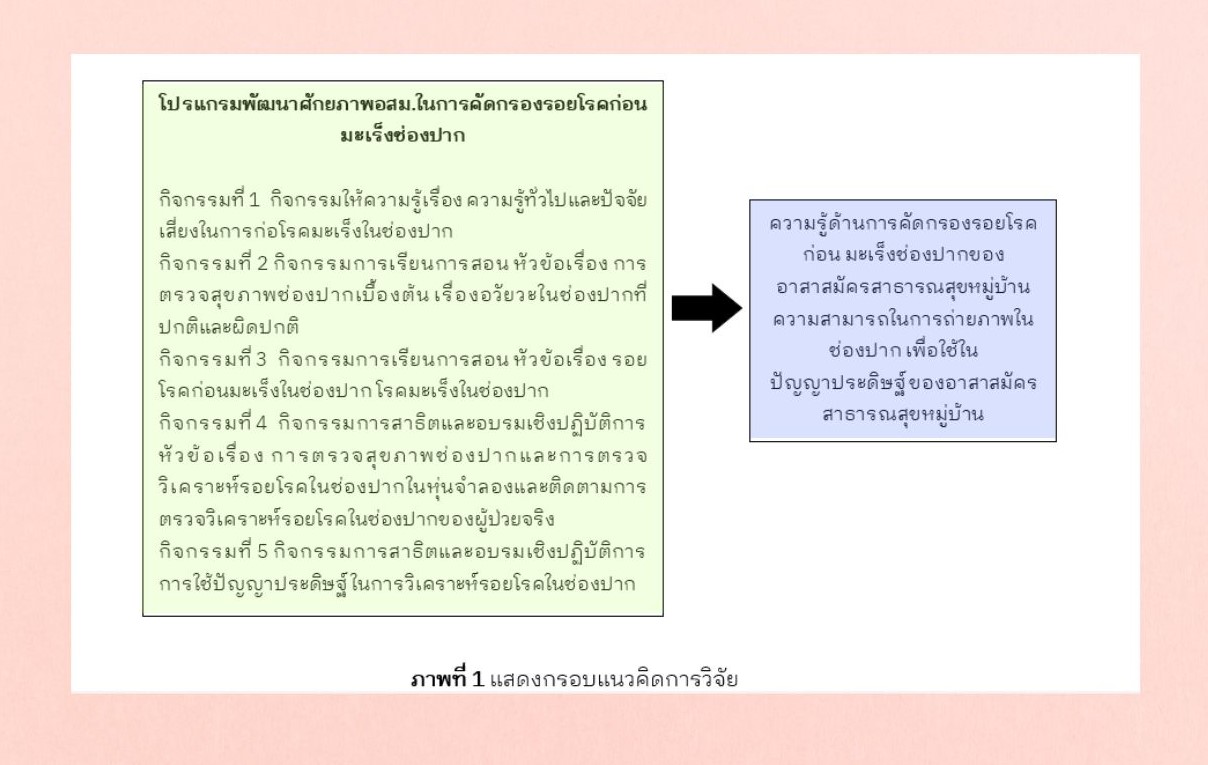
The shortage of dental personnel is a limitation in oral cancer control programs. Using the training method of village health volunteers (VHVs) and using screening tools such as artificial intelligence devices can increase the efficiency of medical personnel in helping screen for precancerous lesions in the oral cavity. This study used quasi-experimental design with two groups of pre- and post-test measurements. The objectives were to compare knowledge of oral precancerous lesion screening and oral photography ability of VHVs before and after participating in the VHVs capacity development program for oral precancerous lesion screening. The subjects consisted of VHVs in Thalang District, Phuket Province, in the experimental and control groups, 32 people each, using systematic sampling. The instruments used for data collection were questionnaires and tests, with reliability values of 0.711 and 0.708, respectively.
Data were analyzed for 1) descriptive personal characteristics of the subjects using frequency distribution, percentage, mean, and standard deviation and 2) Compared the difference in scores of VHVs in measuring knowledge of screening for precancerous lesions of the oral cavity and scores of oral photography ability tests before and after providing the program to develop VHVs' potential in screening for precancerous lesions of the oral cavity using Paired t-test and Independent t-test statistics.
The results of the comparison of knowledge scores on oral precancerous lesions screening showed that before joining the program, the knowledge scores of the experimental group and the control group were not different (p = 0.728), but after joining the program, the scores of the experimental group were significantly higher than those of the control group (p = 0.009). The results of the comparison of oral photography ability scores showed that before joining the program, the ability scores of the experimental group and the control group were not different (p-value = 0.375), but after joining the program, the scores of the experimental group were significantly higher than those of the control group (p < 0.001).
This study suggested that it should increase the subjects used in the study and should select a subject with the most similar demographic characteristics, such as age and education, which may affect the study. In order for the sample group of VHVs to be familiar with normal and abnormal oral organs, they should try examining real patients.
References
Warnakulasuriya S. (2009). Causes of oral cancer – An appraisal of A controversies. Br Dent
J,207:471–475.
Tantipasawasin S.,Tantipasawasin P. (2019). Oral cancer. Chonburi Hospital Journal,44(3):235-348.
HOSPITAL-BASED CANCER REGISTRY (2020). National Cancer Institute Department of Medical
services. Nontaburi:Ministry of Public Health. (in Thai)
Seenuanlae L., Vatanasapt P., Promthet S., Kamsa-ard S.(2013). Five Years Survival of Oral Cavity
Cancer Squamous Cell Carcinoma Type in Srinagarind Hospital, Khon Kaen University.60 (1):61-67.
Tanya M. ( 2021). The evaluation of potentially malignant disorders and oral cancers by non-invasive
adjunctive technique. Udonthani Hospital Medical Journal,29(2):304-313.
Warnakulasuriya S.(2020). Oral potentially malignant disorders: A comprehensive review on clinical
aspects and management. Oral Oncology,102:10455.
Wei L., Yu-Feng W., Hai-Wei Z., Peng S., Zeng-Tong Z., Guo-Yao T.(2010).Malignant transformation of
oral leukoplakia a retrospective cohort study of 218 Chinese patients. BMC Cancer, 10:685.
Sankaranarayanan R., Ramadas K., Thara S., Muwonge R., Thomas G., Anju G., et al. (2013). Long term
effect of visual screening on oral cancer incidence and mortality in a randomized trial in Kerala, India. Oral Oncol, 49(4):314–321.
Sankaranarayanan R., Ramadas K., Thomas G., Muwonge R., Thara S., Mathew B., et.al. (2005). Effect
of screening on oral cancer mortality in Kerala, India: a cluster-randomised controlled trial. Lancet, 365(9475):1927–1933.
Praveen B N., Keerthi G., Sanjana P., Sumsum P., Shubhasini A R., Shubha G., et.al.(2019). The role of
community health worker in a mobile health program for early detection of oral cancer. Indian
Journal of Cancer, 20 (20).1-7.
Ilhan B., Guneri P., Wilder-Smith P. (2021). The contribution of artificial intelligence to reducing the
diagnostic delay in oral cancer. Oral Oncol, 116: 105254.
Hamad G.D. (2022). Mobile Health (mHealth) Technology in Early Detection and Diagnosis of Oral
Cancer-A Scoping Review of the Current Scenario and Feasibility. Journal of Healthcare
Engineering, Article ID 4383303.
Dunn S.P., Roger R.W.(1986). Protection Motivation Theory and Preventive Health : Beyond the Health
Believe Model. In Health Education Research Theory and Practice.
Sajai K., Kitsripisarn S., Bannasaan B. (2018). The Effects of a Self-Management Promotion Program
on the Oral Care Behavior and Oral Mucositis of Cancer Patients Receiving Chemotherapy.
(2) :43-56
Downer M.C., Moles D.R., Palmer S., Speight P.M. (2004). A systematic review of test performance in
screening for oral cancer and precancer. Oral Oncol, 40(3):264–273.
Kumdee C (2015). Health Systems Research Institute (HSRI). HITAP: Health intervention and
Technology Assessment Program
Downloads
Published
How to Cite
Issue
Section
License
Copyright (c) 2024 Thai Journal of Public Health and Health Sciences

This work is licensed under a Creative Commons Attribution-NonCommercial-NoDerivatives 4.0 International License.
บทความทุกบทความที่ได้รับการตีพิมพ์ถือเป็นลิขสิทธิ์ของ วารสารสาธารณสุข