Situational Analysis of Nursing Innovation Management, Nakornping Hospital, Chiang Mai Province
Keywords:
Innovation Management, Nursing Innovation, Situation AnalysisAbstract
This descriptive research aimed to: 1) analyze the situation of nursing innovation management at Nakornping Hospital, Chiang Mai Province, and 2) explore problems, obstacles, and suggestions regarding nursing innovation management. The sample group consisted of 322 registered nurses. Data were collected through questionnaires from 289 participants and focus group discussions with 33 participants. The research instrument was a questionnaire adapted from Tidd and Bessant’s (2014) innovation management framework. The instrument’s content validity index (S-CVI) was 0.97, and its reliability (Cronbach’s alpha) was 0.98. Focus group questions were also used. Data were analyzed using descriptive statistics and content analysis.
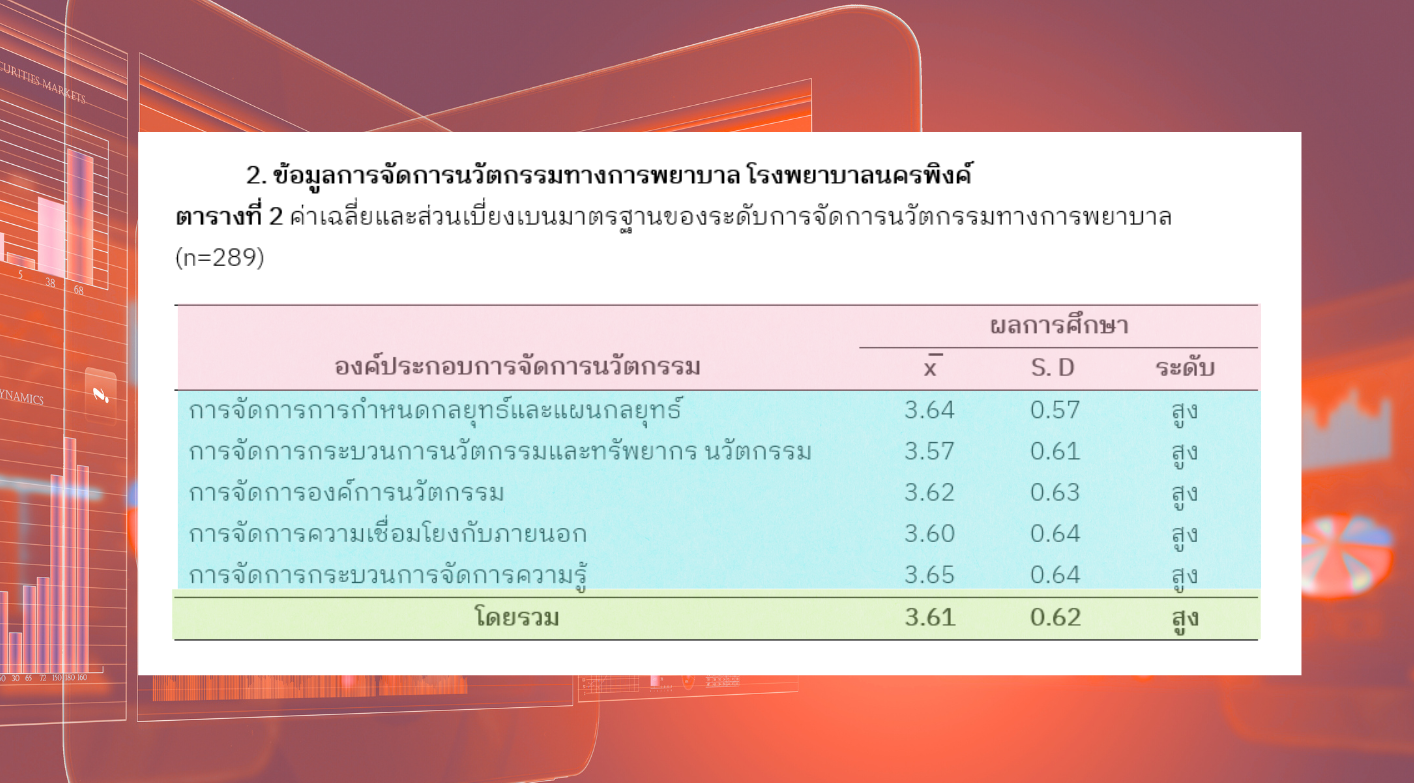
The results showed that the overall level of nursing innovation management was high (mean = 3.61, S.D. = 0.62). Identified problems and obstacles included unclear strategic planning, lack of continuity, limited budget, communication issues, and structural limitations. Recommendations for improvement included developing clear policies and strategies, enhancing project management processes, restructuring research and development units, strengthening external collaboration, and establishing a continuous monitoring and data management system to enhance the efficiency of nursing innovation management.
References
Alshwayat, D., Elrehail, H., Shehadeh, E., Alsalhi, N., Shamout, M. D., & Rehman, S. U. (2023). An exploratory examination of the barriers to innovation and change as perceived by senior management. International Journal of Innovation Studies, 7 (2), 159-170. https://doi.org/10.1016/j.ijis.2022.12.005
Bach-Mortensen, A. M., Lange, B. C. L., & Montgomery, P. (2018). Barriers and facilitators to implementing evidence-based interventions among third sector organisations: A systematic review. Implementation Science, 13 (103), 1-19. https://doi.org/10.1186/s13012-018-0789-7
Cooper, R. G. (2019). Winning at new products: Creating value through innovation. Basic Books.
Damanpour, F. (1991). Organizational innovation: A meta-analysis of effects of determinants and moderators. Academy of Management Journal, 34 (3), 555-590.
Division of Nursing. (2024). Criteria for determining staffing framework of the Bureau of Human Resource Management, Office of the Permanent Secretary, Ministry of Public Health. Office of the Permanent Secretary, Ministry of Public Health.
Ferreira, J. J. M., Fernandes, C. I., Alves, H., & Raposo, M. L. (2015). Drivers of innovation strategies: Testing the Tidd and Bessant (2009) model. Journal of Business Research, 68 (7), 1395-1403. https://doi.org/10.1016/j.jbusres.2015.01.021
Kaya, N., Turan, N., & Aydın, G. Ö. (2015). A Concept analysis of innovation in nursing. Procedia-Social and Behavioral Sciences, 195, 1674-1678. https://doi.org/10.1016/j.sbspro.2015.06.244
Khlangthamniam, K., (2011). Nursing service innovation. Journal of Praboromarajchanok Institute of Nursing, Chanthaburi, 22 (2), 71–79.
Limjaron, K., Singchungchai.P, (2021). Development of Nursing Innovation Management Scale for First-line Nurse Managers, General Hospital Ministry of Public Health. Journal of Bamrasnaradura Infectious Diseases Institute, 15 (1), 49-59.
Luangpirom. N., (2007). Innovation Management: The Development of the Innovative Capability Model of the Researchers. A Dissertation Presented to Ramkhamhaeng University in Partial Fulfillment of the Requirements for the Degree of Philosophy of Public Administration, Ramkhamhaeng University.
Prasertsak, A., Piriyapongrat, P., & Trakoonchokamnuey, K., (2023). Innovation management model of private hospitals in Nakhon Pathom province. Journal of Humanities and Social Sciences, Rajapruk University, 9(1), 56–74.
Ministry of Public Health. (2021). Digital Health Strategy, Ministry of Public Health 2021 - 2025. https://ict.moph.go.th/assets/ebooks/WPHE9LIK3fyymJmABYOPGa7qr88laXmV.html
Mokekhaow, K., Rattanachot, S., Pankhong, T. (2017). The Relationship Model among Transformational Leadership, Knowledge Creation and Innovation Management Performance in Nursing Unit at Community Hospitals. Journal of Boromarajonani College of Nursing, Bangkok, 13(2), 75-89.
Nakornping Hospital. (2022). Nakornping Hospital Strategic Plan, Fiscal Year 2022 and Strategic Implementation Project for Fiscal Year 2022 by the Nakornping Hospital Executive Board. Nakornping Hospital, Chiang Mai Province. (in Thai)
Nantachaipan, P. (2008). Guidelines for clinical situational analysis study. Supporting document for the meeting of the Master's Degree Program Committee in Adult Nursing, Plan B (Special Program). Faculty of Nursing, Chiang Mai University.
Naranjo-Gil, D. (2009). The influence of environmental and organizational factors on innovation adoptions: Consequences for performance in public sector organizations. Technovation, 29 (12), 810-818. https://doi.org/10.1016/j.technovation.2009.07.003
Nonaka, I., & Takeuchi, H. (1995). The knowledge-creating company: How Japanese companies create the dynamics of innovation. Oxford University Press.
Nursing Mission Group, Nakhonping Hospital. (2020). Nursing Mission Group Strategic Plan. (in Thai)
Nursing Research and Development Group, Nakornping Hospital. (2023). Nursing practice in nursing research and development of the Nursing Research and Development Group, nursing missions, Nakornping Hospital. Nakornping Hospital. Retrieved 6, 2024 from https://mis.nkp-hospital.go.th/institute/ admInstitute/nFile/sID2023-01-01_104251.pdf
Porter, M. E. (1996). What is strategy? Harvard Business Review, 74(6), 61-78. https://hbr.org/1996/11/what-is-strategy
Rathachatranon, W., (2019). Determining an Appropriate Sample Size for Social Science Research: The Myth of using Taro Yamane and Krejcie & Morgan Method. Journal of Interdisciplinary Research: Graduate Studies, 8(1): 11-28.
Sawatsingh, T., (2020). Public health innovations and strategies. Faculty of Nursing Chaiyaphum RaJabhat University Retrieved 6, 2024 from http://course.cpru.ac.th/wpcontent/uploads/ 2020/03/บทที่-3-และ5.pdf
Srisa-ard, B., (1992). Introduction to Research. Suweerivasarn company limited.
Srisatidnarakul, B., (2010). The Methodology in Nursing Research. U & I media company limited.
Thai govermnent gazette. (2018). 20-year National Strategy (2018-2037). Retrieved 6, 2024 from
Theerawitayalert, P. (2016). Effective focus group techniques. Journal of Yan Song Wor Research Institute, 7(2), 284–289.
Tidd, J., & Bessant, J. (2009). Managing innovation: Integrating technological, market, and organizational change. John Wiley & Sons.
Tidd, J., & Bessant, J. (2014). Managing innovation: Integrating technological, market and organizational change (6th ed.). Wiley.
Thongthip, S., Chatdokmaiprai, K., Singchungchai, P., (2022). Workplace innovation management of nurse managers in University Hospitals: A phenomenological study. Chula Medical Journal, 66(4), 429-439.
Udomtanateera, K., (2020). Obstacles to innovation. Retrieved 6, 2024 from
https://www.iok2u.com/article/innovation/innovation-008-obstacles-to-innovation?highlight
Weng, R.-H., Huang, C.-Y., & Lin, T.-E. (2013). Exploring the cross-level impact of market orientation on nursing innovation in hospitals. Health Care Management Review, 38(2), 125-136. https://doi.org/10.1097/HMR.0b013e31824b1c84
Yan, D., Li, M., Zhang, Y., & Zhang, Y. (2022). A qualitative study of facilitators and barriers to nurses innovation at work. Journal of Nursing Management, 30(7), 3449–3456. https://doi.org/10.1111/jonm.13811
Zhang, C., & Dhaliwal, J. (2009). An investigation of resource-based and institutional theoretic factors in technology adoption for operations and supply chain management. International Journal of Production Economics, 120 (1), 252-269. https://doi.org/10.1016/j.ijpe.2008.07.023
Downloads
Published
How to Cite
Issue
Section
License
Copyright (c) 2025 Thai Journal of Public Health and Health Sciences

This work is licensed under a Creative Commons Attribution-NonCommercial-NoDerivatives 4.0 International License.
บทความทุกบทความที่ได้รับการตีพิมพ์ถือเป็นลิขสิทธิ์ของ วารสารสาธารณสุข