The Wisdom of Folk Healers in the Treatment of Fractures of the Upper Northern Region
Keywords:
Folk Healers, Bone Fracture, Upper Northern Region, TreatmentAbstract
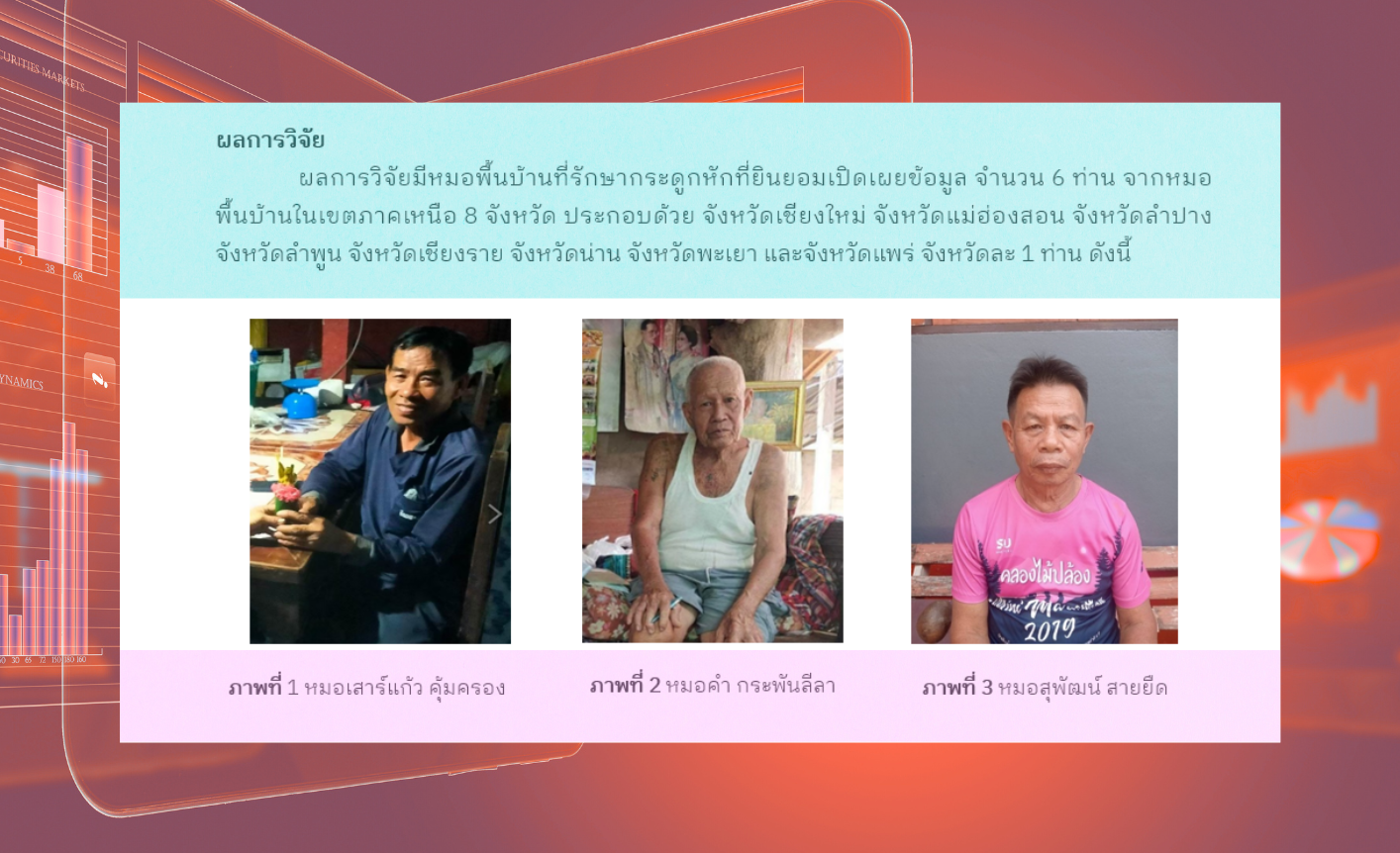
This study aimed to investigate the bone fracture treatment process of traditional healers in the Upper Northern Region of Thailand and its integration with modern medical approaches. A qualitative research methodology was employed, involving document analysis, in-depth interviews, and both participant and non-participant observations. The participants were selected through purposive sampling and included traditional healers renowned for their expertise in bone fracture treatment across six provinces: Lampang, Lamphun, Chiang Rai, Nan, Phayao, and Phrae. All selected healers had a minimum of ten years of experience and were still actively providing treatment at the time of the study. As a result of the research process, six traditional healers who met the inclusion criteria and consented to share their knowledge were included in the study. The data collected through in-depth interviews and various forms of observation were analyzed and categorized in accordance with the research objectives.
The findings revealed that 1) The backgrounds and traditional knowledge of healers were diverse in terms of education, occupation, and learning pathways. Most acquired their knowledge through intergenerational transmission or apprenticeship with a master healer, often embedded in ritual and cultural contexts. This reflects a deeply rooted and community-based body of knowledge. 2) The bone fracture treatment process demonstrated a distinctive integration of traditional medical science and art. The procedures generally involved ritual offerings to the ancestral teachers, patient history-taking, physical examination, application of sesame oil, bone realignment, splinting with bamboo or PVC tubes, and post-treatment dietary and activity restrictions. While formal follow-up systems were lacking, healers often monitored patient outcomes informally through community networks, reflecting strong healer-patient relationships. 3) The core remedy used was sesame oil, prepared via cold-press or steaming techniques. Some healers enriched the oil with specific herbs to enhance pain relief and bone healing. Despite its long-standing efficacy, this traditional formula remains at risk of being lost due to the lack of systematic documentation and limited knowledge transmission across generations. This study underscores the importance of systematically documenting, preserving, and transmitting traditional healing knowledge. Such efforts can help safeguard this cultural heritage while promoting its integration into the modern Thai healthcare system in alignment with the holistic principles of Thai traditional medicine—rooted in nature, community, and ethical practice.
References
Kanakorn, S., Thawat, B., & Darawan, R. (2015). Indigenous wisdom of traditional bone healers in Plaipraya District, Krabi Province. Journal of Community Health Development, 3(2), 321–341.
Thanida, K., Chantana, K., Sirilada, P., Arpakorn, T., Krisana, K., Napatsakorn, K., Laitian, P. (2014). Effectiveness of traditional healers in treating bone fracture patients. Bangkok: Department of Thai Traditional and Alternative Medicine.
Siritat, C., Jenrawee, S., & Thanida, K. (2016). Indigenous wisdom of traditional bone healers in treating elderly patients with fractures. Journal of Nursing and Education, 9(1), 15–29.
Khun-iad, C., Nuiden, N., Songrak, S., Sannahu, A., Deen-namao, O., & Maprasit, A. (2019). Indigenous wisdom of traditional bone healers: A case study of Norohman Kardi, Thepha District, Songkhla Province. Journal of Social Sciences and Humanities Research in Asia, 25(2), 159–184.
Department of Thai Traditional and Alternative Medicine. (2016). Thai public health report on traditional medicine, folk medicine, and alternative medicine 2014–2016.
Laokhompruttajan, J., Laokhompruttajan, T., Kanjanasit, W., & Wongwai, N. (2023). Local wisdom in health: Integrations to learning management in caring for postpartum mothers. Regional Health Promotion Center 9 Journal, 17(2), 618–630.
Piyanuch, Y., & Supim, W. (2009). A study of the traditional knowledge of folk healers in Ongkharak district, Nakhon Nayok province. Faculty of Allied Health Sciences, Srinakharinwirot University.
Saychit, S. (2021). A study of the traditional knowledge of folk healers in Khlong Nam Lai subdistrict, Khlong Lan district, Kamphaeng Phet province. Southern Network Journal of Nursing and Public Health, 8(3), 213.
Chantharumno, S., Jenaravee, S., Areerak, A., & Thanida, K. (2016). Traditional knowledge of folk bone healers in treating elderly patients with bone fractures. Journal of Nursing and Education, 9(1), 27-28.
Suksamra Adisak, S. (2021). Existing roles and existence of folk healers in Pathum-Thani province to community health care. PTU Journal of Science and Technology (PJST), 2(1), 88-89.
Fakkham, J., Sangwichian, S., & Fakkham, S. (2021). Health care with local wisdom in Lom Sak district, Phetchabun province. Mor Ya Thai Research Journal, 7(2), 132.
Hanachawa, K., Fakkham, S., Sangwichian, S., Chinnakhan, T., & Anmanee, P. (2022). A comparison of the efficacy and safety of sesame oil and Kudmon grass oil in alleviating knee pain in patients with knee osteoarthritis. Mor Ya Thai Research Journal, 8(1), 69.
Downloads
Published
How to Cite
Issue
Section
License
Copyright (c) 2025 Thai Journal of Public Health and Health Sciences

This work is licensed under a Creative Commons Attribution-NonCommercial-NoDerivatives 4.0 International License.
บทความทุกบทความที่ได้รับการตีพิมพ์ถือเป็นลิขสิทธิ์ของ วารสารสาธารณสุข