Developing A Model for Promoting the Quality of Life of the Elderly through Family Participation in the Area of Ban Katun-Phipun Lonklao Subdistrict Health Promoting Hospital, Khuan Kalong District, Satun Province
Keywords:
Model for Promoting the Quality of Life of the Elderly, Family ParticipationAbstract
This research was an action research study to develop a model for promoting the quality of life of the elderly through family participation in the Ban Kratun-Phiphun Lon Klao Subdistrict Health Promoting Hospital, Khuan Kalong District, Satun Province. The study conducted two phases: 1) preparation, which studied the community situation and needs for promoting the quality of life of the elderly; and 2) implementation, which developed the model through a four-step process: 1) planning, 2) implementation, 3) observation, and 4) reflection. The sample consisted of 84 elderly individuals, selected using a simple random sample. Data were collected using an Elderly Quality of Life Assessment and a satisfaction assessment, with content validity values of .90 and .81, respectively, and a Cronbach's alpha coefficient of .89. Quantitative data were analyzed using descriptive statistics and a paired-sample t-test, while qualitative data were analyzed using content analysis.
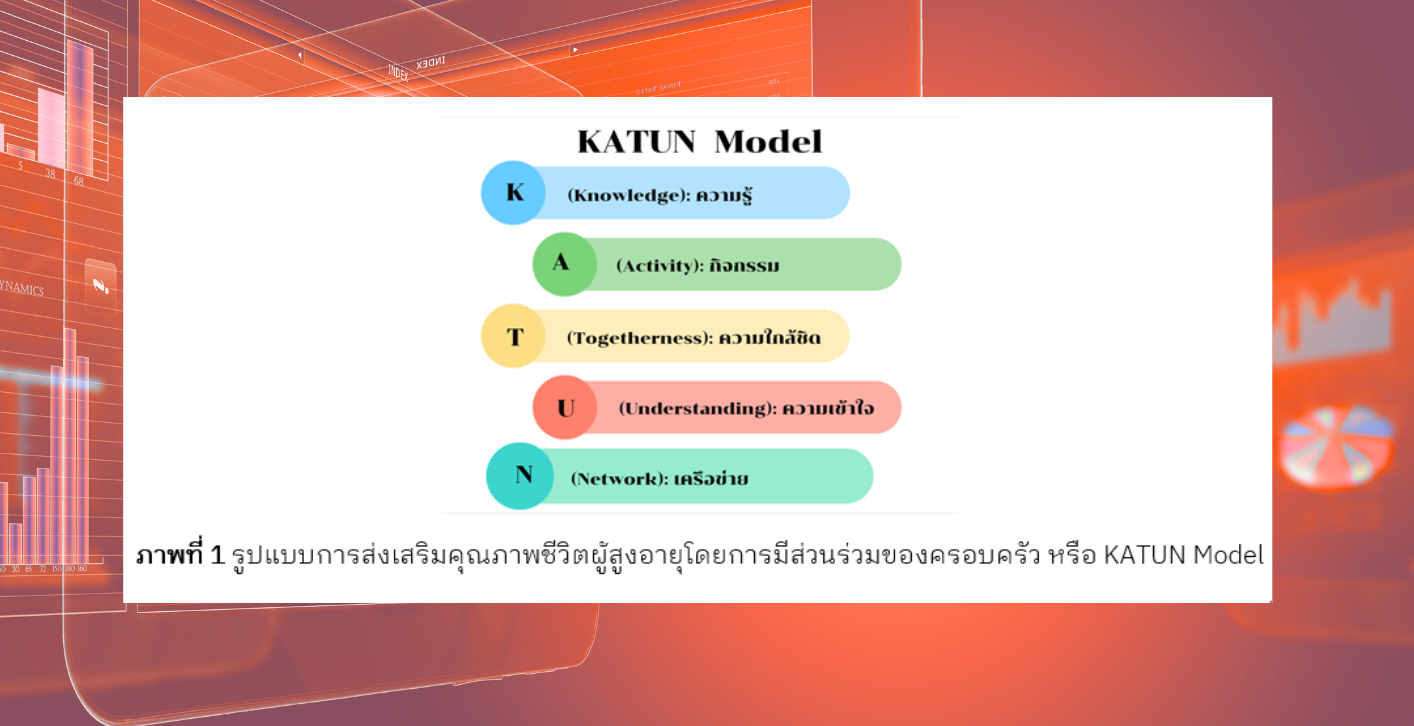
The results revealed that the model for promoting the quality of life of the elderly consists of three steps: 1) planning, with the participation of community leaders, public health officials, the elderly, and family representatives. The activities covered the 5 main components of the KATUN Model: K-Knowledge, A-Activity, T-Togetherness, U-Understanding, and N-Network. 2) The operations emphasized that family members were actively involved in all activities, and 3) the results were followed up. After the project was implemented, it was found that the overall quality of life of the elderly was significantly higher at the .05 level (t = 3.790), and the satisfaction level after participating in the project was mostly high (72.62 %).
References
Bureau of Elderly Health. (2023). Bureau of Elderly Health Annual Report 2024. Bureau of Elderly Health, Department of Disease Control, Ministry of Public Health. Retrieved 11, 2023 from https://online.fliphtml5.com/cyqny/hmox/#p=1
Health Data Center, Satun Provincial Health Office. (2024). Population by Sex, Age Group, Annual, Satun Province, Fiscal Year 2024. Retrieved 11, 2023 from https://hdc.moph.go.th/stn/public/main
Department of Older Persons. (2023). Elderly Statistics June 2023. Retrieved 11, 2023 from https://www.dop.go.th/th/statistics_side?content=1&sub=2
Department of Older Persons. (2023). The 3rd National Plan of Action for Older Persons (B.E. 2566-2580). Retrieved 11, 2023 from https://www.dop.go.th/download/laws/th1653553501-843_0.pdf
Huaysai, W., & Chusuton, S. (2023). Factors Predicting the Quality of Life of Older Adults in the Elderly Club of Bang Nok Kwaek Subdistrict, Bang Khonthi District, Samut Songkhram Province. Journal of Public Health, 32(1), 63-72.
Kas-udom, P., Aphiyanlangkar, K., Chanjaroen, K., & Wae, N. (2018). Family Roles in Promoting the Quality of Life of Older Adults in a Changing Situation. Journal of Nursing and Public Health Network Southern Region, 5(3), 300-310.
Kemmis, S., & McTaggart, R. (2005). Participatory Action Research: Communicative Action and the Public Sphere. In N. K. Denzin & Y. S. Lincoln (Eds.), The Sage Handbook of Qualitative Research (3rd ed., pp. 559-603). Sage Publications.
Khunno, J. (2021). Basic Research Methods for Health Sciences. Chulalongkorn University Press.
Kongmaneekan, J., Sirilak, P., & Nusorn, N. (2020). Environmental Management for Older Adults Health Promotion. Journal of Boromarajonani College of Nursing, Uttaradit, 12(1), 28-38.
Konkaew, K., Thongliam, P., & Subprasert, S. (2019). Predictive Factors of Quality of Life in Homebound Elderly, Khlong Khlung District, Kamphaeng Phet Province. Journal of Public Health, 28(3), 394-401.
Mahatnirankul, S., Tantipivattanakul, V., Phompaisanchai, V., Wongsuwan, K., & Promanarangkul,
V. (1997). World Health Organization Quality of Life Indicators Thai version (WHOQOL – BREF – THAI) . Department of Mental Health, Ministry of Public Health. Retrieved 11, 2023 from https://dmh.go.th/test/download/files/whoqol.pdf
Makateppong, W., Naenudon, A., & Phuangsamai, P. (2022). The Development of a Family Role Model in Caring for Elderly Patients with Hypertension through Family Participation. Thai Journal of Cardio-Thoracic Nursing, 33(2), 101-116.
Palaseuk, R., & Thanomchayathawat, B. (2017). Family Models in Caring for the Elderly. Journal of Nursing and Public Health Network Southern Region, 4(3), 135-150.
Wangsan, R., Worachina, K., & Prom-in, C. (2024). Family and Promoting the Quality of Life of Older Adults. Journal of Health Education, 47(2), 1-14.
Wilawan, J., Laokhompruttajan, J, Laokhompruttajan, T., Boonnao, Y., & Boonserm, P. (2022). The Effect of Socio-Cultural Program for Promoting Quality of Life and Depressive Prevention in The Elderly, Na Fai Subdistrict, Mueang Chaiyaphum District, Chaiyaphum Province. Journal of Health Systems Research, 15(1), 181-195.
The WHOQOL Group. (1993). The Development of the World Health Organization Quality of Life Assessment Instrument (The WHOQOL). In J. Orley & W. Kuyken (Eds.), Quality of life assessment: International perspectives: Proceedings of the joint meeting organized by the World Health Organization and the Foundation IPSEN in Paris, July 2-3 1993 (pp.41-57). Springer-Verlag. Retrieved 11, 2023 from https://link.springer.com/chapter/10.1007/978-3-642-79123-9_4
Downloads
Published
How to Cite
Issue
Section
License
Copyright (c) 2025 Thai Journal of Public Health and Health Sciences

This work is licensed under a Creative Commons Attribution-NonCommercial-NoDerivatives 4.0 International License.
บทความทุกบทความที่ได้รับการตีพิมพ์ถือเป็นลิขสิทธิ์ของ วารสารสาธารณสุข