The Effect of Applying the Innovation “Smart Hemodialysis Self-Management” in Patients with End-stage Renal Disease Receiving Hemodialysis : Two Case Studies
Keywords:
End-Stage Renal Disease, Hemodialysis, Fluid Overload, Self-Management, Nursing InnovationAbstract
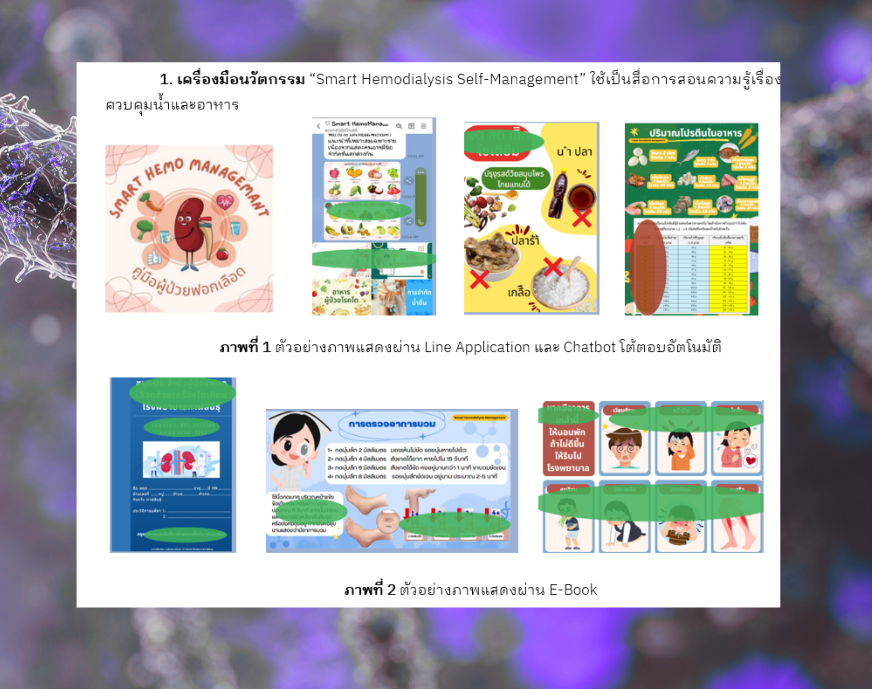
This research aimed to develop the innovation “Smart Hemodialysis Self-Management” and to evaluate its effectiveness among patients with end-stage renal disease (ESRD) undergoing hemodialysis. The innovation was developed based on Soukup’s conceptual framework (phases 1–3), focusing on patient self-management to enhance knowledge and skills in fluid and dietary control, particularly in preventing fluid overload. The innovation comprised educational materials on fluid and diet, a video demonstration of calculating urine volume in relation to fluid intake over 24 hours, and educational support via an E-book, LINE Application, and Chatbot. The intervention was conducted with two hemodialysis patients at the Hemodialysis Unit of Kalasin Hospital over eight weeks from December 2024 to February 2025.
The results showed that both patients achieved knowledge scores on fluid and dietary control exceeding 80%, demonstrated improved self-management behaviors, and reported high satisfaction with the innovation. In addition, both patients were able to better control fluid overload and reduce hospital readmissions. These findings indicate that the “Smart Hemodialysis Self-Management” innovation is effective in promoting patient self-management in hemodialysis, and can be applied as a guideline for nursing practice to prevent fluid overload, reduce hospital readmissions, and serve as a prototype for further studies in larger patient populations.
References
Cockwell, P., & Fisher, L. A. (2020). The global burden of chronic kidney disease. The Lancet,395(10225), 662–664. https://doi.org/10.1016/S0140-6736(20)30045-3
Keivan, S., Shariati, A., Miladinia, M., & Haghighizadeh, M. H. (2023). Role of self-management program based on 5A nursing model in quality of life among patients undergoing hemodialysis: A randomized clinical trial. BMC Nephrology, 24(1), 58. https://doi.org/10.1186/s12882-023-03108-2
Kittirakpanya, W. (2025). Results of using an application to provide knowledge about food consumption in patients with chronic kidney disease receiving hemodialysis in Phrachomklao Hospital, Phetchaburi Province. Singburi Hospital Journal, 33(3), B8–B18. (in Thai)
Brenner, B. M., & Rector, F. C. (2021). Brenner and Rector’s the kidney (11th ed.). Philadelphia, PA: Elsevier Saunders.
Yang, J. (2022). Development and evaluation of an online self-management program in patients with chronic kidney failure undergoing hemodialysis. Journal of Korean Academy of Fundamental Nursing, 29(4), 531–542. https://doi.org/10.7739/jkafn.2022.29.4.531
Bagriacik, E., & Dikmen, B. T. (2024). Self-management training in patients with chronic kidney disease undergoing hemodialysis: A systematic review. Seminars in Dialysis, 37(2), 91–100. https://doi.org/10.1111/sdi.13164
Escudero-Lopez, M., Martinez-Andres, M., Marcilla-Toribio, I., Moratalla-Cebrian, M. L., Perez-Moreno, A., & Bartolome-Gutierrez, R. (2024). Barriers and facilitators in self-care and management of chronic kidney disease in dialysis patients: A systematic review of qualitative studies. Journal of Clinical Nursing, 33(10), 3815–3830. https://doi.org/10.1111/jocn.17193
Lee, M. C., Wu, S. V., Lu, K. C., Liu, C. Y., Liang, S. Y., & Chuang, Y. H. (2021). Effectiveness of a self-management program in enhancing quality of life, self-care, and self-efficacy in patients with hemodialysis: A quasi-experimental design. Seminars in Dialysis, 34(4), 292–299. https://doi.org/10.1111/sdi.12957
Markossian, T. W., Boyda, J., Taylor, J., Etingen, B., Modave, F., Price, R., et al. (2021). A mobile app to support self-management of chronic kidney disease: Development study. JMIR Human Factors, 8(4), e29197. https://doi.org/10.2196/29197
Li, W. Y., Yeh, J. C., Cheng, C. C., Huang, S. H., Yeh, H. C., Cheng, B. W., et al. (2024). Digital health interventions to promote healthy lifestyle in hemodialysis patients: An interventional pilot study. Scientific Reports, 14(1), 2849. https://doi.org/10.1038/s41598-024-53259-x
Fauzi, A., & Oktaviani, Y. (2022). Effects of a hemodialysis diet education program on hemodialysis patients. KnE Life Sciences, 7(2), 656–663. https://knepublishing.com/index.php/KnE-Life/article/view/10366
Cai, J., Huang, D., Abdul Kadir, H. B., Huang, Z., Ng, L. C., Ang, A., et al. (2024). Hospital readmissions for fluid overload among individuals with diabetes and diabetic kidney disease: Risk factors and multivariable prediction models. Nephron, 148(8), 523–535. https://doi.org/10.1159/000538036
Chen, J., Lou, X., Qian, S., Chen, J., Liu, B., Zhang, P., et al. (2024). An artificial intelligence copilot system helps reduce mortality rates of hemodialysis patients. Research Square. Advance online publication. https://doi.org/10.21203/rs.3.rs-3256363/v1
Goueth, R. C., Maki, K. G., Babatunde, A., Eden, K. B., & Darney, B. G. (2022). Effects of technology-based contraceptive decision aids: A systematic review and meta-analysis. American Journal of Obstetrics and Gynecology, 227(5), 705–713.e9. https://doi.org/10.1016/j.ajog.2022.06.050
Long, Q., Yang, M., & Long, J. (2024). Application of intelligent nursing system based on big data in maintenance hemodialysis patients. SLAS Technology. https://doi.org/10.1016/j.slast.2024.100160
Mardiyah, A., Maktum, U., Julianti, E., & Zulkifli. (2024). Self-care of patients undergoing hemodialysis in compliance with diet, nutrition, and fluids. Journal of Applied Nursing and Health, 6(1), 256–262. https://doi.org/10.2667-1609/janh.v6i1.2024.256
Qarajeh, A., Tangpanithandee, S., Thongprayoon, C., Suppadungsuk, S., Krisanapan, P., Aiumtrakul, N., et al. (2023). AI-powered renal diet support: Performance of ChatGPT, Bard AI, and Bing Chat. Clinical Practice, 13(5), 1160–1172. https://doi.org/10.3390/clinpract13050104
Taheri Hatkehlouei, S. A., Sandanasamy, S., Yildirim, N., McFarlane, P., Farhadi, B., & Jaafari, B. (2024). Nutritional knowledge and related factors among hemodialysis patients: A systematic review. Journal of Nursing Reports and Clinical Practice. https://doi.org/10.32598/JNRCP.2405.1103
Loutradis, C., Sarafidis, P. A., Ferro, C. J., & Zoccali, C. (2021). Volume overload in hemodialysis: Diagnosis, cardiovascular consequences, and management. Nephrology Dialysis Transplantation, 36(12), 2182-2193. https://doi.org/10.1093/ndt/gfaa182
The Nephrology Society of Thailand. (2022). Report on chronic kidney disease patients in Thailand 2022. Bangkok: The Nephrology Society of Thailand. (in Thai)
Kalasin Hospital. (2024). Statistics of patients and relevant health information. Kalasin: Kalasin Hospital. (in Thai)
Srithong, V., & Methakanjanasak, N. (2021). Effects of a self-management program with reminder via LINE application for preventing fluid overload in patients undergoing hemodialysis. Journal of Nursing Science and Health, 44(4), 1–12. (in Thai)
Thaiwong, A., Banditthaworn, K., Jaisue, D., Phongtae, K., Kajai, C., & Wichaiwong, T. (2022). Development of a prototype innovation set to promote appropriate protein intake in patients with chronic kidney disease undergoing peritoneal dialysis and hemodialysis. Journal of Mahasarakham Hospital, 19(3), 235–245. (in Thai)
Pinyoyo, S., & Jinawin, S. (2023). Effects of a self-management program on fluid overload in patients with end-stage renal disease undergoing hemodialysis. Phrae Medical Journal of Clinical Science, 31(2), 48–59. (in Thai)
Downloads
Published
How to Cite
Issue
Section
License
Copyright (c) 2025 Thai Journal of Public Health and Health Sciences

This work is licensed under a Creative Commons Attribution-NonCommercial-NoDerivatives 4.0 International License.
บทความทุกบทความที่ได้รับการตีพิมพ์ถือเป็นลิขสิทธิ์ของ วารสารสาธารณสุข