The Efficiency of MCH Level for Differentiation between Normal and Alpha Thalassemia Trait from the Sample Group with Normal Hb Typing, Not Rule out Alpha-thalassemia Results in Sawanpracharak Hospital
Keywords:
Hemoglobin, Mean Corpuscular, Thalassemia, Alpha, Diagnosis, Erythrocyte IndicesAbstract
Alpha-thalassemia is an inherited hemoglobin disorder characterized by reduced synthesis of alpha-globin chains, leading to ineffective erythropoiesis and anemia. Hb typing is routinely used to screen at-risk couples. However, standard Hb typing may not distinguish normal individuals from alpha-thalassemia traits, especially in cases with A2A pattern and microcytosis. These are often reported as “normal Hb typing, cannot rule out alpha-thalassemia,” requiring further confirmation by molecular testing, which may lead to unnecessary costs and delays when results are eventually normal. To evaluate the diagnostic performance of mean corpuscular hemoglobin (MCH) level in distinguishing normal individuals from those with inconclusive Hb typing results. It could decrease the unnecessary confirmation by molecular testing. A retrospective study was conducted at a regional referral hospital in Thailand between September 2023 and October 2024. The medical records of 137 pregnant women and their partners with A2A hemoglobin typing results and inconclusive alpha-thalassemia carrier status were reviewed.
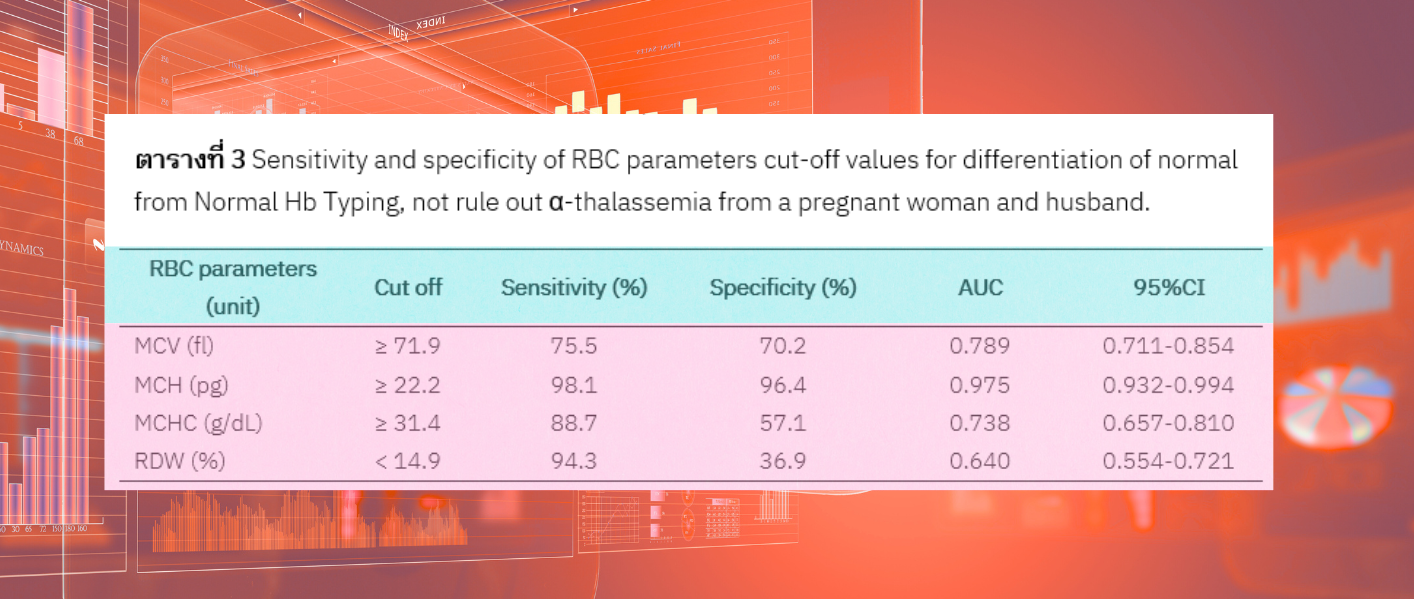
MCH ≥ 22.2 pg showed 98.1% sensitivity, 96.4% specificity, 94.6% positive predictive value, 98.8% negative predictive value, and an overall diagnostic accuracy of 97.1% in identifying non-carriers. MCH ≥ 22.2 pg may serve as an effective tool for excluding normal individuals from patients with inconclusive Hb typing results.
References
Iam-arunthai, K., Suwanban, T., Thungthong, P., Chamnanchanunt, S., Fucharoen, S. (2024) Predicting factors of survival rates among alpha- and beta-thalassemia patients: a retrospective 10-year data analysis. Front. Hematol.3: 1339026.doi: 10.3389/frhem. 2024. 1339026
Department of Medical Science. (2024). Laboratory Guide for the Diagnosis of Thalassemia and abnormal Hemoglobin (9thEd). Premier marketing solution. https://online.fliphtml5.com/ ccksq/yamx/#p=22 (in Thai)
Jasim, R. H., & Aouda, R. H. (2025). Evaluation of RBC Indices and Significance of Mentzer Index for Differentiation Between Iron Deficiency Anemia and Beta Thalassemia Trait. Al- Mustaqbal Journal of Pharmaceutical and Medical Sciences, 3(1), 1.
Kuwatjanukul, P., Waikaew, N., Kamchai, S. (2024). Study of service system model for patients with transfusion-dependent thalassemia for community hospitals in Udon Thani Province. Thai journal of pediatrics, 63(4), 70–84. https://he04.tci-thaijo.org/index.php/TJP/article/ view/2246 (in Thai)
Leckngam, P. (2023). Thalassemia and Hemoglobinopathies in Thailand: A Systematic Review. J Health Sci Alten Merd, 5(3), 104-13. https://he01.tci-thaijo.org/index.php/ jhealth- scialternmed/ article/ view/ 262338/180838
Paiboonsukwong, K., Jopang, Y., Winichagoon, P., Fucharoen, S. (2022). Thalassemia in Thailand. Hemoglobin J, 46(1), 53–7. https://doi.org/10.1080/03630269.2022.2025824
Pata, S., Laopajon, W., Pongpaiboon, M., Thongkum, W., Polpong, N., Munkongdee, T et al. (2019). Impact of the detection of ζ-globin chains and hemoglobin Bart's using immunochromatographic strip tests for α0-thalassemia (--SEA) differential diagnosis. PloS one, 14(10), e0223996. https://doi.org/10.1371/journal.pone.0223996
Phanthong, B., Charoenkwan, P., Kamlungkuea, T., Luewan, S., & Tongsong, T. (2025). Accuracy of Red Blood Cell Parameters in Predicting α0-Thalassemia Trait Among Non-Anemic Males. Journal of clinical medicine, 14(10), 3591. https://doi.org/10.3390/jcm14103591
Sarakarn, P., Munpolsri, P. (2021). Optimal Cut-off points for receiver operating characteristic (ROC) Curve analysis in developing tools of health innovations: Example using STATA. J Thai Bull Pharm Sci, 16(1), 93-108. https://li01.tci-thaijo.org/index.php/tbps/article/view/248029/171563
Thiamkaew, A., Piyamongkol, W. (2024). Thalassemia Screening and Prenatal Diagnosis [Unpublished manuscript]. Department of Obstetrics and Gynaecology, Chiang Mai University. https://w1.med. cmu.ac.th/obgyn/news/latest-news/52681
Zheng, L., Huang, H., Wu, X., Shen, Q., Chen, M., Wang, M., Su, L., & Xu, L. (2022). Erythrocyte Indices and Hemoglobin Analysis for α-Thalassemia Screening in an Area with High Carrying Rate. Indian journal of hematology & blood transfusion : an official journal of Indian Society of Hematology and Blood , 38(2), 352–358. https://doi.org/10.1007/s12288-021-01449-2
Downloads
Published
How to Cite
Issue
Section
License
Copyright (c) 2025 Thai Journal of Public Health and Health Sciences

This work is licensed under a Creative Commons Attribution-NonCommercial-NoDerivatives 4.0 International License.
บทความทุกบทความที่ได้รับการตีพิมพ์ถือเป็นลิขสิทธิ์ของ วารสารสาธารณสุข