ปัจจัยที่ส่งผลต่อความสุขของผู้สูงอายุในชมรมผู้สูงอายุ ตำบลบางปลา อำเภอบางพลี จังหวัดสมุทรปราการ
คำสำคัญ:
ความสุขผู้สูงอายุ, ชมรมผู้สูงอายุ, สภาวะสุขภาพบทคัดย่อ
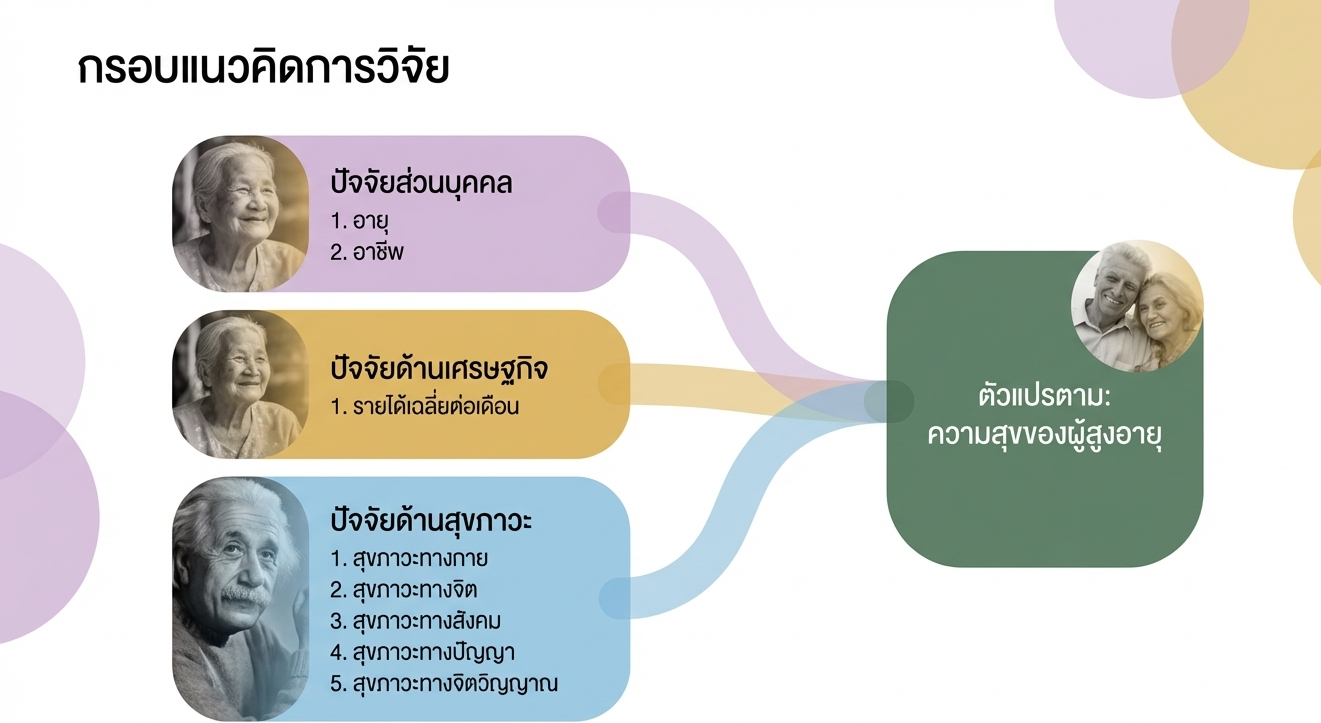
การวิจัยเชิงสำรวจแบบภาคตัดขวาง มีวัตถุประสงค์เพื่อศึกษาความสุขของผู้สูงอายุและปัจจัยที่มีอิทธิพลต่อความสุขของผู้สูงอายุในชมรมผู้สูงอายุ ตำบลบางปลา อำเภอบางพลี จังหวัดสมุทรปราการ กลุ่มตัวอย่างจำนวน 88 คน เก็บข้อมูลโดยใช้แบบสอบถาม มีค่าความเที่ยงของแบบสอบถามด้านสุขภาวะและแบบสอบถามความสุข คือ 0.908 และ 0.938 ตามลำดับ ใช้สถิติ Multiple Linear Regression ในการวิเคราะห์ข้อมูล
ผลการศึกษาพบว่ากลุ่มตัวอย่างส่วนใหญ่ เป็นเพศหญิง (ร้อยละ 56.81) อายุ 60 – 70 ปี (ร้อยละ 71.69) มีการศึกษาระดับประถมศึกษา (ร้อยละ 67.05) มีอาชีพแบบไม่มีรายได้แน่นอน (ร้อยละ 64.77) มีโรคประจำตัว(ร้อยละ 59.09) สถานภาพสมรส (ร้อยละ 53.41) มีรายได้เฉลี่ยต่อเดือนมากกว่า 10,000 บาท (ร้อยละ 38.64) มีรายจ่ายเฉลี่ยต่อเดือนน้อยกว่า 5,000 บาท (ร้อยละ 57.96) รายได้เฉลี่ยของครัวเรือนต่อเดือนน้อยกว่า 20,000 บาท (ร้อยละ 44.32) และส่วนใหญ่ไม่มีภาระหนี้สิน (ร้อยละ 76.14) ค่าเฉลี่ยความสุขของผู้สูงอายุอยู่ในระดับมาก (M = 4.28) การวิเคราะห์ปัจจัยที่มีผลต่อความสุขของผู้สูงอายุ พบว่า ปัจจัยที่ส่งผลต่อความสุขของผู้สูงอายุมี 3 ปัจจัย ได้แก่ อายุ (p = 0.009) การไม่มีอาชีพที่แน่นอน (p = 0.019) และ สุขภาวะทางสังคม (p = 0.011)โดยพบว่าอายุที่เพิ่มขึ้นส่งผลให้ความสุขของผู้สูงอายุลดลง การมีรายได้ไม่ประจำทำให้ความสุขลดลง และการที่มีสุขภาวะทางสังคมที่ดีส่งผลให้มีความสุขเพิ่มขึ้น และตัวแปรทั้ง 3 สามารถอธิบายความสุขของผู้สูงอายุได้ร้อยละ 21 หน่วยงานในท้องถิ่นจึงควรมีการส่งเสริมอาชีพที่มีรายได้ประจำให้แก่ผู้สูงอายุ และควรจัดให้มีกิจกรรมในชุมชนให้ผู้สูงอายุพบปะกันอย่างสม่ำเสมอเพื่อให้ผู้สูงอายุที่อยู่ในชุมชน มีความสุขในชีวิตมากขึ้น
เอกสารอ้างอิง
Argyle, M., & Martin, M. (1991). The psychological causes of happiness. In E. Diener (Ed.), Subjective well‑being, 77–95.
Best, J. W. (1977). Research in Education (3rd ed.). Prentice-Hall.
Biddle, B. J. (1986). Recent developments in role theory. In K. S. Cook, G. A. Fine, & J. S. House (Eds.), Sociological perspectives on social psychology (pp. 67–92). Allyn & Bacon.
Carstensen, L. L. (1995). Evidence for a life-span theory of socioemotional selectivity. Current Directions in Psychological Science, 4(5), 151–156.
Cohen, S., & Wills, T. A. (1985). Stress, social support, and the buffering hypothesis. Psychological Bulletin, 98(2), 310–357.
Cronbach, L. J. (1951). Coefficient alpha and the internal structure of tests. Psychometrika, 16(3), 297–334.
Cumming, E., & Henry, W. E. (1961). Growing old: The process of disengagement. Basic Books.
Department of Local Administration. (2020). Statistical report on elderly clubs in Samut Prakan Province. Bangkok: Department of Local Administration. (in Thai)
Diener E, Oishi S, Tay L. (2018). Advances in subjective well-being research. Nat Hum Behav. 2018 Apr;2(4):253-260.
Easterlin, R. A. (1974). Does economic growth improve the human lot? Some empirical evidence. In P. A. David & M. W. Reder (Eds.), Nations and households in economic growth (pp. 89–125). Academic Press.
Gujarati, D. N., & Porter, D. C. (2009). Basic econometrics (5th ed.). McGraw-Hill Irwin.
Havighurst, R. J. (1961). Successful aging. The Gerontologist, 1(1), 8–13.
Horton, C. J., Walsh, L. C., Rodriguez, A., & Kaufman, V. A. (2024). The diversity of well-being indicators: A latent profile analysis. Frontiers in Psychology, 15.
Huaisai, W., Songsin, N., Chusuton, S., Somporn, K., & Chamnankit, T. (2025). Determinants of subjective well-being among the elderly population: A cross-sectional study in Thai communities. National Journal of Community Medicine, 16(12).
Kono, S. (2021). A study of 2017 secondary data of the happiness among Thai elderly. Sripatum Review of Humanities and Social Sciences, 21(2), 19–33. (in Thai)
Krejcie, R. V., & Morgan, D. W. (1970). Determining sample size for research activities. Educational and Psychological Measurement, 30(3), 607–610.
National Statistical Office. (2021). Elderly population of Thailand by province. Bangkok: National Statistical Office. (in Thai)
National Statistical Office. (2024). Survey on the elderly population in Thailand 2024. Bangkok: National Statistical Office. (in Thai)
Pathong, W. (2006). Effects of a positive thinking development program on life happiness of patients with hypertension. A thesis Submitted in Partial Fulfillment of the Requirements for Degree of Master Degree, Chiang Mai University). (in Thai)
Prasertsin, A., Suriyo, T., & Natmethawin, P. (2018). Well-being of the elderly: Concepts and related factors. Journal of Health Education, Mahidol University, 41(1), 1–15. (In Thai)
Ryff, C. D. (1989). Happiness is everything, or is it? Explorations on the meaning of psychological well-being. Journal of Personality and Social Psychology, 57(6), 1069–1081.
Thongsuk, Y., Watanasin, D., & Hengudomsub, P. (2019). Factors influencing psychological Well‑being among older adults. Journal of Psychiatric Nursing and Mental Health, 33(1), 95–110. (In Thai)
Wannapong S & Hongngam J. (2018). Factors affecting life happiness of elderly people: An empirical study in Amphoe Muang, Khon Kaen Province. Journal of Economics and Management Strategy, 5(2), July–December.
World Health Organization. (2020). Decade of healthy ageing: Baseline report (WHO)
World Health Organization. (2021). Decade of Healthy Ageing: Baseline Report. Geneva: WHO.
ดาวน์โหลด
เผยแพร่แล้ว
รูปแบบการอ้างอิง
ฉบับ
ประเภทบทความ
สัญญาอนุญาต
ลิขสิทธิ์ (c) 2026 วารสารสาธารณสุขและวิทยาศาสตร์สุขภาพ

อนุญาตภายใต้เงื่อนไข Creative Commons Attribution-NonCommercial-NoDerivatives 4.0 International License.
บทความทุกบทความที่ได้รับการตีพิมพ์ถือเป็นลิขสิทธิ์ของ วารสารสาธารณสุข