The Role of the Community in Caring for Pregnant Women Who Use Drugs Through Community Participation
Keywords:
Substance use, Caring for Pregnant Women, Community participationAbstract
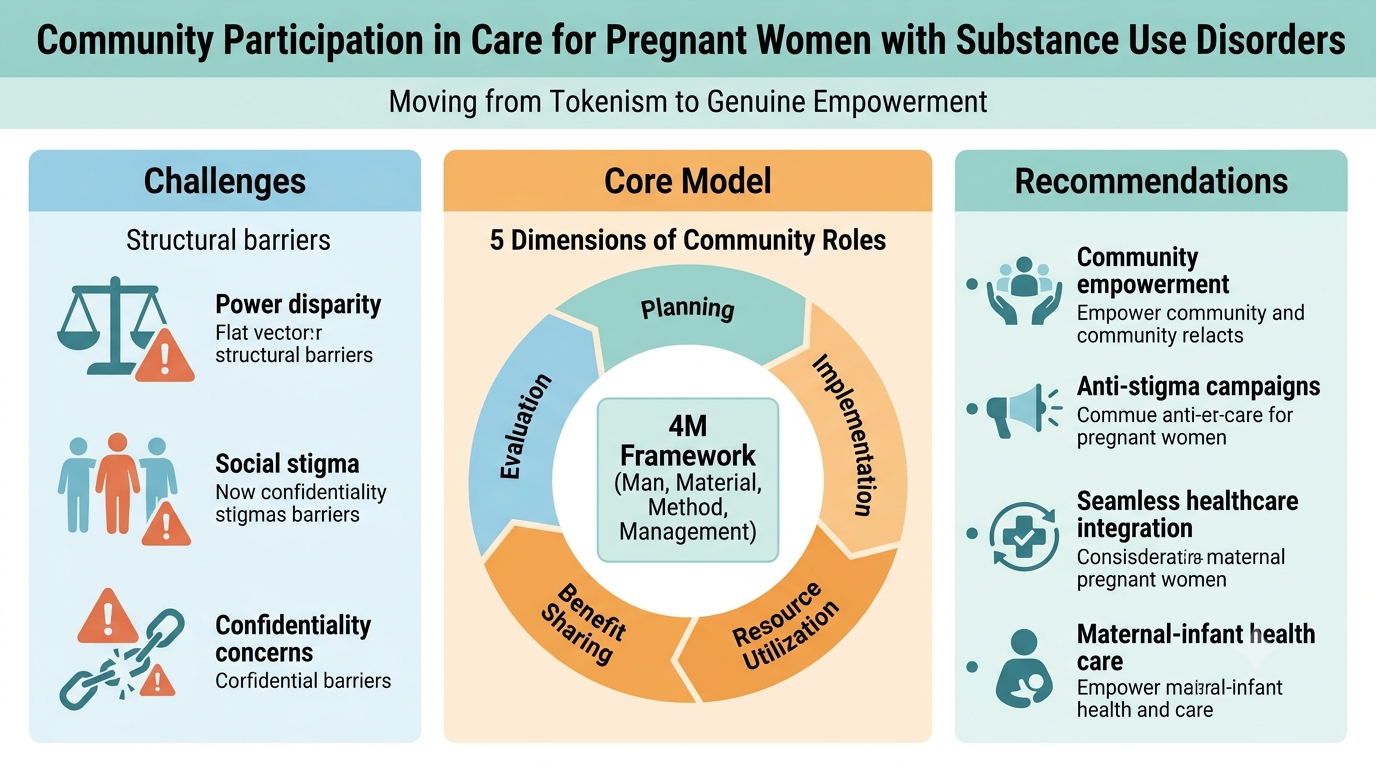
Substance use during pregnancy represents a complex public health challenge with far-reaching implications for maternal and child health, as well as broader social and economic outcomes. Although community participation theory is frequently employed as a primary mechanism for addressing this issue, empirical evidence remains inconsistent with noticeable gaps, as most operational models fall into the trap of symbolic participation and lack genuine decision-making empowerment. This study aims to analyze the role of the community in caring for pregnant women who use drugs and to identify challenges within the framework of community participation theory. The review of academic articles, research reports, and related case studies. The findings indicate that the community role in caring for pregnant women who use drugs is evident across five key dimensions: planning, implementation, utilization, benefit-sharing, and evaluation. The initiative was driven through the implementation of the 4M Model mechanisms, encompassing maternal health literacy, monitoring, multisectoral collaboration and motivation and support. However, a key analytical insight reveals patterns showing that local implementation still faces structural limitations, including power asymmetry, confidentiality constraints, and risks of re-stigmatization. Therefore, this study recommends integrating social capital alongside strengthened stigma reduction to establish a seamless and sustainable care system tailored to cultural contexts. Such a measures to transition from symbolic participation to genuine empowerment, ultimately leading to tangible improvements in the quality of life for both mothers and infants.
References
Arnstein, S. R. (1969). A ladder of citizen participation. Journal of the American Institute of Planners, 35(4): 216–224.
Bouneaw, J. (2007). The Participation in Research for Locally. Chiang Mai: Chiang Mai University. (In Thai)
Chusri, K. (2024). Model of prevention, solving and treatment of drug addict by communities and network partners participation in Ban Thung Mae Bua, Khlong Hoi Khong District, Songkhla Province. In The 15th Hatyai National and International Conference (pp. 539-552). Songkhla, Thailand: Hatyai University. (in Thai)
Heidarifard, S., & Khoshnamrad, M. (2025). Assessing supportive needs in pregnant women with substance use, a qualitative study. AJOG Global Reports, 5(3): 1-6.
Laslett, A. M., Rankin, G., Waleewong, O., Callinan, S., Hoang, H. T. M., Florenzano, R., Hettige, S., Obot, I., Siengsounthone, L., Ibanga, A., Hope, A., Landberg, J., Vu, H. T. M., Thamarangsi, T., Rekve, D., & Room, R. (2017). A Multi-Country Study of Harms to Children Because of Others' Drinking. J Stud Alcohol Drugs, 78(2): 195-202.
National Institute of Drug Abuse Treatment and Rehabilitation (NIDA). (2024). Treatment by enhancing the motivation of drug and substance users. Pathum Thani: Department of Medical Services, Ministry of Public Health. (in Thai)
Northern Substance Abuse Academic Center, Social Research Institute. (2022). Report on the situation of drug problems 2022. Chiang Mai: Chiang Mai University. (in Thai)
Office of the Narcotics Control Board (ONCB). (2022). Thailand narcotics control annual report 2022. Bangkok: Ministry of Justice. (in Thai)
Office of the Secretary of National Addiction treatment & Rehabilitation Committee. (2023). Report on the drug addiction treatment situation in pregnant women. Nonthaburi: Ministry of Public Health. (in Thai)
Powwattana, A., Kalampakorn, S., Lagampan, S., & Amnatsatsue, K. (2011). Health promotion and disease prevention in community: an application of concepts and theories to practice (2nd ed.). Khon Kaen: Khlangnanavittaya Printing. (in Thai)
Puncheuy, S. (2023). Effects of Maternal Methamphetamine Use on the Child. Krabi Medical Journal, 6(2): 115-118. (in Thai)
Putnam, R. D. (1993). The prosperous community: Social capital and public life. The American Prospect, 4(13): 35–42.
Ratchathawan, R., Kaewkrajok, T., Jongkatekit, W., Phromkaew, P., Sumdangsan, D., & Thonglert, D. (2018). The community participation process in well-being development. Journal of Southern Technology, 11(1), 225–232. (in Thai)
Ritsri, N., Wattanapraphaijit, S., & Junharn, S. (2022). The community-based treatment and care model for drug rehabilitation: A case study in a village, Mueang District, Mahasarakham Province. Mahasarakham Hospital Journal, 19(2): 164–173. (in Thai)
Stone, R. (2015). Pregnant women and substance use: Fear, stigma, and barriers to care. Health & Social Work, 40(1): 15-21.
Sukee, S. (2024). The development of care model for pregnant women used methamphetamine during pregnancy in public hospitals in Phetchabun Province. Journal of Khon Kaen Provincial Health Office, 6(4): 1-16. (in Thai)
Tongmuangtunyatep, K., Dekyong, E., Yodwong, A., Thongsukdee, T., & Sanongkhun, P. (2019). Factors Predicting Preeclampsia among Pregnant Women in Sawanpracharak Hospital. Songklanagarind Journal of Nursing, 42(1): 11-22. (in Thai)
United Nations Office on Drugs and Crime. (2024). World drug report 2024. Vienna: Author.
Waiketkarn, A. (2021). Maternal and fetal outcomes in pregnant women who use methamphetamine during pregnancy. Mahasarakham Hospital Journal, 18(2): 105–111. (in Thai)
Wright, T. E., Schuetter, R., Tellei, J., & Sauvage, L. (2015). Methamphetamines and pregnancy outcomes. Journal of Addiction Medicine, 9(2): 111–117.
World Health Organization. (2020). Guidelines for the Identification and Management of Substance Use in Pregnancy. Geneva: WHO Press.
Downloads
Published
How to Cite
Issue
Section
License
Copyright (c) 2026 Thai Journal of Public Health and Health Sciences

This work is licensed under a Creative Commons Attribution-NonCommercial-NoDerivatives 4.0 International License.
บทความทุกบทความที่ได้รับการตีพิมพ์ถือเป็นลิขสิทธิ์ของ วารสารสาธารณสุข