Predictors of High Risk to Violence (SMI-V) among Substance Use Patients : A Retrospective Study in Princess Mother National Institute on Drug Abuse Treatment
Keywords:
Violence risk (SMI-V), Substance use, Predictors, RetrospectiveAbstract
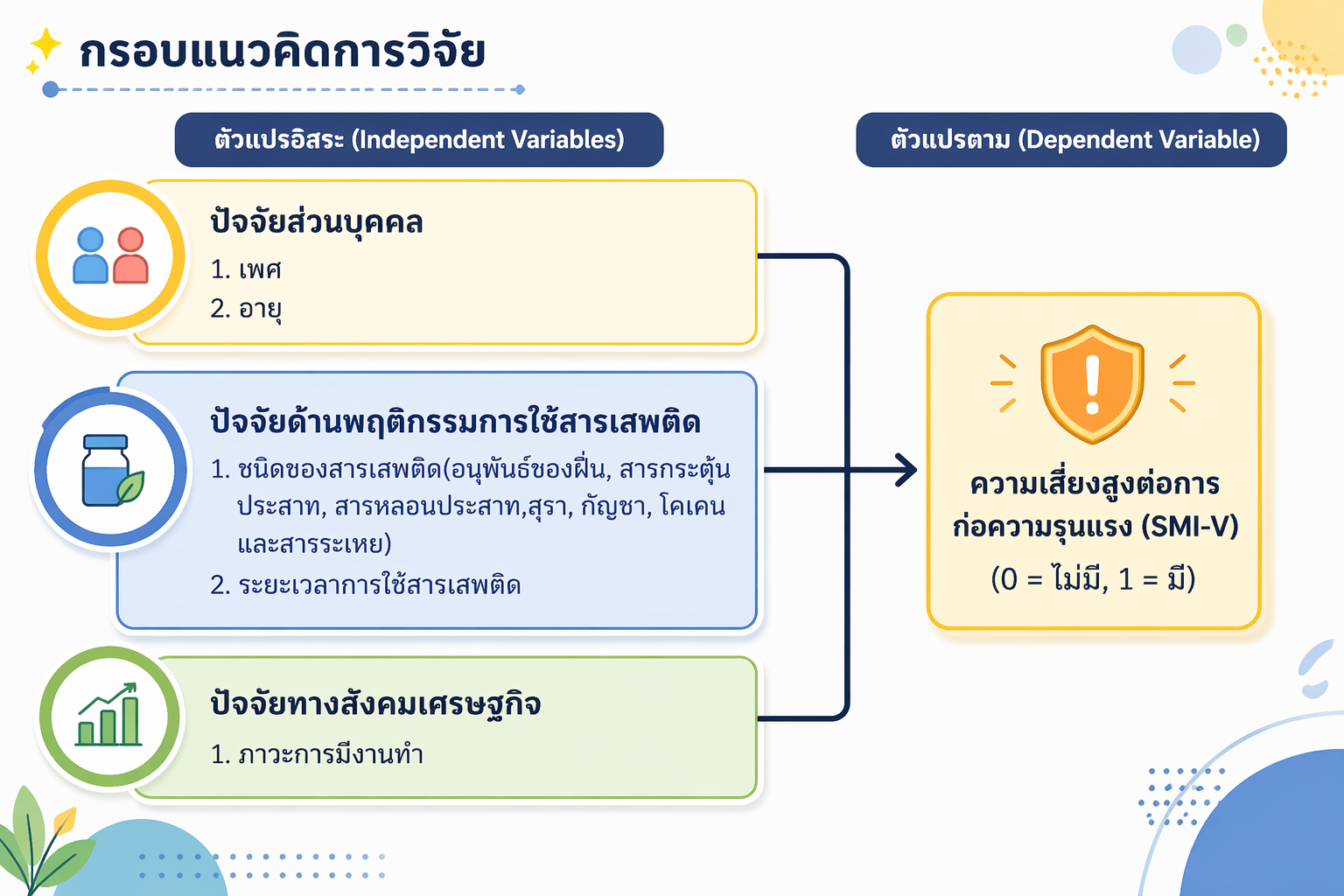
This study aimed to identify predictors of high risk for violence (SMI-V) among patients with substance use disorders. A retrospective study design was employed, utilizing medical records from 4,507 patients who received treatment at the Princess Mother National Institute on Drug Abuse Treatment between January 2023 and March 2024. Data were analyzed using descriptive statistics and logistic regression.
The results indicated that factors significantly associated with a high risk of violence included cannabis use (OR = 3.762), stimulant use (OR = 3.148), alcohol use (OR = 2.077), unemployment (OR = 1.784), and longer duration of substance use. In contrast, opioid derivative use was negatively associated with the risk of violence (OR = 0.637). These findings suggest that the type of substance used, duration of use, and employment status are key predictors that can be utilized for screening and monitoring high-risk patients. This evidence may inform the development of targeted interventions to prevent and reduce violence at both individual and societal levels.
References
Bhalotra, S., Britto, D. G. C., Pinotti, P., & Sampaio, B. (2025). Job displacement, unemployment benefits and domestic violence. The Review of Economic Studies, 92(6), 3649–3681. doi:10.1093/restud/rdaf004
Chananiramitphon, S. (2021). Nursing care for patients with violent behaviors from methamphetamine use: A case study. Retrieved from https://inb.moph.go.th/MyPDF/16.pdf (in Thai)
Chroback, K. M. (2022). The Effects of Substance Use on Violence. A Dissertation Submitted in Partial Fulfillment of the Requirements for the Degree of Doctor of Philosophy, Texas Tech University.
Chumnanuksron, A., & Chintapanyakun, T. (2025). Factors influencing aggressive behavior in psychiatric patients with substance abuse at U Thong Hospital. Journal of Health and Nursing, Ubon Ratchathani University, 4(1), 29–44. (in Thai)
Moulin, V., Framorando, D., Gasser, J., & Dan-Glauser, E. (2022). The Link Between Cannabis Use and Violent Behavior in the Early Phase of Psychosis: The Potential Role of Impulsivity. Frontiers in Psychiatry, 13, 746287. doi:10.3389/fpsyt.2022.746287
Narcotics Control Division. (2023). Methamphetamine. Retrieved from https://narcotic.fda.moph.go.th/information-about-drugs/metamphetamine (in Thai)
Sousa, C. (2025). The contemporaneous impact of unemployment and income inequality on violent vs property crime rates in New England: A panel data and machine learning approach. Empirical Economic Bulletin, 18, 149–174.
Tongsamsi, K., & Tongsamsi, I. (2019). Family violence resulting alcohol misuse: An analysis of Thai newspapers’ reports during 2011–2015. Walailak Journal of Social Sciences,12(1), 61 – 90.
United Nations Office on Drugs and Crime. (2023). World Drug Report 2023. United Nations publication.
Varshney, M., Mahapatra, A., Krishnan, V., Gupta, R., & Deb, K. S. (2016). Violence and mental illness: what is the true story?. Journal of epidemiology and community health, 70(3), 223–225. doi:10.1136/jech-2015-205546
Volkow, N. D., Compton, W. M., Blanco, C., Einstein, E. B., & Han, B. (2024). Associations of cannabis use, use frequency, and cannabis use disorder with violent behavior among young adults in the United States. International Journal of Drug Policy, 128, 104431. doi:10.1016/j.drugpo.2024.104431
World Health Organization. (2018). Global status report on alcohol and health 2018. Geneva, Switzerland: Author.
Zhong, S., Yu, R., & Fazel, S. (2020). Drug Use Disorders and Violence: Associations With Individual Drug Categories. Epidemiologic reviews, 42(1), 103–116. doi:10.1093/epirev/mxaa006
Downloads
Published
How to Cite
Issue
Section
License
Copyright (c) 2026 Thai Journal of Public Health and Health Sciences

This work is licensed under a Creative Commons Attribution-NonCommercial-NoDerivatives 4.0 International License.
บทความทุกบทความที่ได้รับการตีพิมพ์ถือเป็นลิขสิทธิ์ของ วารสารสาธารณสุข