Effect of a Drug Use Evaluation Program on the Appropriateness of Levofloxacin Prescribing: A Retrospective Cohort Study at Cha-am Hospital
Keywords:
Drug Use Evaluation Program (DUE), Levofloxacin, Prescribing Appropriateness , Antimicrobial agentsAbstract
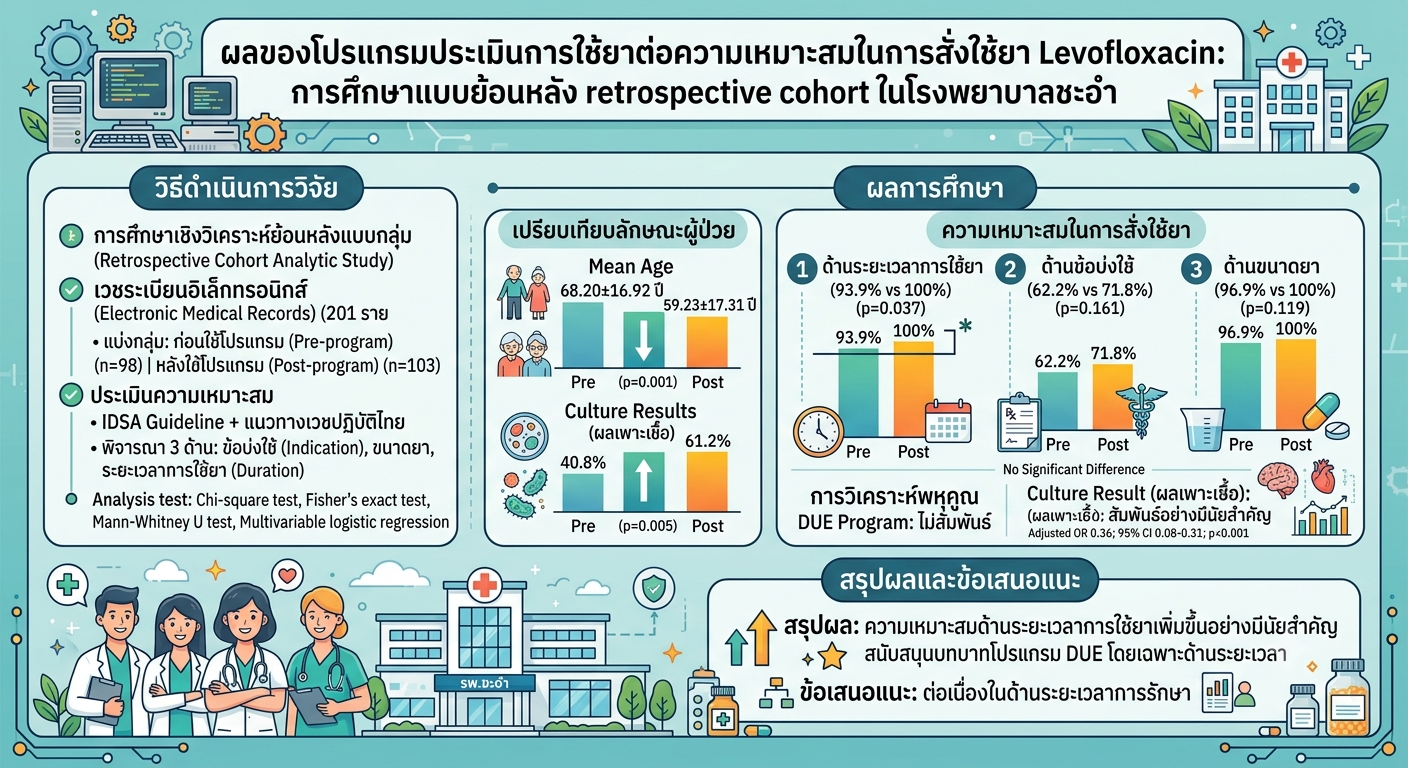
Objective To compare the appropriateness of levofloxacin prescribing between patients managed with and without a Drug Use Evaluation (DUE) program. Methods A retrospective cohort analytic study was conducted using electronic medical records from Cha-am Hospital. A total of 201 patients were included, with 98 in the pre-DUE group and 103 in the post-DUE group. Prescribing appropriateness was evaluated based on clinical practice guidelines, including Infectious Diseases Society of America (IDSA) guidelines and Thai national guidelines, considering indication, dose, and duration of therapy. Data were analyzed using the chi-square test, Fisher’s exact test, Mann–Whitney U test, and multivariable logistic regression.
Results The post-DUE group had a lower mean age (59.23±17.31 vs. 68.20±16.92 years; p=0.001) and a higher proportion of culture-positive patients (61.2% vs. 40.8%; p=0.005). The proportion of appropriate prescribing significantly improved in terms of duration of therapy (100% vs. 93.9%; p=0.037). No statistically significant differences were observed for indication (71.8% vs. 62.2%; p=0.161) or dose (100% vs. 96.9%; p=0.119). In multivariable analysis, the DUE program was not significantly associated with appropriateness of indication (adjusted OR 0.36; 95% CI 0.05–2.41; p=0.290), while culture results were significantly associated (adjusted OR 0.15; 95% CI 0.08–0.31; p<0.001). Conclusion The post-DUE period was associated with improved appropriateness of levofloxacin prescribing in terms of duration of therapy. No statistically significant improvement was observed for indication or dose. These findings support the role of DUE as part of antimicrobial stewardship, particularly for optimizing treatment duration.
References
กิติยศ ยศสมบัติ. (2563). เภสัชวิทยาคลินิกและอาการไม่พึงประสงค์ของยาต้านจุลชีพ กลุ่ม quinolone ที่มีการใช้บ่อยในร้านยา. วารสารสมาคมเภสัชกรรมชุมชน, 19(108).
จันจิรา พืชธัญญากิจ, ลิลตา ทับทอง, พัชรี กาญจนวัฒน์, อุไรวรรณ อกนิตย์, ธีรพร สุภาพันธุ์, และประสิทธิชัย พูลผล. (2562). ผลของโปรแกรมการประเมินการใช้ยาต่อความเหมาะสมในการสั่งใช้ยาไทกีไซคลิน. วารสารเภสัชศาสตร์อีสาน, 15(4), 27–36.
ธวัช สุขสถิต. (2566). การประเมินการใช้ยาต้านการอักเสบชนิดที่ไม่ใช่สเตียรอยด์ กลุ่ม selective cyclooxygenase-2 inhibitors ในโรงพยาบาลสกลนคร. วารสารวิชาการสาธารณสุขชุมชน, 19(1), 139–147.
ธวัชชัย คุ้มเมือง, และพรอนันต์ โดมทอง. (2564). การศึกษาเชิงพรรณนาแบบย้อนหลังเกี่ยวกับการใช้ยาโคลิสตินในโรงพยาบาลขอนแก่น. วารสารเภสัชกรรมไทย, 13(2), 422–432.
ภัคพรรณ คำแฝง, & เปรมชัย เม่นสิน. (2566). การพัฒนาระบบการประเมินความเหมาะสมของการใช้ยาต้านจุลชีพชนิดฉีดโดยเภสัชกรในแผนกผู้ป่วยใน โรงพยาบาลสมุทรปราการ [รายงานวิจัย]. โรงพยาบาลสมุทรปราการ. https://www.smpkhos.go.th/file/performance3.pdf
วิมล ตันสกุล. (2566). การทบทวนความเหมาะสมของการใช้ dabigatran ในผู้ป่วยนอก ณ โรงพยาบาลหาดใหญ่. วารสารเภสัชกรรมคลินิก, 29(1), 25–37.
ศศิโสภา เสตะกลัมพ์, พงศธร ชาวนาแปน, และ ณีรชา คมขำ. (2562). การประเมินการใช้ยา Meropenem ในโรงพยาบาลพนัสนิคม จังหวัดชลบุรี [รายงานวิจัย]. กลุ่มงานเภสัชกรรมและคุ้มครองผู้บริโภค โรงพยาบาลพนัสนิคม. https://www.phanathos.go.th/myfile/888078.pdf
สมาคมโรคติดเชื้อแห่งประเทศไทย. (2568). แนวทางเวชปฏิบัติการรักษาโรคติดเชื้อทางเดินปัสสาวะ พ.ศ. 2568
สำนักงานคณะกรรมการอาหารและยา. (2555). เอกสารกำกับยา VEFLOX (Levofloxacin). https://ndi.fda.moph.go.th/uploads/drug_detail_corporation/doc/word/1177/0fcdfe48efec60e22ddb9d249c8d396a-a1.pdf
Andersson, M. I., & MacGowan, A. P. (2003). Development of the quinolones. Journal of Antimicrobial Chemotherapy, 51(Suppl. 1), 1–11
Aynalem, G. A., Bekele, T. A., & Alemayehu, F. A. (2020). Drug use evaluation of vancomycin at the medical ward of Yekatit 12 Hospital Medical College, Addis Ababa, Ethiopia. International Journal of Scientific Reports, 6(10), 381–387.
Delorme, C., Viel-Thériault, I., Moradipour, T., et al. (2020). Drug use evaluation of ceftriaxone: A quality metric in a pediatric hospital. Journal of the Association of Medical Microbiology and Infectious Disease Canada, 5(3), 139–144.
Department of Medical Services, Ministry of Public Health. (2021). Guidelines for appropriate use of antibiotics for common infections. Department of Medical Services. https://www.dms.go.th/backend/Content/Content_File/Publication/Attach/25650614112828AM_คู่มือการใช้ยาปฏิชีวนะอย่างเหมาะสม.
Dona, I., Moreno, E., Perez-Sanchez, N., Andreu, I., Hernandez Fernandez de Rojas, D., & Torres, M. J. (2017). Update on quinolone allergy. Current Allergy and Asthma Reports, 17(8), 56.
Douros, A., Grabowski, K., & Stahlmann, R. (2015). Safety issues and drug-drug interactions with commonly used quinolones. Expert Opinion on Drug Metabolism & Toxicology, 11(1), 25–39.
Dyar, O. J., Huttner, B., Schouten, J., & Pulcini, C. (2017). What is antimicrobial stewardship? Clinical Microbiology and Infection, 23(11), 793–798. https://doi.org/10.1016/j.cmi.2017.08.026
Farooq, P. D., Urrunaga, N. H., Tang, D. M., & von Rosenvinge, E. C. (2015). Pseudomembranous colitis. Disease-a-Month, 61(5), 181–206.
Jagarlamudi, A., Pasha, A., Rettala, M., et al. (2018). Drug utilization evaluation of levofloxacin at a secondary care center in Hyderabad, India. Indian Journal of Pharmacy Practice, 11(1), 25–31.
Jifar, W. W., Adugna, D., Gadisa, B., Debele, G. R., & Admasu, T. T. (2022). Retrospective drug use evaluation of ceftriaxone in resource-limited setting: The case of Bedele General Hospital, Ethiopia. Research Square. https://doi.org/10.21203/rs.3.rs-2315263/v1
Karanika, S., Paudel, S., Grigoras, C., Kalbasi, A., & Mylonakis, E. (2020). Systematic review and meta-analysis of clinical and economic outcomes from antimicrobial stewardship programs in hospitals. Antimicrobial Agents and Chemotherapy, 64(7), e02521-19. https://doi.org/10.1128/AAC.02521-19
Mazzei, T., Cassetta, M. I., Fallani, S., Arrigucci, S., & Novelli, A. (2006). Pharmacokinetic and pharmacodynamic aspects of antimicrobial agents for the treatment of uncomplicated urinary tract infections. International Journal of Antimicrobial Agents, 28(Suppl. 1), 35–41.
Muhammed, O. S., & Nasir, B. B. (2020). Drug use evaluation of ceftriaxone in Ras-Desta Memorial General Hospital, Ethiopia. Drug, Healthcare and Patient Safety, 12, 161–168.
Nathwani, D., Varghese, D., Stephens, J., Ansari, W., Martin, S., & Charbonneau, C. (2021). Value of hospital antimicrobial stewardship programs [Systematic review]. Clinical Microbiology and Infection, 27(3), 388–396. https://doi.org/10.1016/j.cmi.2020.12.002
World Health Organization. (2002). Promoting rational use of medicines: Core components. WHO
Policy Perspectives on Medicines.
Downloads
Published
How to Cite
Issue
Section
License
Copyright (c) 2026 Thai Journal of Public Health and Health Sciences

This work is licensed under a Creative Commons Attribution-NonCommercial-NoDerivatives 4.0 International License.
บทความทุกบทความที่ได้รับการตีพิมพ์ถือเป็นลิขสิทธิ์ของ วารสารสาธารณสุข