
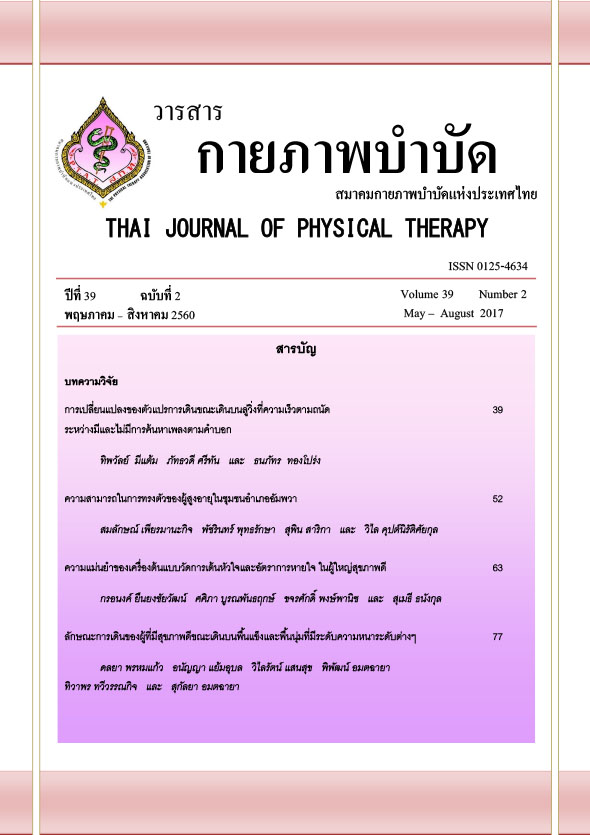
การเปลี่ยนแปลงของตัวแปรการเดินขณะเดินบนลู่วิ่งที่ความเร็วตามถนัด ระหว่างมีและไม่มีการค้นหาเพลงตามคำบอก
Article Sidebar
Main Article Content
บทคัดย่อ
ที่มาและความสำคัญ: มีหลักฐานงานวิจัยที่แสดงให้เห็นว่าการใช้โทรศัพท์ขณะเดินส่งผลต่อความเร็วการเดิน, ความมั่นคงร่างกายและประสิทธิภาพงานการใช้โทรศัพท์ ผลกระทบเหล่านี้มักถูกรายงานขณะทดสอบให้เดินบนพื้นถนน อย่างไรก็ตามยังไม่มีการศึกษาผลกระทบเหล่านี้ในขณะเดินบนลู่วิ่งซึ่งถูกควบคุมให้มีความเร็วคงที่เท่ากับความเร็วตามถนัดของอาสาสมัคร
วัตถุประสงค์: วัตถุประสงค์ของการศึกษาเพื่อเปรียบเทียบตัวแปรการเดินขณะเดินบนลู่วิ่งและร้อยละจำนวนเพลงที่เลือกถูกต้อง ระหว่าง 4 สถานการณ์ ประกอบด้วย 1) งานเดินอย่างเดียวที่ความเร็วตามถนัด (ST-W) 2) งานค้นหาเพลงตามคำบอกขณะเดินที่ความเร็วเดียวกับงานเดินอย่างเดียว (DT1) 3) งานค้นหาเพลงตามคำบอกขณะเดินที่ความเร็วตามถนัด (DT2) 4) งานนั่งค้นหาเพลงตามคำบอก (ST-S)
วิธีการ: อาสาสมัครจำนวน 30 คน เข้าร่วมการศึกษานี้ อาสาสมัครทำการทดสอบงานทั้ง 4 สถานการณ์ แต่ละสถานการณ์ถูกทดสอบซ้ำ 3 ครั้ง แต่ละครั้งจะบันทึกข้อมูลเป็นเวลา 2 นาที
ผลการศึกษา: เมื่อมีการค้นหาเพลงขณะเดินด้วยความเร็วถูกกำหนดให้เท่ากัน ค่า percentage of total double support ในสถานการณ์ DT1 มีค่าเพิ่มมากขึ้นและ percentage of single support มีค่าน้อยลงเมื่อเปรียบเทียบกับสถานการณ์ ST-W เมื่อเปรียบเทียบระหว่างสถานการณ์ที่มีการเปลี่ยนความเร็วการเดิน ผลการศึกษาพบค่าเฉลี่ยในสถานการณ์ DT2 ของตัวแปร step time, total double support และ stride time มีค่าเพิ่มมากขึ้น ขณะที่ step length, single support, stride length, speed และ cadence มีค่าลดลงอย่างมีนัยสำคัญทางสถิติเมื่อเปรียบเทียบกับสถานการณ์ ST-W และ DT1 อย่างไรก็ตามไม่พบความแตกต่างอย่างมีนัยสำคัญทางสถิติของตัวแปรร้อยละจำนวนเพลงที่เลือกถูกต้องระหว่างแต่ละสถานการณ์
สรุปการศึกษา: ตัวแปรการเดินเปลี่ยนแปลงตามปัจจัยความเร็วการเดินเป็นหลัก เมื่อเปรียบเทียบระหว่างกับสถานการณ์ ST-W ขณะที่อาสาสมัครทำการค้นหาเพลงตามคำบอกขณะเดินที่ความเร็วเดียวกันพบการเปลี่ยนแปลงของตัวแปร percentage of single และ double support
Article Details
เอกสารอ้างอิง
2. Hatfield J, Murphy S. The effects of mobile phone use on pedestrian crossing behaviour at signalised and unsignalised intersections. Accid Anal Prev. 2007; 39(1): 197-205.
3. Nasar J, Hecht P, Wener R. Mobile telephones, distracted attention, and pedestrian safety. Accid Anal Prev. 2008; 40(1): 69-75.
4. Yamada M, Aoyama T, Okamoto K, Nagai K, Tanaka B, Takemura T. Using a smartphone while walking: a measure of dual-tasking ability as a falls risk assessment tool. Age Ageing. 2011; 40(4): 516-9.
5. Plummer P, Apple S, Dowd C, Keith E. Texting and walking: Effect of environmental setting and task prioritization on dual-task interference in healthy young adults. Gait Posture. 2015; 41(1): 46-51.
6. Hyong IH. The effects on dynamic balance of dual-tasking using smartphone functions. J Phys Ther Sci. 2015; 27(2): 527–9.
7. Huxhold O, Li SC, Schmiedek F, Lindenberger U. Dual-tasking postural control: aging and the effects of cognitive demand in conjunction with focus of attention. Brain Res Bull. 2006; 69(3):294-305.
8. Agostini V, Lo Fermo F, Massazza G, Knaflitz M. Does texting while walking really affect gait in young adults?. J Neuroengineering Rehabil. [Internet]. 2015 [cited 2011 Sept 23]; 12:86 [about 10 p.]. Available from: BioMed Central
9. Szturm T, Maharjan P, Marotta JJ, Shay B, Shrestha S, Sakhalkar V. The interacting effect of cognitive and motor task demands on performance of gait, balance and cognition in young adults. Gait Posture 2013; 38(4): 596-602.
10. Parr N, Hass C, Tillman M. Cellular phone texting impairs gait in able-bodied young adults. JAB. 2014; 30(6): 685-8.
11. Al-Yahya E, Dawes H, Smith L, Dennis A, Howells K, Cockburn J. Cognitive motor interference while walking: a systematic review and meta-analysis. Neuroscience & Biobehavioral Reviews. 2011; 35(3): 715-28.
12. Grabiner MD, Troy KL. Attention demanding tasks during treadmill walking reduce step width variability in young adults. J Neuroengineering Rehabil. [Internet]. 2005 [cited 2011 Sept 23]; 2:25 [about 6 p.]. Available from: BioMed Central
13. Gray SE, Zabjek K, Finch CF. The causes of injuries sustained at fitness facilities presenting to Victorian emergency departments – identifying the main culprits. Inj. Epidemiol. 2015; 2(1): 2-6.
14. Chien JH, Yentes J, Stergiou N, Siu KC. The effect of walking speed on gait variability in healthy young, middle-aged and elderly individuals. J Phys Act Nutr Rehabil. [Internet]. 2015 [cited 2011 Sept 23]; 2:25 [about 11 p.]. Available from: PMC
15. Yogev-Seligmann G1, Hausdorff JM, Giladi N. The role of executive function and attention in gait. Mov Disord. 2008; 23(3): 329-42.
16. Cappellini G, Ivanenko YP, Poppele RE, Lacquaniti F. Motor patterns in human walking and running. J Neurophysiol. 2006; 95(6): 3426-37.
17. McFadyen BJ, Hegeman J, Duysens J. Dual task effects for asymmetric stepping on a split-belt treadmill. Gait Posture. 2009; 30(3): 340-4.
18. Nadkarni NK, Zabjek K, Lee B, Mcllroy WE, Black SE. Effect of working memory and spatial attention tasks on gait in healthy yound and older adults. Motor Control. 2010; 14(2): 195-210.
19. Woollacott MH, Shumway-Cook A. Motor Control: theory and practical applications. Baltimore: Williams & Wilkins, 1995.
20. Schimdt RA, Lee TD. Motor control and learning: a behavioral emphasis. 5th ed. Illinois: Human Kinetics, 2011.
