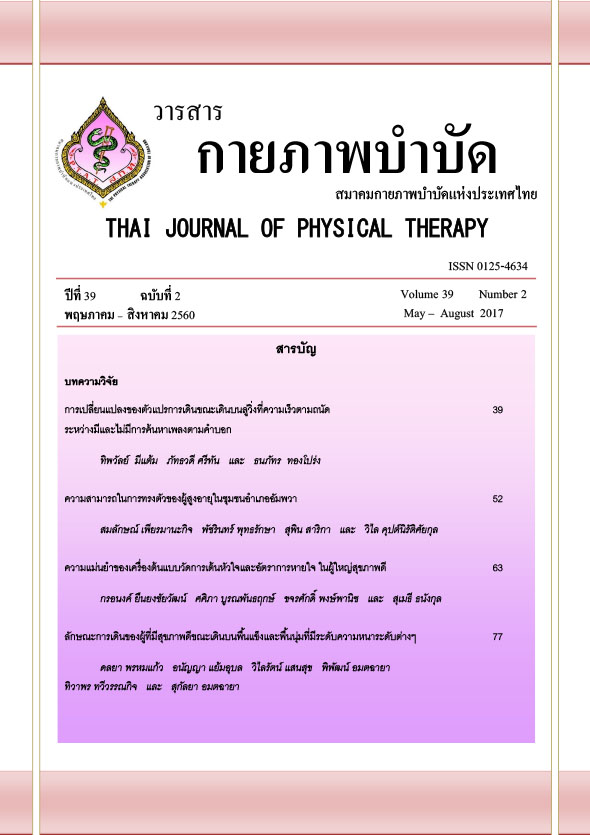
Accuracy of a prototype of heart rate and respiratory rate measurement in healthy adults
Article Sidebar
Main Article Content
Abstract
Background: A several studies have been reported that slow and deep breathing could be decreased blood pressure (BP). Furthermore, a breathing device that promotes slow and deep breathing has been reported helping reduced BP. However, the portable electronic device is a commercial price and it detects only breathing rate not heart beat detection.
Objectives: To develop a prototype of heart rate and respiratory rate measurement and to study the accuracy of the breathing and heart rates detector in healthy adults.
Methods: Thirty healthy participants underwent heart rate and respiratory rate monitoring by both cardiorespiratory monitor (Electrocardiography (ECG): Philips Intellivue MP20 bedside monitor] and under the prototype of breathing device. Heart beat and breathing were recorded for 10 minute resting period.
Results: The results found that the efficiency of the prototype of heart rate and respiratory rate measurement had a good agreement and accuracy when comparted to ECG bedside monitor. In addition, 30 healthy volunteers aged 32.07 ± 11.58 years old were not different from ECG monitoring and the accuracy of heart beat was within -2.03% and 1.35% for breathing rate compared to the ECG monitoring.
Conclusion: The prototype of heart rate and respiratory rate measurement is accurate in detecting for heart beat and breathing among healthy adults. Therefore, the prototype of heart rate and respiratory rate measurement may be an alternative device to encourage breathing training and also detect cardiorespiratory.
Article Details
References
2. Mahtani KR, Nunan D, Henghan CJ. Device-guided breathing exercises in the control of human blood pressure: systematic review and meta-analysis. J Hypertens 2012;30:852-60. doi: 10.1097/HJH.0b013e3283520077.
3. Schein MH, Gavish B, Baevsky T, Kaufman M, Levine S, Nessing A, Alter A. Treating hypertension in type II diabetic patients with device-guided breathing: a randomized controlled trial. J Hum Hypertens 2009;23:325-31.
4. Wang SZ, Li S, Lin GP, Shao L, Zhao Y, Wang TH. Effect of slow abdominal breathing combined with biofeedback on blood pressure and heart rate variability in prehypertension. J Altern Complement Med 2010; 16: 1039-45.
5. Elliott WJ, Jr Izzo JL. Device-guided breathing to lower blood pressure: case report and clinical overview. MedGenMed 2006; 8:23. PMCID: PMC1781326
6. Pandic S, Ekman I, Nord L, Kjellgren KI. Device-guided breathing exercises in the treatment of hypertension – perceptions and effects. CVD Prev Control 2008; 3:163-9.
7. Sharma M, Frishman WH, Gandhi K. RESPeRATE: nonpharmacological treatment of hypertension. Cardiol Rev 2011; 19:47-51.
8. Bernardi L, Spadacini G, Bellwon J, Hajric R, Roskamm H, Frey AW. Effect of breathing rate on oxygen saturation and exercise performance in chronic heart failure. Lancet 1998; 351: 1308-11.
9. Bosnak-Guclu M, Arikan H, Savci, S, Inal-Ince D, Tulumen E, Aytemir K, Tokgozoglu L. Effects of inspiratory muscle training in patients with heart failure. Respir Med 2011; 105:1671-81.
10. Sutbeyaz ST, Koseoglu F, Inan L, Coskun O. Respiratory muscle training improves cardiopulmonary function and exercise tolerance in subjects with subacute stroke: a randomized controlled trial. Clin Rehabil 2010; 24:240-50.
11. Hulzebos EH, Helders PJ, Favie NJ, De Bie RA, Brutel de la Riviere A, Van Meeteren NL. Preoperative intensive inspiratory muscle training to prevent postoperative pulmonary complications in high-risk patients undergoing CABG surgery: a randomized clinical trial. JAMA 2006; 296:1851-7.
12. Matheus GB, Dragossavac D, Trevisan P, Costa CE, Lopes MM, Ribeiro GC. Inspiratory muscle training improved tidal volume and vital capacity after CABG surgery. Rev Bras Cir Cardiovascs 2012; 27:362-369.
13. Kordric M, Trevisan R, Torregiani C, Cifaldi R, Longo c, Cantarutti F, Confalonieri M. Inspiratory muscle training for diaphragm dysfunction after cardiac surgery. J Thorac Cardiovasc Surg 2013; 145:819-23.
14. Crisafulli E, Venturelli E, Siscaro G, Florini F, Papetti A, Lugli D, Cerulli M, Clini E. Respiratory muscle training in patients recovering recent open cardiothoracic surgery: a randomized-controlled trial. Biomed Res Int 2013:354276. doi: 10.1155/2013/354276
15. Bernardi L, Gabutti A, Porta C, Spicuzza L. Slow breathing reduces chemoreflex response to hypoxia and hypercapnia, and increases baroreflex sensitivity. J Hypertens 2001; 19:2221–9.
16. Pramanik T, Sharma HO, Mishra S, Mishra A, Prajapati R, Singh S. Immediate effect of slow pace Bhastrika Pranayama on blood pressure and heart rate. J Altern Complement Med 2009;15:293-5.
17. Scully CG, Lee J, Meyer J, Gorbach AM, Granquist-Fraser D, Mendelson Y, Chon KH. Physiological parameter monitoring from optical recordings with a mobile phone. IEEE Trans Biomed Eng 2012; 59: 303-6.
18. Thought Technology Ltd. Blood volume pulse (BVP): HR/BVR sensor (P/N: SA9308M) Available from http://thoughttechnology.com/index.php/respiration-sensor.html. Accessed 20 December 2016.
19. Schein MH, Gavish B, Herz M, Rosner-Kahana D, Naveh P, Knishkowy B, Zlotnikov E, Ben-Zvi N, Melmed RN. Treating hypertension with a device that slows and regularises breathings: a randomised, double-blind controlled study. J Hum Hypertens 2001; 15: 271-8.
20. Linacre JM. Sample size and item calibration stability. Rasch Measurement Transactions 1994; 7(4): 328. Available from: http://www.rasch.org/rmt/rmt74m.htm.
21. Cohen J. A power primer. Psychol Bull 1992; 112: 155–9.
22. Dawson JA, Saraswat A, Simionato L, Thio M, Kamlin CO, Owen LS, Schmölzer GM, Davis PG. Comparison of heart rate and oxygen saturation measurements from Masimo and Nellcor pulse oximeters in newly born term infants. Acta Paediatr 2013; 102:955-60.
