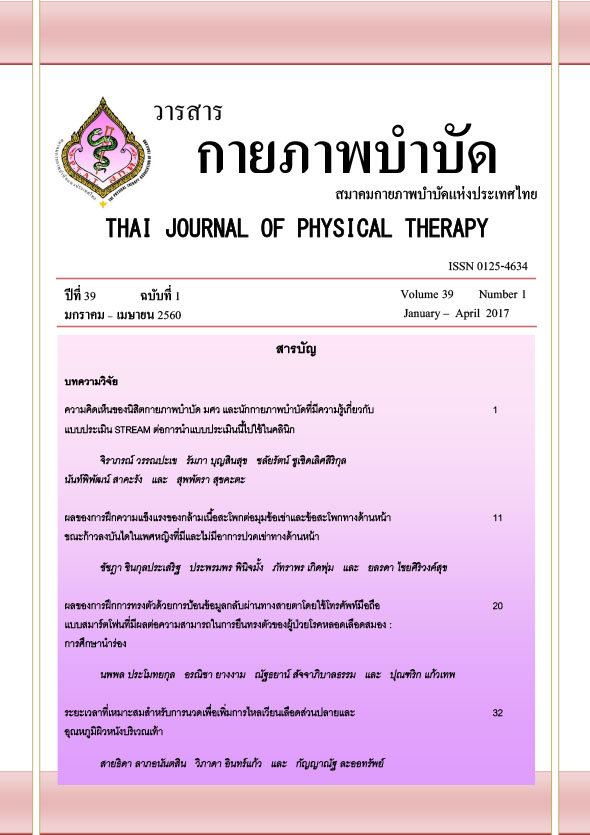
Opinions of Srinakharinwirot University students and physical therapists who have the knowledge of the Stroke Rehabilitation Assessment of Movement (STREAM) on the implementation of this scale in clinical practice
Article Sidebar
Main Article Content
Abstract
Background: Assessment of functional ability in patients with stroke using standardized clinical scale is important in rehabilitation but the use of such scale is not commonly practiced in Thailand. Faculty of Physical Therapy, Srinakharinwirot University (SWU) selected the STREAM as the main scale for assessing movement in patients with stroke by incorporating into the SWU physical therapy curriculum since 2011 and distributing the STREAM materials to physical therapists who are interested and SWU clinical instructors. However, there is no information on the implementation of the STREAM in clinic.
Objective: This study surveyed the opinions of SWU physical therapy students and clinical instructors for the implementation of the STREAM in clinic.
Method: Data was obtained from 274 participants, including 119 3rd and 4th year SWU Physical Therapy students, 77 SWU alumni and 78 physical therapists and neurological clinical instructors using the questionnaire.
Results: The study showed that 83.75% have experience in using the STREAM to assess the patients with stroke. Most of participants (83.33%) agreed that the STREAM was able to identify abnormal movement and plan the treatment for patients with stroke. Fifty one percent of participants had a tendency to use the STREAM as a major scale to assess patients with stroke but some were hesitant (41%) or did not intend to use the STREAM (6%).
Conclusion: The use of the STREAM in practice is not enough because the STREAM could be solved by increased practice time for using the STREAM.
Article Details
References
2. Hsueh IP, Lin JH, Jeng JS, Hsieh CL. Comparison of the psychometric characteristics of the functional independence measure, 5 item Barthel index, and 10 item Barthel index in patients with stroke. J Neurol Neurosurg Psychiatry. 2002; 73: 188–90.
3. Hsueh IP, Hsu MJ, Sheu CF, Lee S, Hsieh CL, Lin JH. Psychometric comparisons of 2 versions of the Fugl-Meyer Motor Scale and 2 versions of the Stroke Rehabilitation Assessment of Movement. Neurorehabil Neural Repair. 2008; 22: 736-44.
4. Hsueh IP, Wang WC, Wang CH, Sheu CF, Lo SK, Lin JH, et al. A simplified stroke rehabilitation assessment of movement instrument. Phys Ther 2006; 86(7): 936-43.
5. Daley K, Mayo N, Wood-Dauphinee S. Reliability of scores on the Stroke Rehabilitation Assessment of Movement (STREAM) measure. Phys Ther 1999; 79(1): 8-23.
6. Ward I, Pivko S, Brooks G, Parkin K. Validity of the stroke rehabilitation assessment of movement scale in acute rehabilitation: a comparison with the functional independence measure and stroke impact scale-16. PM R 2011;3(11):1013-21.
7. Hsieh YW, Lin JH, Wang CH, Sheu CF, Hsueh IP, Hsieh CL. Discriminative, predictive and evaluative properties of the simplified stroke rehabilitation assessment of movement instrument in patients with stroke. J Rehabil Med 2007; 39(6): 454-60.
8. Wang CH, Hsieh CL, Dai MH, Chen CH, Lai YF. Inter-rater reliability and validity of the stroke rehabilitation assessment of movement (stream) instrument. J Rehabil Med 2002; 34(1): 20-4.
