
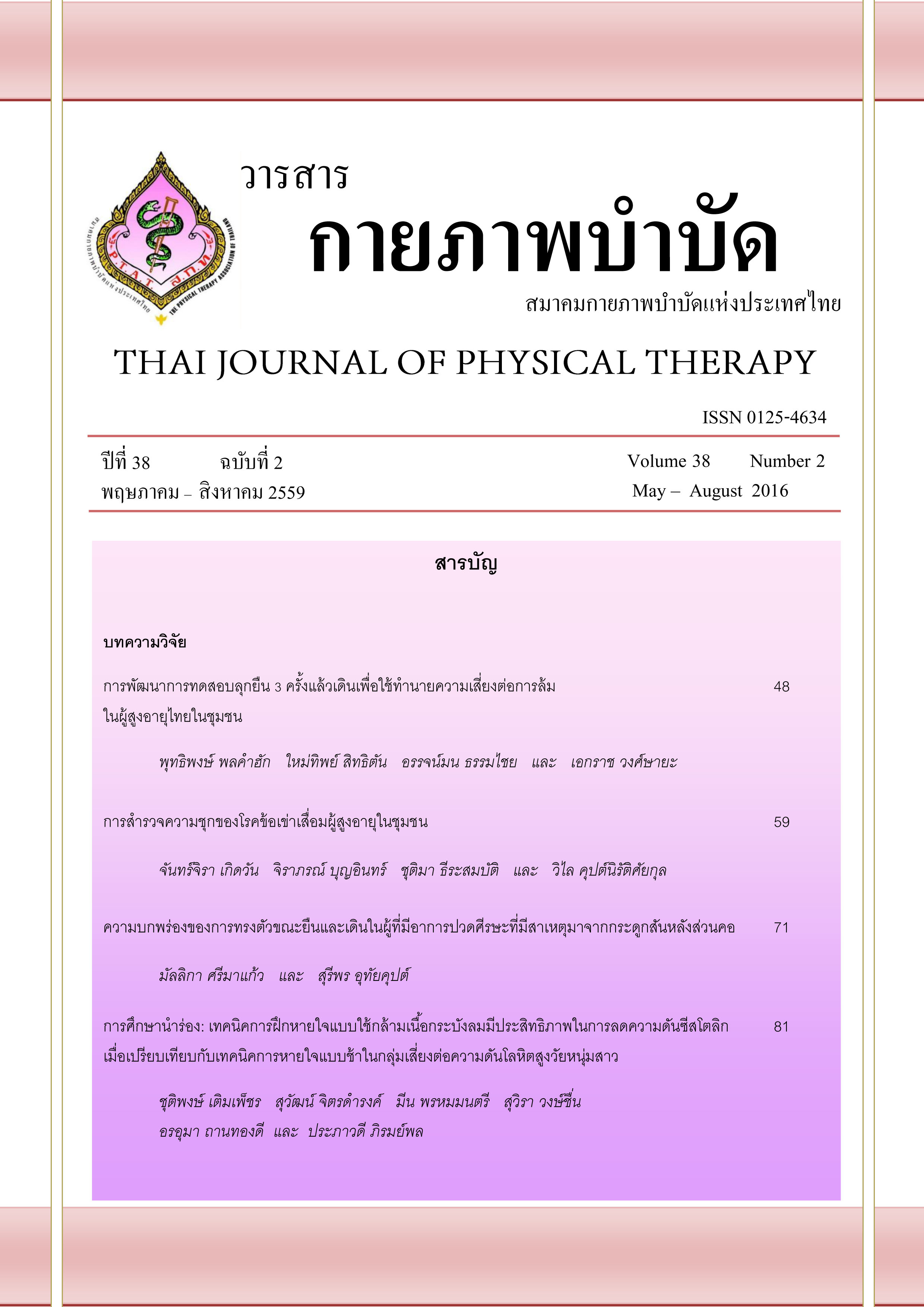
Pilot study: Diaphragmatic Breathing Technique is Effective in Lowering Systolic Blood Pressure Compared with Slow Breathing Technique in Young Adult with Prehypertension
Article Sidebar
Main Article Content
Abstract
Background: Breathing exercise has been well received alternative intervention to lower blood pressure in patients with hypertension and prehypertension. However, the efficiency between slow breathing exercise and diaphragmatic breathing exercise in patients with prehypertension remain inconclusive.
Objectives: To compare the efficiency between slow breathing and diaphragmatic breathing techniques in lowering blood pressure in patients with prehypertension.
Methods: This study was Quasi-experimental design with double blind control trial. Twenty-seven subjects (ages 18-22 years) with pre-hypertension (SBP: 120-139 mmHg; DBP: 80-89 mmHg) were divided into three intervention groups; slow breathing at 6 beat per minute (n=9), diaphragmatic breathing at 6 beat per minute (n=9) and control (n=9) groups. We evaluated the changes of all non-invasive blood pressure parameters; systolic blood pressure (SBP), diastolic blood pressure (DBP), heart rate (HR), mean arterial blood pressure (MAP), pulse pressure (PP), and Srithanya stress scale (ST-5) after acute phase and two weeks of breathing training.
Results: SBP in diaphragmatic breathing group was lower than in control group both acute phase (p = 0.02) and after two weeks of training (p = 0.006). No statistically differences in other parameters were found in diaphragmatic and slow breathing groups compared to control group.
Conclusion: Diaphragmatic breathing is more effective in lowering SBP than in slow breathing exercise in pre-hypertensive subjects aged 18-22 years old in both acute phase and after two weeks of training.
Article Details
References
2. Zhao J, Kelly M, Bain C, Seubsman SA, Sleigh A. Risk factors for cardiovascular disease mortality among 86866 members of the Thai Cohort Study, 2005-2010. Glob J Health Sci. 2015;7(1):107-14.
3. Izzo JL, Sica DA, Black HR, Council for High Blood Pressure Research (American Heart Association). Hypertension primer : [the essentials of high blood pressure : basic science, population science, and clinical management]. 4th ed. Philadelphia, PA: Lippincott Williams & Wilkins; 2008.
4. Hackam DG, Quinn RR, Ravani P, Rabi DM, Dasgupta K, Daskalopoulou SS, et al. The 2013 Canadian Hypertension Education Program recommendations for blood pressure measurement, diagnosis, assessment of risk, prevention, and treatment of hypertension. Can J Cardiol 2013;29(5):528-42.
5. Zhang PY. Review of new hypertension guidelines. Eur Rev Med Pharmacol Sci. 2015;19(2):312-5.
6. Woolf KJ, Bisognano JD. Nondrug interventions for treatment of hypertension. J Clin Hypertens (Greenwich) 2011;13(11):829-35.
7. Bhavanani AB, Madanmohan, Sanjay Z. Immediate effect of chandra nadi pranayama (left unilateral forced nostril breathing) on cardiovascular parameters in hypertensive patients. Int J Yoga 2012;5(2):108-11.
8. Chobanian AV, Bakris GL, Black HR, Cushman WC, Green LA, Izzo JL, Jr., et al. The Seventh Report of the Joint National Committee on Prevention, Detection, Evaluation, and Treatment of High Blood Pressure: the JNC 7 report. JAMA 2003;289(19):2560-72.
9. Subramanian H, Soudarssanane MB, Jayalakshmy R, Thiruselvakumar D, Navasakthi D, Sahai A, et al. Non-pharmacological Interventions in Hypertension: A Community-based Cross-over Randomized Controlled Trial. Indian J Community Med 2011;36(3):191-6.
10. Hagins M, States R, Selfe T, Innes K. Effectiveness of yoga for hypertension: systematic review and meta-analysis. Evid Based Complement Alternat Med 2013;2013:649836.
11. Anderson DE, McNeely JD, Windham BG. Regular slow-breathing exercise effects on blood pressure and breathing patterns at rest. J Hum Hypertens 2010;24(12):807-13.
12. Lin G, Xiang Q, Fu X, Wang S, Chen S, Shao L, et al. Heart rate variability biofeedback decreases blood pressure in prehypertensive subjects by improving autonomic function and baroreflex. J Altern Complement Med 2012;18(2):143-52.
13. Wang SZ, Li S, Xu XY, Lin GP, Shao L, Zhao Y, et al. Effect of slow abdominal breathing combined with biofeedback on blood pressure and heart rate variability in prehypertension. J Altern Complement Med 2010;16(10):1039-45.
14. Mourya M, Mahajan AS, Singh NP, Jain AK. Effect of slow- and fast-breathing exercises on autonomic functions in patients with essential hypertension. J Altern Complement Med 2009;15(7):711-7.
15. Joseph CN, Porta C, Casucci G, Casiraghi N, Maffeis M, Rossi M, et al. Slow breathing improves arterial baroreflex sensitivity and decreases blood pressure in essential hypertension. Hypertension 2005;46(4):714-8.
16. Radaelli A, Raco R, Perfetti P, Viola A, Azzellino A, Signorini MG, et al. Effects of slow, controlled breathing on baroreceptor control of heart rate and blood pressure in healthy men. J Hypertens 2004;22(7):1361-70.
17. Subbalakshmi NK, Adhikari P, Shanmugavel Jeganathan P. Comparative study on cardiac autonomic modulation during deep breathing test and diaphragmatic breathing in type 2 diabetes and healthy subjects. J Diabetes Investig 2014;5(4):456-63.
18. Pletcher MJ, Bibbins-Domingo K, Lewis CE, Wei GS, Sidney S, Carr JJ, et al. Prehypertension during young adulthood and coronary calcium later in life. Ann Intern Med 2008;149(2):91-9.
19. Yano Y, Stamler J, Garside DB, Daviglus ML, Franklin SS, Carnethon MR, et al. Isolated systolic hypertension in young and middle-aged adults and 31-year risk for cardiovascular mortality: the Chicago Heart Association Detection Project in Industry study. J Am Coll Cardiol 2015;65(4):327-35.
20. al'Absi M, Arnett DK. Adrenocortical responses to psychological stress and risk for hypertension. Biomed Pharmacother 2000;54(5):234-44.
21. Silpakit O. Srithanya stress scale. Journal of Mental Health of Thailand 2008 Sep;16(3):177-85.
22. Bernardi L, Gabutti A, Porta C, Spicuzza L. Slow breathing reduces chemoreflex response to hypoxia and hypercapnia, and increases baroreflex sensitivity. J Hypertens 2001;19(12):2221-9.
23. Pickering TG, Hall JE, Appel LJ, Falkner BE, Graves J, Hill MN, et al. Recommendations for blood pressure measurement in humans and experimental animals: Part 1: blood pressure measurement in humans: a statement for professionals from the Subcommittee of Professional and Public Education of the American Heart Association Council on High Blood Pressure Research. Hypertension 2005;45(1):142-61.
