
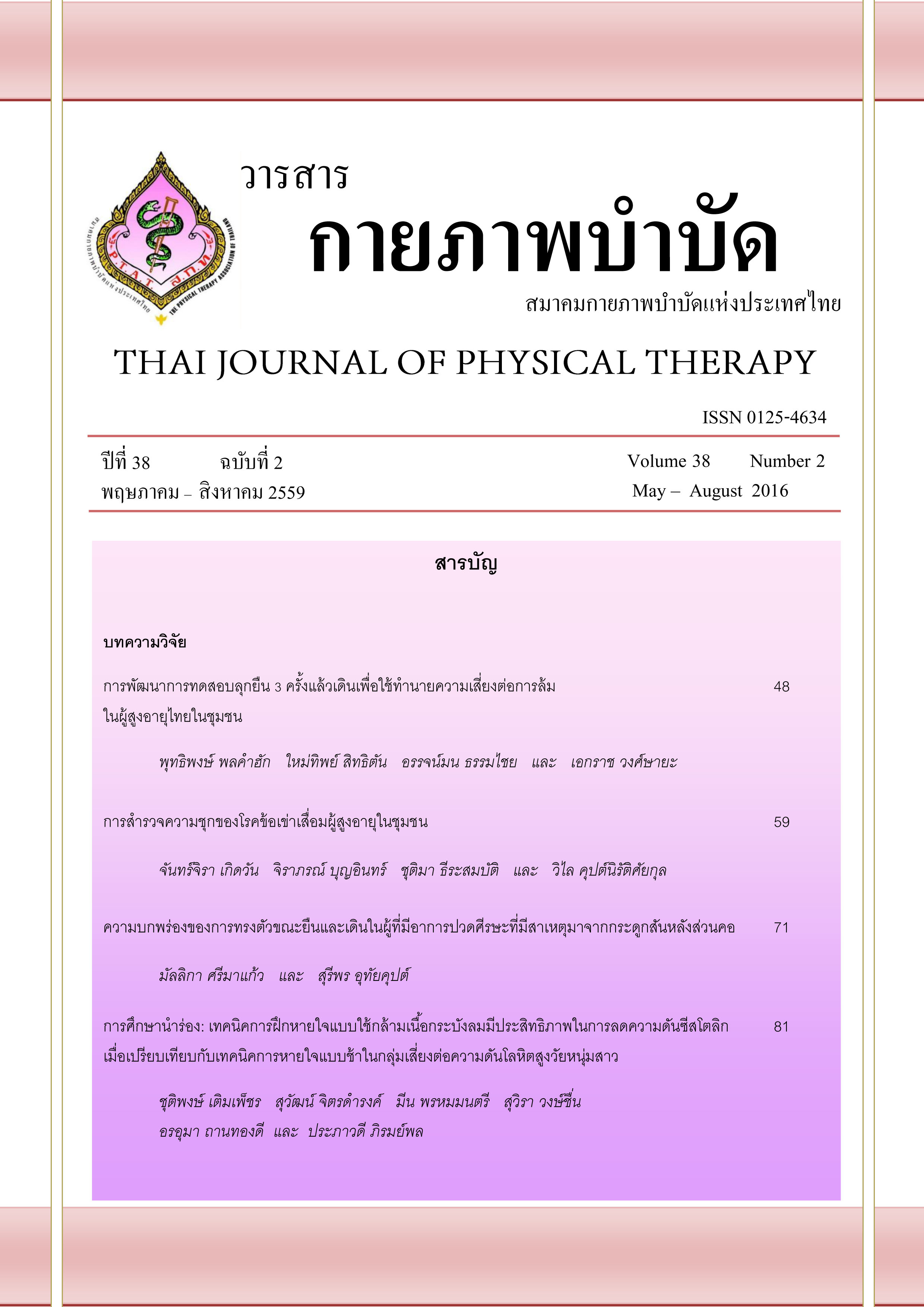
The prevalence of knee OA in community-based elders
Article Sidebar
Main Article Content
Abstract
Background: Knee OA is one of the most common musculoskeletal problem affecting daily life and quality of life in the elders.
Objectives: To determine the prevalence of knee OA in community-based elders and related factors.
Methods: This cross-sectional survey was performed in elders living in Umpawa province, Samutsongkram. The prevalence of knee OA was determined by using the American Rheumatism Association criteria of knee pain, crepitus on moving joints, and morning stiffness of less than 30 minutes. In addition, Quadriceps strength measured by dynamometer, gait speed (6-meter walk) and body mass index (BMI) were evaluated. Then, all factors related to knee OA were analyzed.
Results: Eighty-six from 243 elders were diagnosed knee OA with the prevalence of 35.4 (95%CI: 29.6, 41.6). The prevalence in female was more than male (39.8% vs. 22.6%). This prevalence showed increasing trend as they aged (33.3% in 60-69 years, 37.8% in age ≥ 70 years). Factors related to knee OA were female sex (adjusted OR 2.13 with 95%CI: 1.07, 4.24) and BMI ≥23.0 kg/m2 (adjusted OR 2.46 with 95%CI: 1.37, 4.42).
Conclusion: Approximately one-third of community -dwelling elders was found to be knee OA. Female and elders with high BMI should be screened for knee OA.
Article Details
References
2. Neogi T, Zhang Y. Epidemiology of osteoarthritis. Rheum Dis Clin North Am. 2013; 39 (1): 1-19.
3. Kuptniratsaikul V, Tosayanonda O, Nilganuwong S, Thamalikitkul V. The epidemiology of osteoarthritis of the knee in elderly patients living an urban area of Bangkok. J Med Assoc Thai. 2002; 85 (2): 154-61.
4. Murphy L, Schwartz TA, Helmick CG, et al. Lifetime risk of symptomatic knee osteoarthritis. Arthritis Rheum. 2008; 59 (9): 1207-13.
5. Felson DT, Naimark A, Anderson J, Kazis L, Castelli W, Meenan RF. The prevalence of knee osteoarthritis in the elderly. The Framingham Osteoarthritis Study. Arthritis Rheum. 1987; 30 (8): 914-8.
6. Alnahdi AH, Zeni JA, Snyder-Mackler L. Muscle impairments in patients with knee osteoarthritis. Sports Health. 2012; 4 (4): 284-92.
7. Levinger P, Nagano H, Downie C, et al. Biomechanical balance response during induced falls under dual task conditions in people with knee osteoarthritis. Gait Posture. 2016;48:106-112.
8. Kim HS, Yun DH, Yoo SD, et al. Balance control and knee osteoarthritis severity. Ann Rehabil Med. 2011;35 (5):701-9.
9. Bindawas SM. Relationship between frequent knee pain, obesity, and gait speed in older adults: data from the Osteoarthritis Initiative. Clin Interv Aging. 2016;11:237-44.
10. Hayashi K, Kako M, Suzuki K, et al. Gait Speeds Associated with Anxiety Responses to Pain in Osteoarthritis Patients. Pain Med. 2015 Sep 9.
11. Sharma L, Song J, Dunlop D, et al. Varus and valgus alignment and incident and progressive knee osteoarthritis. Ann Rheum Dis. 2010; 69 (11): 1940-5.
12. Harvey WF, Yang M, Cooke TD, et al. Association of leg-length inequality with knee osteoarthritis: a cohort study. Ann Intern Med. 2010; 152 (5): 287-95.
13. Altman R, Asch E, Bloch D, et al. Development of criteria for the classification and reporting of osteoarthritis. Classification of osteoarthritis of the knee. Diagnostic and Therapeutic Criteria Committee of the American Rheumatism Association. Arthritis Rheum. 1986; 29 (8): 1039–49.
14. Lan Le-Ngoc, Jessica Janssen (2012). Validity and reliability of a hand-held dynamometer for dynamic muscle strength assessment. Rehabilitation Medicine. Chong Tae Kim, ed. InTech, DOI: 10.5772/37688. Available from: http://www.intechopen.com/books/rehabilitation-medicine/validity-and-reliability-of-a-hand-held-dynamometer-for-dynamic-muscle-strength-assessment
15. WHO Expert Consultation. Appropriate body-mass index for Asian populations and its implications for policy and intervention strategies. Lancet. 2004; 363 (9403): 157-63.
16. Assantachai P, Muangpaisan W, Intalapaporn S, Sitthichai K, Udompunturak S. Cut-off points of quadriceps strength, declines and relationships of sarcopenia-related variables among Thai community-dwelling older adults. Geriatr Gerontol Int. 2014; 14 Suppl 1:61-8.
17. Robinett CS, Vondran MA. Functional ambulation velocity and distance requirements in rural and urban communities. A clinical report. Phys Ther. 1988; 68 (9): 1371-3.
18. Cho HJ, Morey V, Kang JY, Kim KW, Kim TK. Prevalence and risk factors of spine, shoulder, hand, hip, and knee osteoarthritis in community-dwelling Koreans older than age 65 years. Clin Orthop Relat Res. 2015;473 (10):3307-14.
19. Lee S, Kim SJ. Prevalence of knee osteoarthritis, risk factors, and quality of life: The Fifth Korean National Health and Nutrition Examination Survey. Int J Rheum Dis 2015 Nov 18. doi: 10.1111/1756-185X.12795. [Epub ahead of print]
20. Andrianakos AA, Kontelis LK, Karamitsos DG, et al. Prevalence of symptomatic knee, hand, and hip osteoarthritis in Greece. The ESORDIG study. J Rheumatol. 2006; 33 (12): 2507-13.
21. Tang X, Wang S, Zhan S, et al. The prevalence of symptomatic knee osteoarthritis in China: Results from the China Health and Retirement Longitudinal Study. Arthritis Rheumatol. 2016;68 (3):648-53.
22. Liu Y, Zhang H, Liang N, Fan W, Li J, Huang Z, et al. Prevalence and associated factors of knee osteoarthritis in a rural Chinese adult population: an epidemiological survey. BMC Public Health. 2016;16 (1):94.
23. Al Saleh J, Sayed ME, Monsef N, Darwish E. The prevalence and the determinants of musculoskeletal diseases in Emiratis attending primary health care clinics in Dubai. Oman Med J. 2016;31 (2):117-23.
24. Davatchi F, Sandoughi M, Moghimi N, et al. Epidemiology of rheumatic diseases in Iran from analysis of four COPCORD studies. Int J Rheum Dis 2015 Dec 1. doi: 10.1111/1756-185X.12809. [Epub ahead of print]
25. Losina E, Weinstein AM, Reichmann WM, et al. Lifetime risk and age at diagnosis of symptomatic knee osteoarthritis in the US. Arthritis Care Res (Hoboken). 2013; 65 (5): 703-11.
26. Zhang Y, Xu L, Nevitt MC, et al. Comparison of the prevalence of knee osteoarthritis between the elderly Chinese population in Beijing and whites in the United States: The Beijing Osteoarthritis Study. Arthritis Rheum. 2001; 44 (9): 2065-71.
27. Zhang Y, Hunter DJ, Nevitt MC, et al. Association of squatting with increased prevalence of radiographic tibiofemoral knee osteoarthritis: the Beijing Osteoarthritis Study. Arthritis Rheum. 2004; 50 (4): 1187-92.
28. Blagojevic M, Jinks C, Jeffery A, Jordan KP. Risk factors for onset of osteoarthritis of the knee in older adults: a systematic review and meta-analysis. Osteoarthritis Cartilage. 2010; 18 (1): 24-33.
29. Plotnikoff R, Karunamuni N, Lytvyak E, et al. Osteoarthritis prevalence and modifiable factors: a population study. BMC Public Health. 2015;15:1195.
30. de Zwart AH, van der Esch M, Pijnappels MA, et al. Falls associated with muscle strength in patients with knee osteoarthritis and self-reported knee instability. J Rheumatol. 2015;42 (7):1218-23.
31. Tsonga T, Michalopoulou M, Malliou P, et al. Analyzing the history of falls in patients with severe knee osteoarthritis. Clin Orthop Surg. 2015;7 (4):449-56.
32. White DK, Niu J, Zhang Y. Is symptomatic knee osteoarthritis a risk factor for a trajectory of fast decline in gait speed? Results from a longitudinal cohort study. Arthritis Care Res (Hoboken). 2013;65 (2):187-94.
