
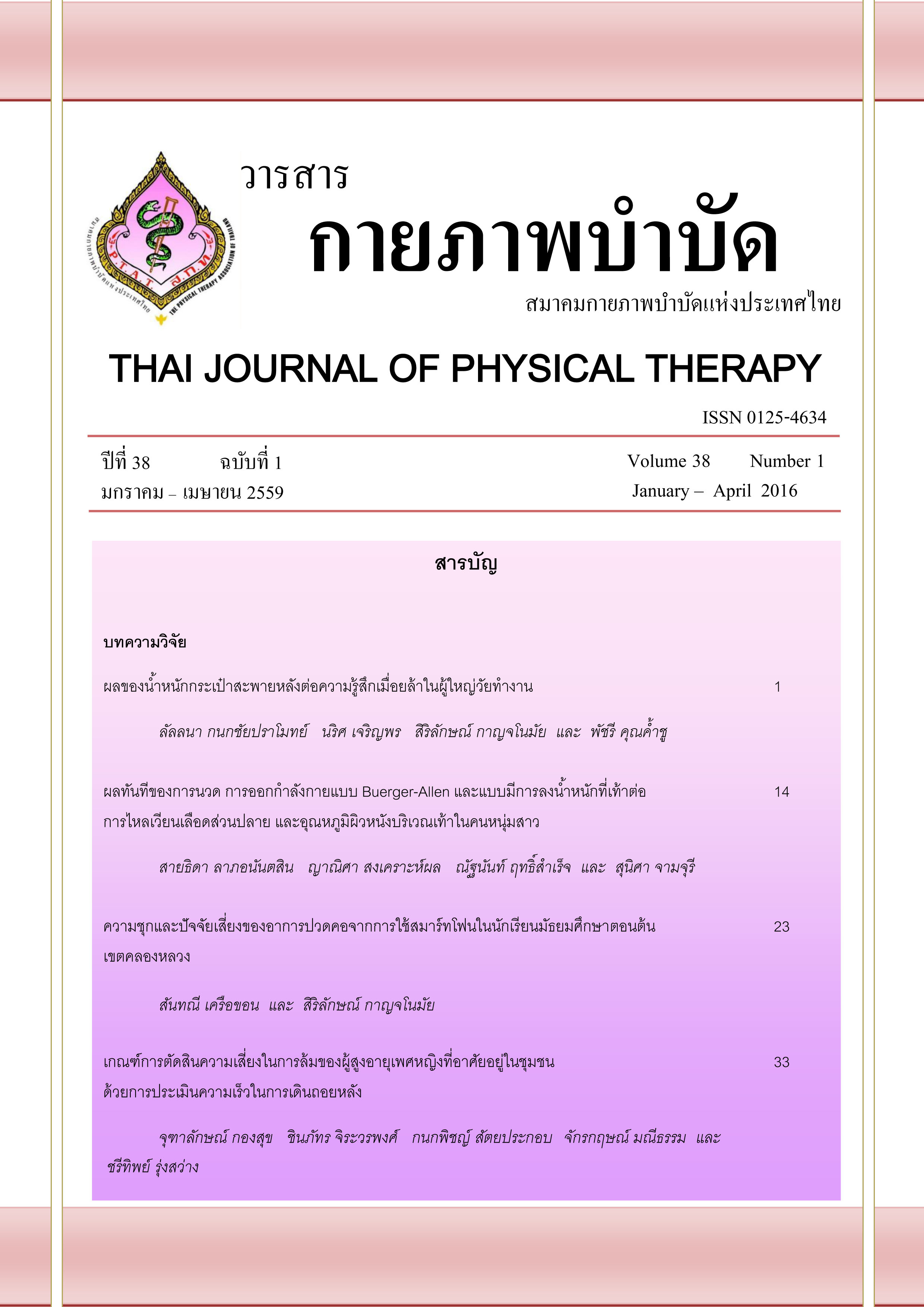
Immediate effects of massage, Buerger-Allen exercise and weight bearing exercise on peripheral blood flow and skin temperature of foot in young adults
Article Sidebar
Main Article Content
Abstract
Background: Several methods were claimed to increase peripheral blood flow such as massage, Buerger-Allen exercise and weight bearing exercise. However, no evidence comparing effectiveness of the 3 methods was found. Objectives: To investigate the immediate effects of massage, Buerger-Allen exercise and weight bearing exercise on peripheral blood flow and skin temperature of foot in young adults Methods: Thirty healthy young adults aged 20.87±1.20 years participated in the study. The experiments were performed in the controlled room temperature at 25-27 ˚c. All participants received 4 randomized conditions as the followings: 1) control (supine lying), 2) massage (M) from foot to leg, 3) Buerger-Allen exercise (B), and 4) weight bearing exercise (W). Each condition was taken 30 min with 1 week washout period. Ankle brachial index (ABI), and skin temperature (T) of foot were measured before and immediately after each condition. Data were analyzed by two-way repeated measures ANOVA. Results: The interaction of condition and time effect on ABI was significantly detected (p=0.023). The ABI was decreased immediately after program M and W. While after program B, the ABI was tended to increase similarly to the control condition. Moreover, the effects of time and an interaction between condition and time on T were statistically found (p=0.001 and p=0.009 respectively). The foot skin temperature was decreased after all conditions, except after massage it was maintained. Conclusions: Massage and weight bearing exercise showed a statistically significant immediate effect on peripheral blood flow rather than Buerger-Allen exercise, but the changes of ABI and T from these programs were not clinically significant. Therefore, the long-term effects and clinical proof in patient with peripheral circulation problem should be studied further.
Article Details
References
2.Aourell M, Skoog M, Carleson J. Effects of Swedish massage on blood pressure. Complement TherClinPract. 2005 Nov;11(4):242-6.
3.Kisner C, Colby LA. Therapeutic exercise: foundations and techniques. 2nd ed. Singapore: Info Access & Distribution; 1991.
4.Kawasaki T, Uemura T, Matsuo K, Masumoto K, Harada Y, Chuman T, et al. The effect of different positions on lower limbs skin perfusion pressure. Indian J Plast Surg. Sep;46(3):508-12.
5. Chang Chyong-Fang, Chang Chang-Cheng, Chen Mei-Yen. Effect of Buerger’s Exercises on Improving Peripheral Circulation: A Systematic Review. 2015;5:120-128.
6.สัญญา ร้อยสมมุติ. สรีรวิทยาของหัวใจและการไหลเวียนเลือด. พิมพ์ครั้งที่ 1. กรุงเทพฯ; โรงพิมพ์ขอนแก่นธุรภัณฑ์; 2556. P.15, 19, 20, 380, 398.
7.Piotr Mika, Krzysztof Spodaryk, Andrzej Cencora. Effects of treadmill training on walking distance and lower limb blood flow in patient with intermittent claudication. Medical Rehabilitation. 2005; 9(1):3-9.
8.สายธิดา ลาภอนันตสิน, สิริกานต์ เจตนประกฤต, เรืองรักษ์ อัศราช, วาธินี อินกล่ำ, ศิรประภา จำนงค์ผล. ผลของการนวดร่วมกับการออกกาลังกายเพื่อเพิ่มการไหลเวียนเลือดส่วนปลายต่ออาการเส้นประสาทส่วนปลายเสื่อมบริเวณขาส่วนล่างในผู้ป่วยเบาหวานชนิดที่ 2: การศึกษานำร่อง. วารสารกายภาพบำบัด 2557;36 (3):97-105.
9.Cassar M-P. Handbook of massage therapy: a complete guide for the student and professional massage therapist. Oxford; Boston: Butterworth-Heinemann; 1999.
10.สุวรรณ ธีระวรพันธ์, วิสุดา สุวิทยาวัฒน์, เพ็ญโฉม พึ่งวิชา. สรีรวิทยาระบบไหลเวียนโลหิต. พิมพ์ครั้งที่ 5. กรุงเทพฯ: ไทยมิตรการพิมพ์; 2547. P.173
11.Gilligan DM, Panza JA, et al. Contribution of endothelium-derived nitric oxide to exercise-induced vasodilation. Circulation. 1994; 90(6):2853-2858.
12.Dimkpa U, Ugwu AC. Determination of systolic blood pressure recovery time after exercise in apparently healthy, normotensive nonathletic adults and the effects of age, gender and exercise intensity. International journal of exercise science. 2009;2(2):115-130.
13.Weerapong P, Hume PA, Kolt GS. The mechanisms of massage and effects on performance, muscle recovery and injury prevention. Sports Med. 2005;35(3):235-56.
