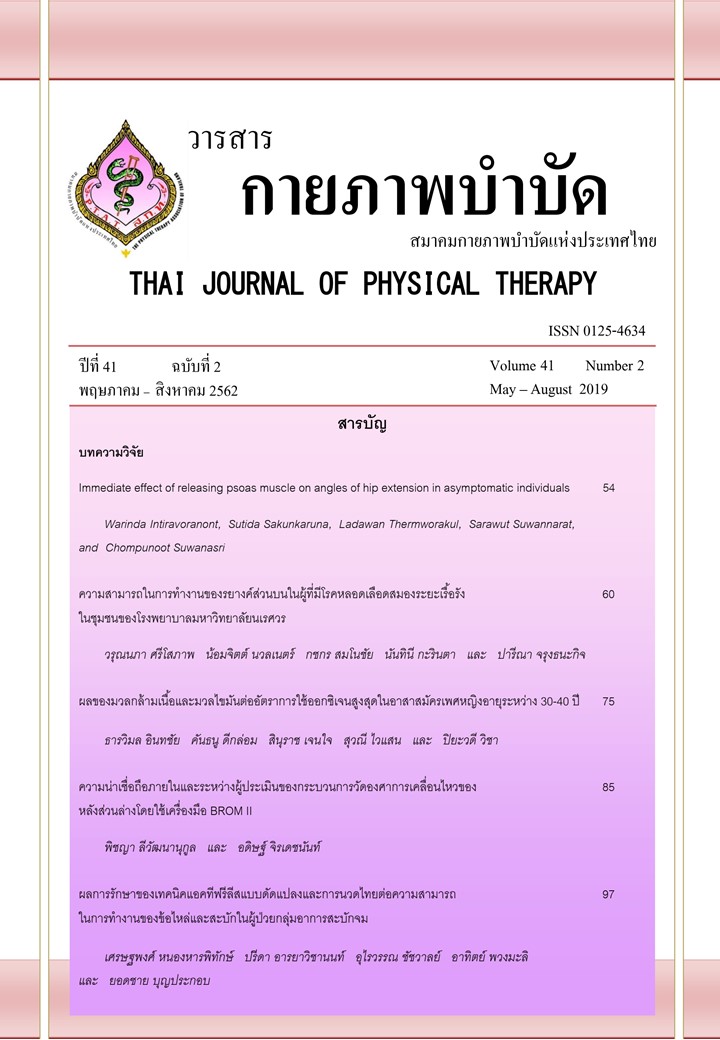
Upper Limb Functional Ability of Individuals with Chronic Stroke in Communities of Naresuan University Hospital
Article Sidebar
Main Article Content
Abstract
Background: Upper limb functional ability (ULFA) dysfunction is one of the most common and persistent disabilities after stroke. However, currently no studies have been undertaken to investigate the ULFA of people with chronic stroke after discharge.
Objective: To investigate the ULFA of the affected arm in community-dwellers with chronic stroke.
Methods: Participants were individuals with at least 6 months post-stroke who had upper limb motor impairment and were able to sit independently for at least 30 minutes and understand commands to perform a test. The Streamlined Wolf Motor Function Test for chronic stroke (SWMFT-C) was applied to evaluate the ULFA. The SWMFT-C were timed and rated by using the functional ability scale (FAS) starting from zero (cannot attempt task with involved arm) to five (movement appears to be normal). Scores of three or above indicated that the SWMFT-C tasks could be completed. Data were analyzed using descriptive statistics.
Results: Forty-five patients who were on average of 66.4±53.0 months post-stroke were recruited. The median (IQR) for the SWMFT-C-FAS of participants was 1.17 (0.25, 3.25) points with the timescale of 80.75 (5.10, 120.00) seconds. Twenty-nine (64.4%) participants had SWMFT-C-FAS scores lower than 3.
Conclusion: The majority of people with at least six months post-stroke had poor ULFA of the affected arm. Continuing upper limb rehabilitation is therefore needed after hospital discharge, in order to enhance the ULFA recovery.
Article Details

This work is licensed under a Creative Commons Attribution-NonCommercial-NoDerivatives 4.0 International License.
References
2. Venketasubramanian N, Yoon BW, Pandian J, Navarro JC. Stroke Epidemiology in South, East, and South-East Asia: A Review. J Stroke. 2017; 19(3): 286-94.
3. Smith MC, Byblow WD, Barber PA, Stinear CM. Proportional Recovery From Lower Limb Motor Impairment After Stroke. Stroke. 2017; 48(5): 1400-3.
4. Ada L, O'Dwyer N, O'Neill E. Relation between spasticity, weakness and contracture of the elbow flexors and upper limb activity after stroke: an observational study. Disabil Rehabil. 2006; 28(13-14): 891-7.
5. Kwakkel G, Kollen B, Twisk J. Impact of time on improvement of outcome after stroke. Stroke. 2006; 37(9): 2348-53.
6. Kong KH, Lee J. Temporal recovery and predictors of upper limb dexterity in the first year of stroke: a prospective study of patients admitted to a rehabilitation centre. NeuroRehabilitation. 2013; 32(2): 345-50.
7. Nijland RH, van Wegen EE, Harmeling-van der Wel BC, Kwakkel G. Presence of finger extension and shoulder abduction within 72 hours after stroke predicts functional recovery: early prediction of functional outcome after stroke: the EPOS cohort study. Stroke. 2010; 41(4): 745-50.
8. Kong KH, Chua KS, Lee J. Recovery of upper limb dexterity in patients more than 1 year after stroke: frequency, clinical correlates and predictors. NeuroRehabilitation. 2011; 28(2): 105-11.
9. Paci M, Nannetti L, Moretti S, Boccaletti E, Lombardi B. Are there differences in motor recovery between upper and lower limbs in hemiplegic patients with hemorrhagic stroke? It J Physiother. 2012; 2(2): 59-64.
10. Lang CE, Beebe JA. Relating movement control at 9 upper extremity segments to loss of hand function in people with chronic hemiparesis. Neurorehabil Neural Repair. 2007; 21(3): 279-91.
11. Likhi M, Jidesh VV, Kanagaraj R, George JK. Does trunk, arm, or leg control correlate best with overall function in stroke subjects? Top Stroke Rehabil. 2013; 20(1): 62-7.
12. Levin MF, Kleim JA, Wolf SL. What do motor “recovery” and “compensation” mean in patients following stroke? Neurorehabil Neural Repair. 2009; 23(4): 313-9.
13. Sackley C, Brittle N, Patel S, Ellins J, Scott M, Wright C, et al. The prevalence of joint contractures, pressure sores, painful shoulder, other pain, falls, and depression in the year after a severely disabling stroke. Stroke. 2008; 39(12): 3329-34.
14. Prodbumrung J. Complications following hemiparesis in stroke patients. Buddhachinaraj Med J. 2014; 31(3): 376-84.
15. Meyer S, Verheyden G, Brinkmann N, Dejaeger E, De Weerdt W, Feys H, et al. Functional and motor outcome 5 years after stroke is equivalent to outcome at 2 months: follow-up of the collaborative evaluation of rehabilitation in stroke across Europe. Stroke. 2015; 46(6): 1613-9.
16. Hsieh YW, Hsueh IP, Chou YT, Sheu CF, Hsieh CL, Kwakkel G. Development and validation of a short form of the Fugl-Meyer motor scale in patients with stroke. Stroke. 2007; 38(11): 3052-4.
17. Institute of Geriatric Medicine, Department of Medical Services, Ministry of Public Health Thailand. Mini-Mental State Examination-Thai 2002, 2002.
18. Bogard K, Wolf S, Zhang Q, Thompson P, Morris D, Nichols-Larsen D. Can the Wolf Motor Function Test be streamlined? Neurorehabil Neural Repair. 2009;23(5):422-8.
19. Morris DM, Uswatte G, Crago JE, Cook EW 3rd, Taub E. The reliability of the Wolf Motor Function Test for assessing upper extremity function after stroke. Arch Phys Med Rehabil. 2001;82(6):750-5.
20. Tretriluxana J, Vachalathiti R, Poungvarin N, Emsakul J, Juntrkaew T, Srirugsa P, et al. PO05-MO-05 The reliability and validity of Wolf motor function test (WMFT) for assessing paretic limb of individuals with acute stroke. J Neurol Sci. 2009;285:S176-S7.
21. Chen HF, Wu CY, Lin KC, Chen HC, Chen CP, Chen CK. Rasch validation of the streamlined Wolf Motor Function Test in people with chronic stroke and subacute stroke. Phys Ther. 2012;92(8):1017-26.
22. Wu CY, Fu T, Lin KC, Feng CT, Hsieh KP, Yu HW, et al. Assessing the streamlined Wolf motor function test as an outcome measure for stroke rehabilitation. Neurorehabil Neural Repair. 2011;25(2):194-9.
23. Wee SK. Relationship between trunk control and recovery of upper extremity function in stroke patients (Doctoral dissertation, University of Southampton). 2015.
24. Veale JF. Edinburgh handedness inventory–short form: a revised version based on confirmatory factor analysis. Laterality. 2014; 19(2): 164-77.
25. Au-Yeung SS, Hui-Chan CW. Predicting recovery of dextrous hand function in acute stroke. Disabil Rehabil. 2009; 31(5): 394-401.
26. Kwah LK, Harvey LA, Diong J, Herbert RD. Models containing age and NIHSS predict recovery of ambulation and upper limb function six months after stroke: an observational study. J Physiother. 2013; 59(3): 189-97.
27. Kwakkel G, Kollen BJ, van der Grond J, Prevo AJ. Probability of regaining dexterity in the flaccid upper limb: impact of severity of paresis and time since onset in acute stroke. Stroke. 2003; 34(9): 2181-6.
28. Lee Y-y, Hsieh Y-w, Wu C-y, Lin K-c, Chen C-k. Proximal Fugl-Meyer Assessment Scores Predict Clinically Important Upper Limb Improvement After 3 Stroke Rehabilitative Interventions. Arch Phys Med Rehabil. 2015; 96(12): 2137-44.
29. Hoonhorst MH, Nijland RH, van den Berg JS, Emmelot CH, Kollen BJ, Kwakkel G. How Do Fugl-Meyer Arm Motor Scores Relate to Dexterity According to the Action Research Arm Test at 6 Months Poststroke?. Arch Phys Med Rehabil. 2015; 96(10): 1845-9.
30. Jones CL, Kamper DG. Involuntary neuromuscular coupling between the Thumb and Finger of stroke survivors during Dynamic Movement. Front Neurol. 2018; 9: 84.
31. Turk R. Neuromechanical measurement of motor impairments in relation to upper limb activity limitations after stroke (Doctoral dissertation, University of Southampton). 2011.
32. Musampa NK, Mathieu PA, Levin MF. Relationship between stretch reflex thresholds and voluntary arm muscle activation in patients with spasticity. Exp Brain Res. 2007; 181(4): 579-93.
33. Coupar F, Pollock A, Rowe P, Weir C, Langhorne P. Predictors of upper limb recovery after stroke: a systematic review and meta-analysis. Clin Rehabil. 2012; 26(4): 291-313.
34. Chen CL, Tang FT, Chen HC, Chung CY, Wong MK. Brain lesion size and location: effects on motor recovery and functional outcome in stroke patients. Arch Phys Med Rehabil. 2000; 81(4): 447-52.
35. Shelton FN, Reding MJ. Effect of lesion location on upper limb motor recovery after stroke. Stroke. 2001; 32(1): 107-12.
36. Do Valle L. Comparative study on the relationship between stroke hemisphere and functional evolution in right-handed individuals. Braz J Phys Ther. 2008; 12(2): 113-20.
37. Waller SM, Whitall J. Hand dominance and side of stroke affect rehabilitation in chronic stroke. Clin Rehabil. 2005; 19(5): 544-51.
38. Sarikaya PM, Incel NA, Yilmaz A, Cimen OB, Sahin G. Effect of Hand Dominance on Functional Status and Recovery of Hand in Stroke Patients. Science. 2017; 6(3): 39-45.
39. Nakayama H, Jorgensen HS, Raaschou HO, Olsen TS. Compensation in recovery of upper extremity function after stroke: the Copenhagen Stroke Study. Arch Phys Med Rehabil. 1994; 75(8): 852-7.
40. Stinear CM, Barber PA, Petoe M, Anwar S, Byblow WD. The PREP algorithm predicts potential for upper limb recovery after stroke. Brain. 2012; 135(8): 2527-35.
41. Taub E, Uswatte G, Mark VW, Morris DM. The learned nonuse phenomenon: implications for rehabilitation. Eura Medicophys. 2006; 42(3):
241-56.
42. Leuenberger K, Gonzenbach R, Wachter S, Luft A, Gassert R. A method to qualitatively assess arm use in stroke survivors in the home environment. Med Biol Eng Comput. 2017;55(1): 141-50.
