
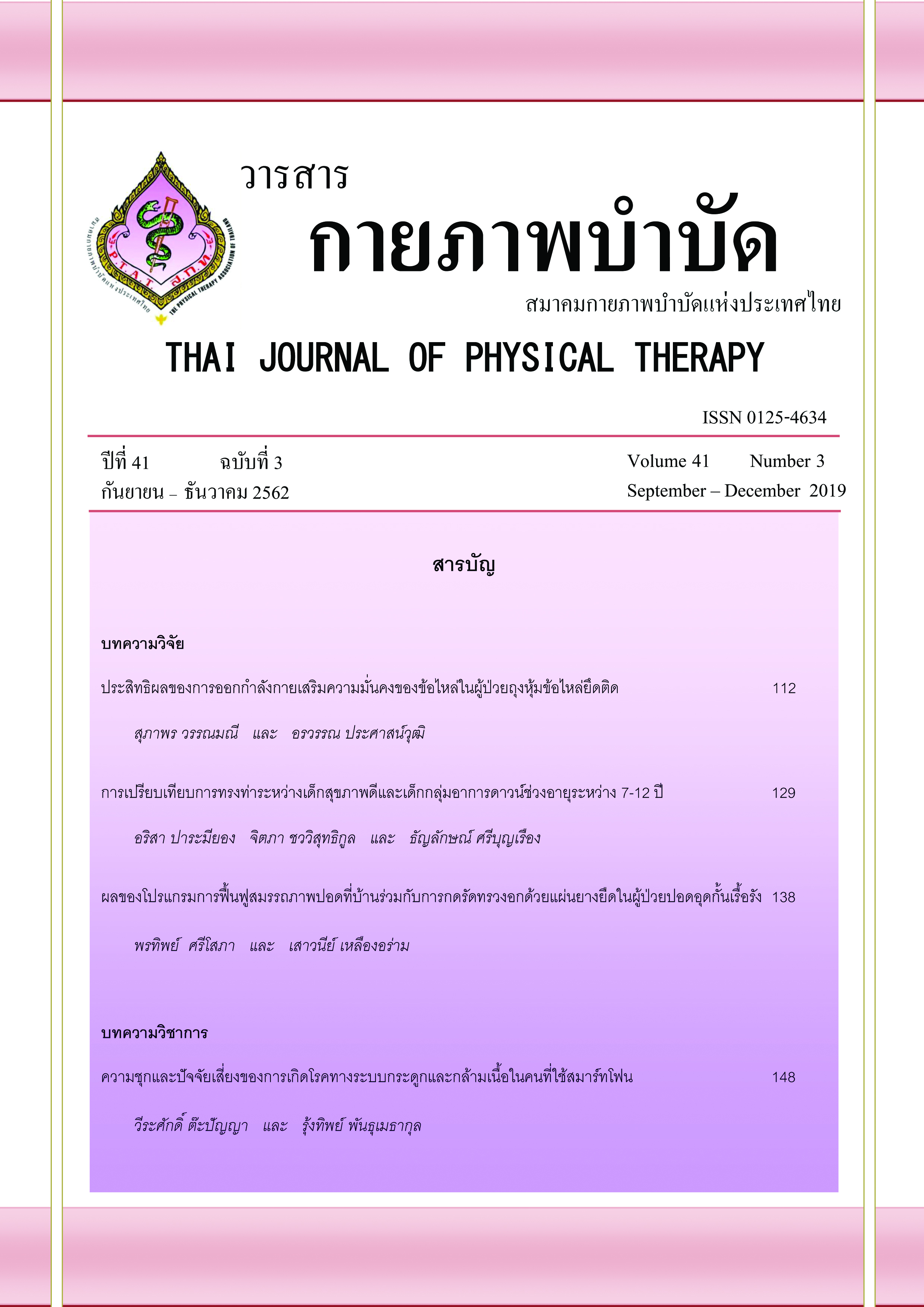
Effectiveness of Shoulder Stabilizing Exercises in Patients with Adhesive Capsulitis
Article Sidebar
Main Article Content
Abstract
Background: Shoulder stabilizing exercises have a good therapeutic effect in patients with shoulder impingement syndrome; however, patients with adhesive capsulitis also have biomechanical movement impairments such as shrugging and abnormal scapular movements. Therefore, shoulder stabilizing exercises might also be able to apply efficiently.
Objective: To evaluate the effectiveness of shoulder stabilizing exercises compared with general exercises.
Methods: A1-B-A2 single-subject design was used in 10 participants with adhesive capsulitis. Phase A1 and A2 were control phases in which participants were treated by general exercises for 3 weeks. Phase B was an intervention phase in which participants were treated by shoulder stabilizing exercise for 6 weeks. Outcome measures were range of motion (ROM), maximum voluntary isometric contraction (MVC), scapular positions, pain, and disabilities of shoulder score. The split-middle line was used to compare control and intervention phases, and the significance level was set at 0.05.
Results: When compared B with the A1 phase, the ROM of the shoulder joint demonstrated a statistically significant increase in all directions, whereas MVC only increased shoulder flexor muscles. In the B phase, the scapular position changed close to the sound side. Pain and disabilities of shoulder score showed a statistically significant decrease in 3 participants. When compared B with the A2 phase, all outcome measures changed superiorly in the B phase, except the MVC of shoulder flexor and internal rotation muscles.
Conclusion: Shoulder stabilizing exercises could demonstrate better therapeutic effects than general exercises in term of improvement in ROM and adjustment of scapular position in patients with adhesive capsulitis. They also could partly increase the maximal force of shoulder flexors, decrease pain level, and shoulder disabilities.
Article Details
References
2. Hand C. Clipsham K. Rees JL. Carr AJ. Long-term outcome of frozen shoulder. J Shoulder Elbow Surg 2008: 17(2): 231-6.
3. Neviaser AS, Hannafin JA. Adhesive capsulitis: a review of current treatment. Am J Sports Med 2010; 38(11): 2346-56.
4. Page MJ, Green S, Kramer S, Johnston RV, McBain B, Buchbinder R. Electrotherapy modalities for adhesive capsulitis (frozen shoulder).Cochrane Database Syst Rev. 2014;10:Cd011324.
5. Yang Jl, Chang CW, Chen SY, Lin JJ. Shoulder kinematic features using arm elevation and rotation tests for classifying patients with frozen shoulder syndrome who respond to physical therapy. Man Ther. 2008; 13(6): 544-51.
6. Donatelli R, Ruivo RM, Thurner M, Ibrahim MI. New concepts in restoring shoulder elevation in a stiff and painful shoulder patient. Phys Ther Sport 2014; 15(1): 3-14.
7. Page MJ, Green S, Kramer S, Johnston RV, McBain B, Chau M, et al. Manual therapy and exercise for adhesive capsulitis (frozen shoulder). Cochrane Database Syst Rev 2014; 8: Cd011275.
8. Yang JL, Jan MH, Chang CW, Lin JJ. Effectiveness of the end-range mobilization and scapular mobilization approach in a subgroup of subjects with frozen shoulder syndrome: a randomized control trial. Man Ther. 2012; 17(1): 47-52.
9. Maricar N, Shacklady C, McLoughlin L. Effect of Maitland mobilization and exercises for the treatment of shoulder adhesive capsulitis: a single-case design. Physiother Theory Pract 2009; 25(3): 203-17.
10. Kelley MJ, McClure PW, Leggin BG. Frozen shoulder: evidence and a proposed model guiding rehabilitation. J Orthop Sports Phys Ther 2009; 39(2): 135-48.
11. Shah S.Comparison between supervised structured exercise program and home based exercise program in idiopathic adhesive capsulitis. Ann Phys Rehabil Med 2014; 57 Supplement 1(0): e183.
12. Russell S, Jariwala A, Conlon R, Selfe J, Richards J, Walton M. A blinded, randomized, controlled trial assessing conservative management strategies for frozen shoulder. J Shoulder Elbow Surg 2014; 23(4): 500-7.
13. Sokk J, Gapeyeva H, Ereline J, Merila M, Paasuke M. Shoulder muscle isometric strength and active range of motion in patients with frozen shoulder syndrome after manipulation under anesthesia.Medicina (Kaunas, Lithuania) 2012; 48(7): 331-7.
14. Levine WN, Kashyap CP, Bak SF, Ahmad CS, Blaine TA, Bigliani LU.Nonoperative management of idiopathic adhesive capsulitis. J Shoulder Elbow Surg 2007;16:569-73.
15. Griggs SM, Ahn A, Green A.Idiopathic adhesive capsulitis. A prospective functional outcome study of nonoperative treatment. J Bone Joint Surg Am. 2000;82(A):1398-407.
16. Page P, Labbe A. Adhesive capsulitis: use the evidence to integrate your interventions. N Am J Sports Phys Ther. 2010;5(4):266-73.
17. Rundquist PJ, Anderson DD, Guanche CA, Ludewig PM. Shoulder kinematics in subjects with frozen shoulder. Arch Phys Med Rehabil 2003; 84(10): 1473-9.
18. Ludewig PM, Reynolds JF. The association of scapular kinematics and glenohumeral joint pathologies. J Orthop Sports Phys Ther 2009; 39(2): 90-104.
19. Lin JJ, Wu YT, Wang SF, Chen SY. Trapezius muscle imbalance in individuals suffering from frozen shoulder syndrome. Clin Rheumatol 2005; 24: 569-75.
20. Fayad F, Roby-Brami A, Yazbeck C, Hanneton S, Lefevre-Colau MM, Gautheron V, et al. Three-dimensional scapular kinematics and scapulohumeral rhythm in patients with glenohumeral osteoarthritis or frozen shoulder. J Biomech. 2008; 41(2): 326-32.
21. Kelley MJ, Shaffer MA, Kuhn JE, Michener LA, Seitz AL, Uhi TL, et al. Shoulder pain and mobility deficits: adhesive capsulitis. J Orthop Sports Phys Ther 2013 ;43(5): A1-31.
22. Jia X, Ji JH, Petersen SA, Keefer J, McFarland EG. Clinical evaluation of the shoulder shrug sign. Clin Orthop Relat Res 2008; 466(11): 2813-9.
23. Lin JJ, Hanten WP, Olson SL, Roddey TS, Soto-quijano DA, Lim HK, et al. Functional activity characteristics of individuals with shoulder dysfunctions. J Electromyogr Kinesiol 2005; 15(6): 576-86.
24. Donatelli RA. Functional Anatomy and Mechanics. In: Donatelli RA, editor. Physical Therapy of the Shoulder (Fifth Edition). Saint Louis: Churchill Livingstone, 2012. 9-23.
25. Magarey ME, Jones MA. Dynamic evaluation and early management of altered motor control around the shoulder complex. Man Ther. 2003; 8(4): 195-206.
26. Magarey ME, Jones MA. Specific evaluation of the function of force couples relevant for stabilization of the glenohumeral joint.Man Ther 2003; 8(4): 247-53
27. Roy JS, Moffet H, Hébert LJ, Lirette R. Effect of motor control and strengthening exercises on shoulder function in persons with impingement syndrome: A single-subject study design. Man Ther. 2009; 14(2): 180-8.
28. Bae YH, Lee GC, Shin WS, Kim TH, Lee SM. Effect of Motor Control and Strengthening Exercises on Pain, Function, Strength and the Range of Motion of Patients with Shoulder Impingement Syndrome. J Phys Ther Sci 2011; 23(4): 687-92.
29. Darlow B. Neuromuscular retraining for multidirectional instability of the shoulder - a case study. NZ J Phys 2006; 34(2): 60-5.
30. Magarey ME, Jones MA. Motor control of the shoulder region. In: Huijbregts, editor. Neck and Arm Pain Syndromes. Edinburgh: Churchill Livingstone, 2011: 279-95.
31. Backman CL, Harris SR, Chisholm JA, Monette AD. Single-subject research in rehabilitation: a review of studies using AB, withdrawal, multiple baseline, and alternating treatments designs. Arch Phys Med Rehabil 1997; 78(10): 1145-53.
32. Singla D, Veqar Z. Methods of Postural Assessment Used for Sports Persons.J Clin Diagn Res 2014; 8(4): 1-4.
33. Kibler WB. Shoulder rehabilitation: principles and practice. Med Sci Sports Exerc 1998; 30(4): 40-50.
34. Tongprasert S, Rapipong J, Buntragulpoontawee M. The cross-cultural adaptation of the DASH questionnaire in Thai (DASH-TH). J Hand Ther 2014; 27(1): 49-54.
35. Mulroy SJ, Hatchett P, Eberly VJ, Lighthall Haubert L,Conners S, Requejo PS. Shoulder strength and physical predictors of shoulder pain in people with paraplegia from spinal injury: prospective cohort study. Phys Ther 2015; 95(7): 1027-38.
36. Moezy A, Sepehrifar S, Dodaran MS. The effects of scapular stabilization based exercise therapy on pain, posture, flexibility and shoulder mobility in patients with shoulder impingement syndrome:a controlled randomized clinical trial. Med J Islam Repub Iran 2014; 28: 87-95.
37. Struyf F, Nijs J, Mollekens S, Jeurissen I, Truijen S, Mottram S, et al. Scapular-focused treatment in patients with shoulder impingement syndrome: a randomized clinical trial. Clin Rheumatol 2013; 32(1): 73-85
38. Struyf F, Cagnie B, Cools A, Baert I, Brempt JV, Struyf P, et al. Scapulothoracic muscle activity and recruitment timing in patients with shoulder impingement symptoms and glenohumeral instability.J Electromyogr Kinesiol 2014; 24(2): 277-84.
39. Tanaka K, Saura R, Takahashi N, Hiura Y, Hashimoto R. Joint mobilization versus self-exercises for limited glenohumeral joint mobility: randomized controlled study of management of rehabilitation. Clin Rheumatol. 2010; 29 (12):1439-44.
