
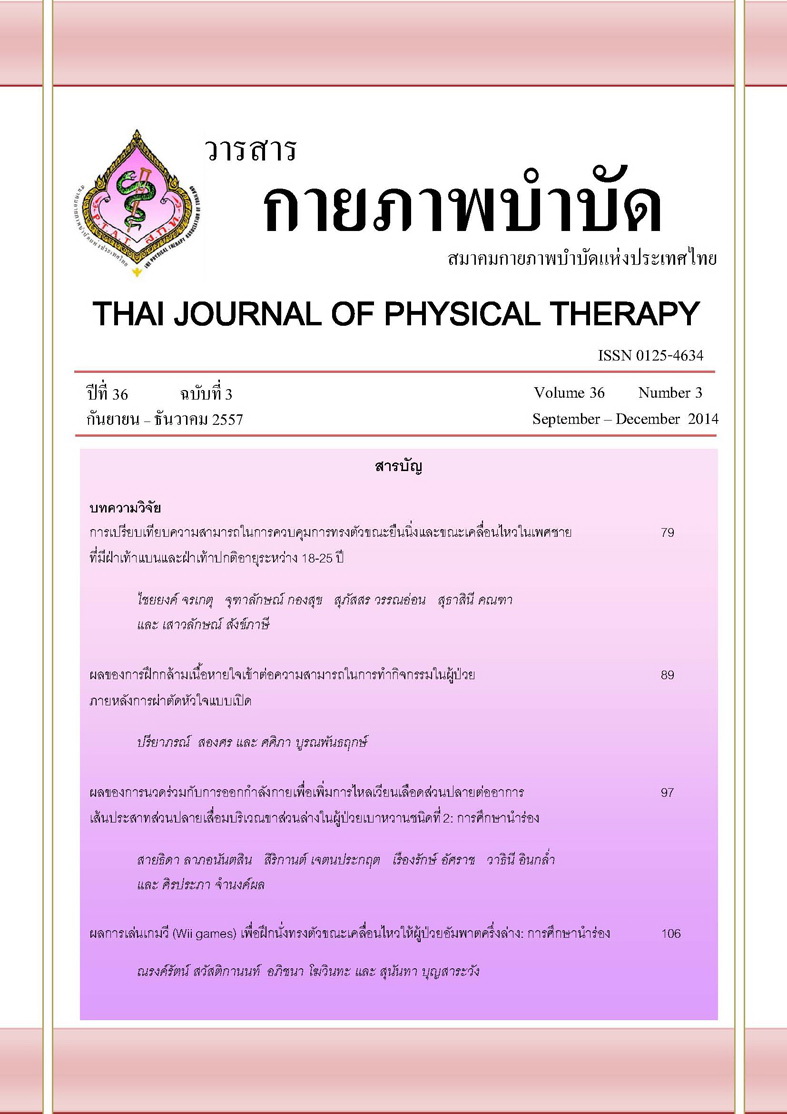
Comparisons of ability to control static and dynamic standing balances in male individuals with and without flat foot aged between 18–25 years
Article Sidebar
Main Article Content
Abstract
Deformation of joint structures in flat foot individual was hypothesized to be a cause of ankle joint instability. Objective: To compare the ability to control static and dynamic ankle joint stability between flat foot and normal foot individuals. Methods: Healthy male volunteers with normal (n=15) and without flatfoot (n=15) were measured static ankle joint stability with one leg standing test (OLS) and dynamic ankle joint stability with functional reach test (FRT) and multiple directional reach test (MRT). Independent-t-test and Mann Whitney U test were used to analyze the data. Results: No differences between two groups were found in three conditions including the OLS test (eyes open: 14.84±9.48s VS.20.01±9.86s, eyes closed: 3.06±1.87s VS.3.82±2.18s), the FRT test (10.13±3.25 in VS. 11.91±1.98in) and the MRT test for left side (6.71±2.02in VS.7.49±1.11in), but there was significant difference in the MRT test values for right side (6.62±1.74in VS.8.10±1.43in, p<0.05). Conclusion: The ability to control static ankle joint stability in healthy male individuals with and without flat foot was not different. Statistically significant difference in dynamic ankle stability control between normal and flatfoot individuals may not be clinically significant.
Article Details
References
2. Gutierrez GM, Kaminski TW, Douex AT. Neuromuscular Control and Ankle Instability. PM R 2009; 1(4): 359-65.
3. Hertel J. Functional Anatomy, pathomechanics, and pathophysiology of lateral ankle instability. J Athl Train 2002; 37(4): 364-75.
4. Riemann BL, Lephart SM.Sensorimotor system, part II: the role of proprioception in motor control and functional joint stability. J Athl Train 2002; 37(1): 80-4.
5. Pijnenburg AC, Van Dijk CN, Bossuyt PM, Marti RK. Treatment of ruptures of the lateral ankle ligaments: a meta-analysis. J Bone Joint Surg Am 2000; 82(6): 761-73.
6. Jonsson E, Seiger A, Hirschfeld H. One-leg stance in healthy young and elderly adults: a measure of postural steadiness? Clin Biomech (Bristol, Avon) 2004; 19(7): 688-94.
7. Hunt AE, Smith RM. Mechanics and control of the flat versus normal foot during the stance phase of walking. Clin Biomech 2004; 19: 391-7.
8. Fan Y, Fan Y, Li Z, Lv C, Luo D. Natural gaits of the non-pathological flat foot and high-arched foot. PLoS ONE 2011; 6(3); e17749.
9. Chang H-W, Chieh H-F, Lin-C-J, Su FC, Tsai M-J. The relationship between foot arch volumes and dynamic plantar pressure during midstance of walking in preschool children. PLoS ONE 2014; 9(4): e94535.
10. Barry RJ, Scranton PE Jr. Flat feet in children. Clin Orthop Relat Res 1983; (181):68-75.
11. Rao UB, Joseph B. The influence of footwear on the prevalence of flat foot: a survey of 2,300 children. J Bone Joint Surg Br 1992; 74: 525-7.
12. สุจิตรา บุญหยง. ผลของการเสริมอุ้งเท้าด้านในต่อรูปแบบการกระจายของแรงใต้ฝ่าเท้าในเท้าแบนที่ปรับตัวได้และไม่มีอาการ [วิทยานิพนธ์ / วิทยาศาสตรมหาบัณฑิต (กายภาพบำบัด)]. กรุงเทพมหานคร: บัณฑิตวิทยาลัยมหาวิทยาลัยมหิดล;1998.
13. Hertel J, Gay MR, Denegar CR. Differences in postural control during single-leg stance among healthy individuals with different foot types. J Athl Train 2002; 37: 129-32.
14. Cote KP, Brunet ME, Gansneder BM, Shultz SJ. Effects of pronated and supinated foot postures on static and dynamic postural stability. J Athl Train 2005; 40: 41-6.
15. Lin CW, Hiller CE, de Bie RA. Evidence-based treatment for ankle injuries: a clinical perspective. J Man Manip Ther 2010; 18: 22-8.
16. Murley GS MH, Landorf KB. A protocal for classifying normal and flat-arched foot posture for research studies using clinical and radiographic measurements. J Foot Ankle Res 2009; 2: 22.
17. Springer BA, Marin R, Cyhan T, Roberts H, Gill NW. Normative values for the unipedal stance test with eyes open and closed. J Geriatr Phys Ther 2007; 30: 8-15.
18. Duncan PW, Weiner DK, Chandler J, Studenski S. Functional reach: a new clinical measure of balance. J Gerontol 1990; 45: M192-7.
19. Newton RA. Validity of the multi-directional reach test: a practical measure for limits of stability in older adults. J Gerontol A Biol Sci Med Sci 2001; 56: M248-52.
20. Robert A, Donatelli. The Biomechanics of the foot and ankle. Philadelphia: FA Davis Company. 1996: 91-5, 104-5, 180-1.
21. Camicioli R,Moore MM, Sexton G,Howieson DB,Kaye JA. Age-related brain changes associated with motor function in healthy older people. J Am Geriatr Soc 1999; 47 (3): 330-4.
22. Hertel J. Sensorimotor deficits with ankle sprains and chronic ankle instability. Clin Sports Med 2008; 27: 353-70.
