
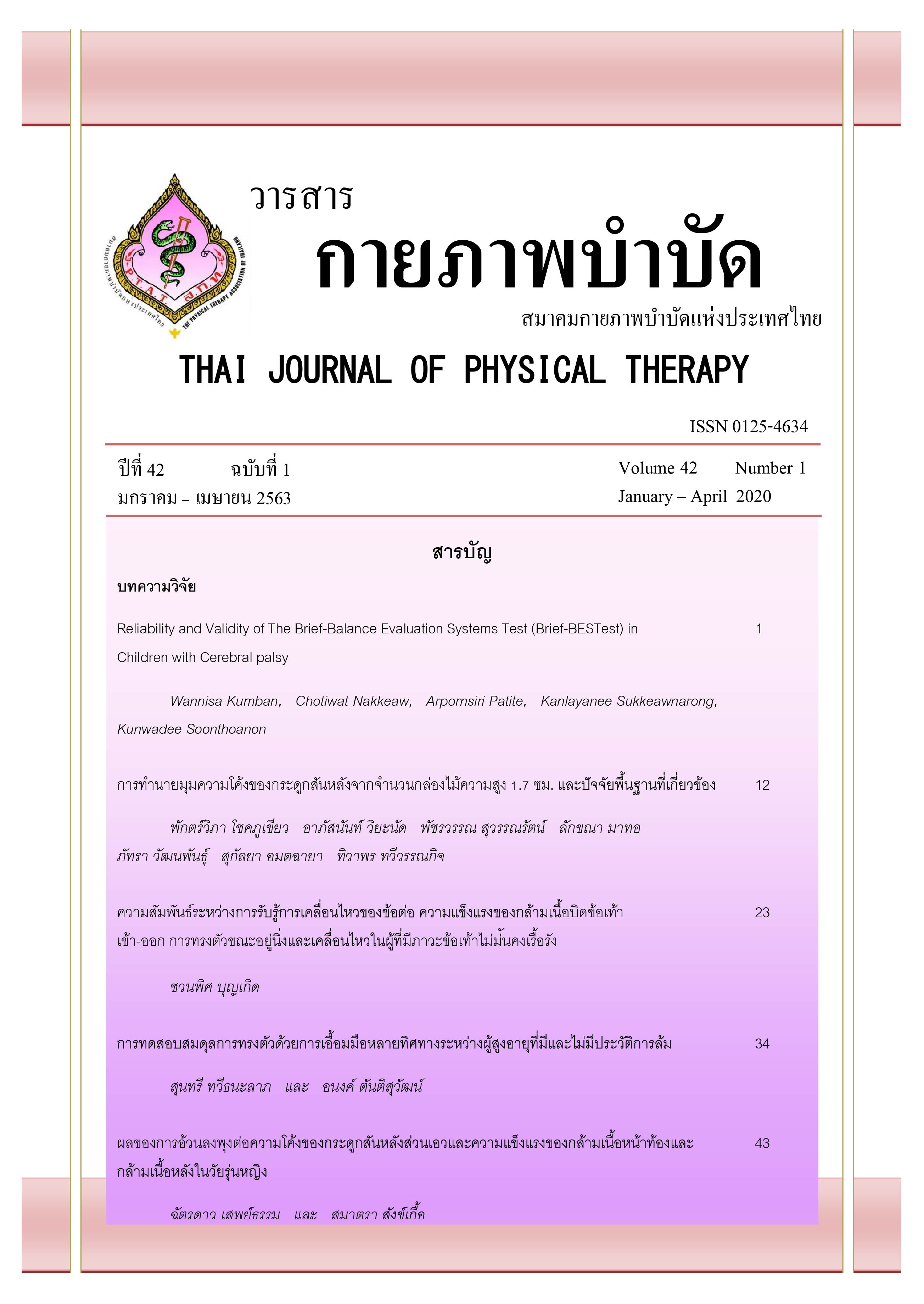
Prediction of kyphosis angle from the number of 1.7-cm block and related basic factors
Article Sidebar
Main Article Content
Abstract
Background: The 1.7-cm block is a simple method to evaluate kyphosis. The outcomes are reported as the number of block which is different to the others with kyphosis angle. Therefore, the study of equation to predict the kyphosis angle from the number of block and related basic factors might be more convenient for assessment.
Objective: To determine a predictive equation of kyphosis angle from the number of 1.7-cm block and related basic factors.
Methods: The study was cross-sectional collected data in 62 participants with kyphosis who aged at least 10 years. The participants were recorded the data of age, gender, height, weight, and kyphosis assessment using the 1.7-cm block. Then, within 7 days apart, the participants were taken a radiography. The multiple linear regression was utilized to analyze a predictive equation of kyphosis angle.
Results: The basic factors related kyphosis angle included gender, the number of 1.7-cm block, height, and weight. The predictive equation was 114.81 – 9.66 (gender) + 4.32 (block) – 0.45 (height) – 0.26 (weight) which the ability of prediction was 64%.
Conclusion: This study reported predictive ability of the equation as a moderate level which might have other related factors to kyphosis angle, for example posture and activities in daily living. Therefore, further study should investigate such these factors for more effective implication.
Article Details
References
Ailon T, Shaffrey CI, Lenke LG, Harrop JS, Smith JS. Progressive spinal kyphosis in the aging population. Neurosurg. 2015; 77(4): 164-72.
Katzman WB, Wanek L, Shepherd JA, Sellmeyer DE. Age-related hyperkyphosis: its causes, consequences, and management. J Orthop Sports Phys Ther. 2010; 40(6): 352-60.
Cutler WB, Friedmann E, Genovese-Stone E. Prevalence of kyphosis in a healthy sample of pre- and postmenopausal women. Am J Phys Med Rehabil. 1993; 72(4): 219-25.
Kado DM. The rehabilitation of hyperkyphotic posture in the elderly. Eur J Phys Rehabil Med. 2009; 45(4): 583-93.
Eslami S, Hemati J. Prevalence lordosis and dorsal kyphosis deformity among girls 23-11 years and its relationship to selected physical factors. Intl J Sport Std. 2013; 3(9): 924-9.
Sedrez JA, da Rosa MI, Noll M, Medeiros FS, Candotti CT. Risk factors associated with structural postural changes in the spinal column of children and adolescents. Rev Paul Pediatr. 2015; 33(1): 72-81.
Lewis JS, Valentine RE. Clinical measurement of the thoracic kyphosis: a study of the intra-rater reliability in subjects with and without shoulder pain. BMC Musculoskelet Disord. 2010; 11(39): 1-7.
Weon JH, Oh JS, Cynn HS, Kim YW, Kwon OY, Yi CH. Influence of forward head posture on scapular upward rotators during isometric shoulder flexion. J Bodyw Mov Ther. 2010; 14(4): 367-74.
Canales JZ, Cordas TA, Fiquer JT, Cavalcante AF, Moreno RA. Posture and body image in individuals with major depressive disorder: a controlled study. Rev Bras Psiquiatr. 2010; 32(4): 375-80.
Fadaee E, Seidi F, Minoei A. The relationship between forward shoulder posture and self esteem in non-athlete female students of Tehran University. Int J App Basic Med Res. 2015; 9(4): 583-6.
Kado DM, Prenovost K, Crandall C. Narrative review: hyperkyphosis in older persons. Ann Intern Med. 2007; 147(5): 330-8.
Bari MD, Chiarlone M, Matteuzzi D, Zacchei S, Pozzi C, Bellia V, et al. Thoracic kyphosis and ventilator dysfunction in unselected older persons: an epidemiological study in Dicomano, Italy. J Am Geriatr Soc. 2004; 52(6): 909-15.
Katzman WB, Vittinghoff E, Ensrud K, Black DM, Kado DM. Increasing kyphosis predicts worsening mobility in older community-dwelling women: a prospective cohort study. J Am Geriatr Soc. 2011; 59(1): 96-100.
Kado DM, Huang MH, Karlamangla AS, Barrett-Connor E, Greendale GA. Hyperkyphotic posture predicts mortality in older community-dwelling men and women: a prospective study. J Am Geriatr Soc. 2004; 52(10): 1662-7.
van der Jagt-Willems HC, de Groot MH, van Campen JPCM, Lamoth CJC, Lems WF. Associations between vertebral fractures, increased thoracic kyphosis, a flexed posture and falls in older adults: a prospective cohort study. BMC Geriatrics. 2015; 15(34): 1-6.
Tran TH, Wing D, Davis A, Bergstrom J, Schousboe JT, Nichols JF. Correlations among four measures of thoracic kyphosis in older adults. Osteoporos Int. 2016; 27(3): 1255-9.
Azadinia F, Kamyab M, Behtash H, Saleh Ganjavian M, Javaheri MR. The validity and reliability of noninvasive methods for measuring kyphosis. J Spinal Disord Tech. 2014; 27(6): E212-8.
Perriman DM, Scarvell JM, Hughes AR, Ashman B, Lueck CJ, Smith PN. Validation of the flexible electrogoniometer for measuring thoracic kyphosis. Spine. 2010; 35(14): 633-40.
Barrett E, McCreesh K, Lewis J. Reliability and validity of non-radiographic methods of thoracic kyphosis measurement: a systematic review. Man Ther. 2014; 19(1): 10-7.
Huang MH, Barrett-Connor E, Greendale GA, Kado DM. Hyperkyphotic posture and risk of future osteoporotic fractures: the Rancho Bernardo study. J Bone Miner Res. 2006; 21(3): 419-23.
Wongsa S, Amatachaya P, Saengsuwan J, Amatachaya S. Concurrent validity of occiput-wall distance to measure kyphosis in communities. J Clin Trials. 2012; 2(2): 1-3.
Tizabi AAT, Mahdavinejad R, Azizi A, Jafarnejadgero T, Sanjari M. Correlation between height, weight, BMI with standing thoracic and lumbar curvature in growth ages. World J Sport Sci. 2012; 7(1): 54-6.
Plichta SB, Garzon LS. Statistics for nursing and allied health. United States of America: Wolters Kluwer Helth, 2009: 352.
Wu W, Liang J, Du Y, Tan X, Xiang X, Wang W, et al. Reliability and reproducibility analysis of the Cobb angle and assessing sagittal plane by computer-assisted and manual measurement tools. BMC Musculoskelet Disord. 2014; 15: 1-8.
Suwannarat P, Wattanapan P, Wiyanad A, Chokphukiao P, Wilaichit S, Amatachaya S. Reliability of novice physiotherapists for measuring Cobb angle using a digital method. Hong Kong Physio Ther J. 2017; 37: 34-8.
Fon GT, Pitt MJ, Thies AC. Thoracic kyphosis: range in normal subjects. Am J Roentgenol. 1980; 134(5): 979-83.
Katzman WB, Huang MH, Lane NE, Ensrud KE, Kado DM. Kyphosis and decline in physical function over 15 years in older community-dwelling women: the Study of Osteoporotic Fractures. J Gerontol A Biol Sci Med Sci. 2013; 68(8): 976-83.
Telford RM, Telford RD, Olive LS, Cochrane T, Davey R. Why are girls less physically active than boys? findings from the LOOK Longitudinal Study. PLoS One. 2016; 11(3): 1-11.
Popat VB, Calis KA, Vanderhoof VH, Cizza G, Reynolds JC, Sebring N, et al. Bone mineral density in estrogen-deficient young women. J Clin Endocrinol Metab. 2009; 94(7): 2277-83.
Sinaki M, Itoi E, Rogers JW, Bergstralh EJ, Wahner HW. Correlation of back extensor strength with thoracic kyphosis and lumbar lordosis in estrogen-deficient women. Am J Phys Med Rehabil. 1996; 75(5): 370-4.
Fotiadis E, Kenanidis E, Samoladas E, Christodoulou A, Akritopoulos P, Akritopoulou K. Scheuermann’s disease: focus on weight and height role. Eur Spine. 2008; 17(5): 673-8.
Aulisa AG, Falciglia F, Giordano M, Mastantuoni G, Poscia A, Guzzanti V. Conservative treatment in Scheuermann’s kyphosis: comparison between lateral curve and variation of the vertebral geometry. Scoliosis Spinal Disord. 2016; 11(33): 20-3.
Rabieezadeh A, Hovanloo F, Khaleghi M, Akbari H. The relationship of height, weight and body mass index with curvature of spine kyphosis and lordosis in 12-15-year old male adolescents of Tehran. Turk J Sport Exe. 2016; 18(3): 42-6.
Katzman WB, Harrison SL, Fink HA, Marshall LM, Orwoll E, Barrett-Connor E, et al. Physical function in older men with hyperkyphosis. J Gerontol A Biol Sci Med Sci. 2015; 70(5): 635-40.
