
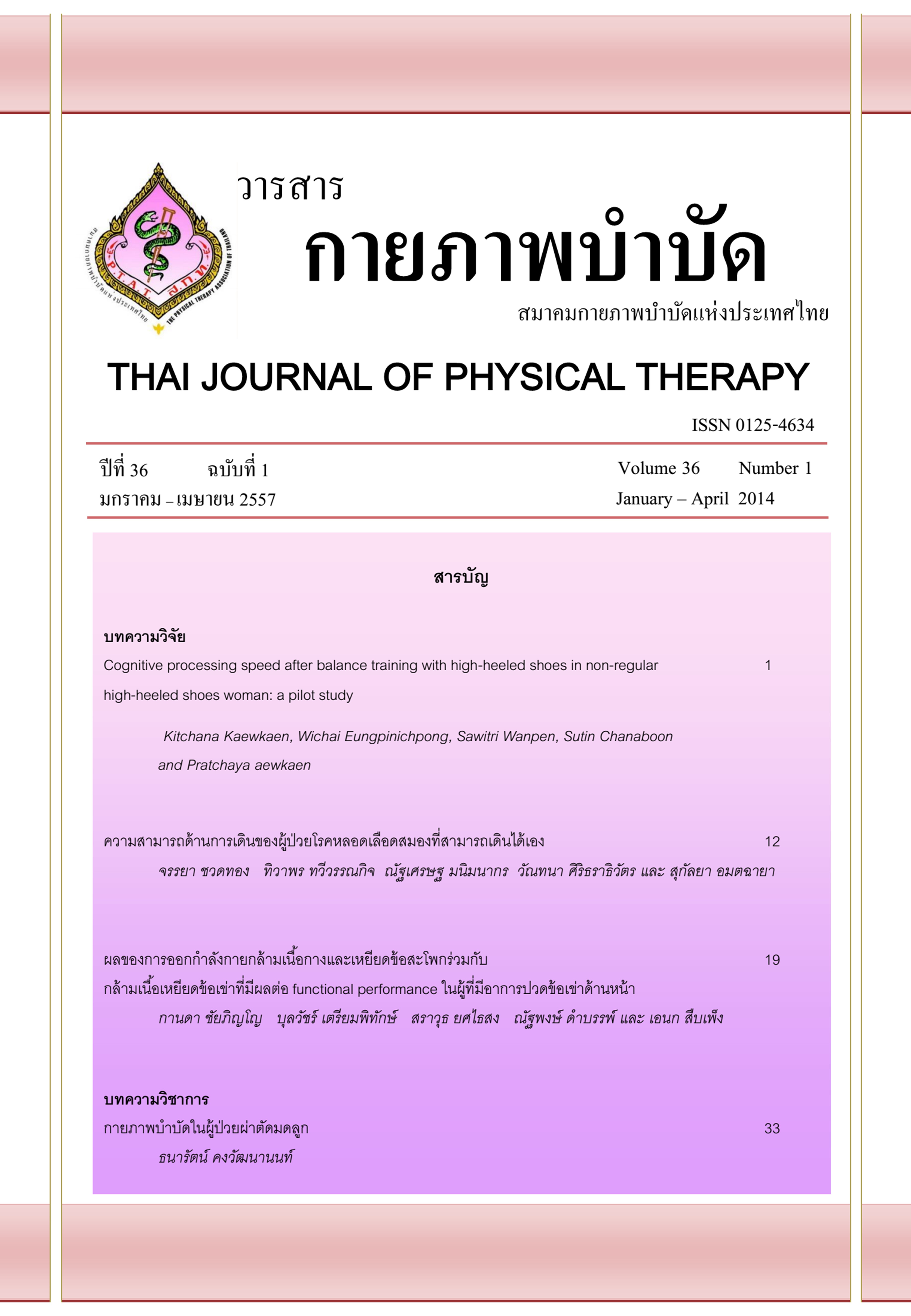
Cognitive processing speed after balance training with high-heeled shoes in non-regular high-heeled shoes woman: a pilot study
Article Sidebar
Main Article Content
Abstract
Dual task in daily life decrease the postural control and cognitive performance. Many studies showed improvement in postural control under dual task condition after training but no studies investigated the cognitive performance after training. Wearing high-heeled shoes to work which was used cognitive task while working lead to a decreased postural stability and/or cognitive performance. This is especially true for the non-regular high-heeled shoes wearers who could experience more effects on balance control at their beginning stage of wearing the shoes. The objectives of this study were 1) to examine the immediate effect of balance training with high-heeled shoes on cognitive processing speed of the non-regular high-heeled shoes wearers and 2) to compare the cognitive processing speed when balance training on high-heeled shoes between standing and sitting position. Ten healthy young women participated in this randomized crossover design study. The study consisted of 2 interventions which included balance training with high-heeled shoes in standing and balance training with high-heeled shoes in sitting. Each intervention consisted of 45-minute period of training with a 7-days washout period. The cognitive processing speed and sway path were tested before and immediately after the training. The results showed that after training, there was improvement in cognitive processing speed both interventions. However, there was no statistical significant different in cognitive processing speed and sway path between the two interventions. Further study with larger sample size is needed.
Article Details
References
2. Horak FB. Postural orientation and equilibrium: what do we need to know about neural control of balance to prevent falls? Age Ageing 2006; 35 Suppl 2: ii7-ii11.
3. Jacobs JV, Horak FB. Cortical control of postural responses. J Neural Transm 2007; 114: 1339-48.
4. Maki BE, McIlroy WE. Cognitive demands and cortical control of human balance-recovery reactions. J Neural Transm 2007; 114: 1279-96.
5. Ren J, Wu YD, Chan JSY, Yan JH. Cognitive aging affects motor performance and learning. Geriatr Gerontol Int 2013; 13: 19-27.
6. Schmidt RA, Lee TD. Motor control and learning: A Behavioral Emphasis. 5th ed. Human kinetics publishers, 2011.
7. Tombu M, Jolicoeur P. A central capacity sharing model of dual-task performance. J Exp Psychol Hum Percept Perform 2003; 29: 3-18.
8. Shumway-Cook A, Woollacott M. Motor control: translating research in to clinical practice. 4th ed. Lippincott Williams & Wilkins, 2012.
9. Prado JM, Stoffregen TA, Duarte M. Postural sway during dual tasks in young and elderly adults. Gerontology 2007;53: 274-81.
10. Al-Yahya E, Dawes H, Smith L, Dennis A, Howells K, Cockburn J. Cognitive motor interference while walking: a systematic review and meta-analysis. Neurosci Biobehav Rev 2011; 35: 715-28.
11. Andersson G, Hagman J, Talianzadeh R, Svedberg A, Larsen HC. Effect of cognitive load on postural control. Brain Res Bull 2002; 58: 135-9.
12. Srygley JM, Mirelman A, Herman T, Giladi N, Hausdorff JM. When does walking alter thinking? Age and task associated findings. Brain Res 2009; 1253: 92-9.
13. Silsupadol P, Lugade V, Shumway-cook A, Donkelaar PV, Chou LS, Mayr U, Woollacott M. Training-related changes in dual-task walking performance of elderly persons with balance impairment: a double-blind, randomized controlled trial. Gait Posture 2009; 29: 634-9.
14. Fritz NE, Basso DM. Dual-task training for balance and mobility in a person with severe traumatic brain injury: a case study. J Neurol Phys Ther 2013; 37: 37-43.
15. Taubert M, Villringer A, Ragert P. Learning-related gray and white matter changes in humans: an update. Neuroscientist 2012; 18: 320-5.
16. Kitago T, Krakauer JW. Motor learning principles for neurorehabilitation. Handb Clin Neurol 2013; 110: 93-103.
17. Gefen A, Megido-Ravid M, Itzchak Y, Arcan M. Analysis of muscular fatigue and foot stability during high-heeled gait. Gait Posture 2002; 15: 56-63.
18. Kim Y, Lim JM, Yoon B. Changes in ankle range of motion and muscle strength in habitual wearers of high-heeled shoes. Foot Ankle Int 2013; 34: 414-9.
19. Lee CM, Jeong EH, Freivalds A. Biomechanical effects of wearing high-heeled shoes. International Journal of Industrial Ergonomics. 2001; 28: 321-6.
20. Gerber SB, Costa RV, Grecco LAC, Pasini H, Marconi NF, Oliveira CS. Interference of high-heeled shoes in static balance among young women. Hum Mov Sci 2012; 31: 1247-52.
21. Schaefer S, Lindenberger U. Thinking while walking: experienced high-heel walkers flexibly adjust their gait. Front Psychol. 2013; 4: 316-22.
22. Kaewkaen K, Eungpinichpong W, Wanpen S. The immediate effect of balance training on high heel shoes on cognitive performance of the non regular high-heel shoe wearers while balancing in high-heel shoes: a pilot study. Proceedings of international graduate research conference 2013; 2013 Dec 20; Chiang Mai University, Chiang Mai. 2013.
23. Silsupadol P, Siu K-C, Shumway-Cook A, Woolacott M. Training of balance under single- and dual-task conditions in older adults with balance impairment. Phys Ther. 2006; 86: 269-81.
24. Bauer JM, Bohlin E. From static to dynamic regulation recent developments in U.S. telecommunications policy. Intereconomics: Review of European Economic Policy. 2008; 43: 38-50.
25. Jonsson E, Seiger A, Hirschfeld H. Postural steadiness and weight distribution during tandem stance in healthy young and elderly adults. ClinBiomech (Bristol, Avon). 2005; 20: 202-8.
26. Clark RA, Bryant AL, Pua Y, McCrory P, Bennell K, Hunt M. Validity and reliability of the Nintendo Wii Balance Board for assessment of standing balance. Gait Posture. 2010; 31: 307-10.
27. Roerdink M, Hlavackova P, Vuillerme N. Center-of-pressure regularity as a marker for attentional investment in postural control: a comparison between sitting and standing postures. Hum Mov Sci 2011; 30: 203-12.
28. Donker SF, Roerdink M, Greven AJ, Beek PJ. Regularity of center-of-pressure trajectories depends on the amount of attention invested in postural control. Exp Brain Res 2007; 181: 1-11.
29. van Veen V, Krug MK, Carter CS. The neural and computational basis of controlled speed-accuracy tradeoff during task performance. J Cogn Neurosci 2008; 20: 1952-65.
30. Woollacott M, Shumway-Cook A. Attention and the control of posture and gait: a review of an emerging area of research. Gait Posture 2002; 16: 1-14.
