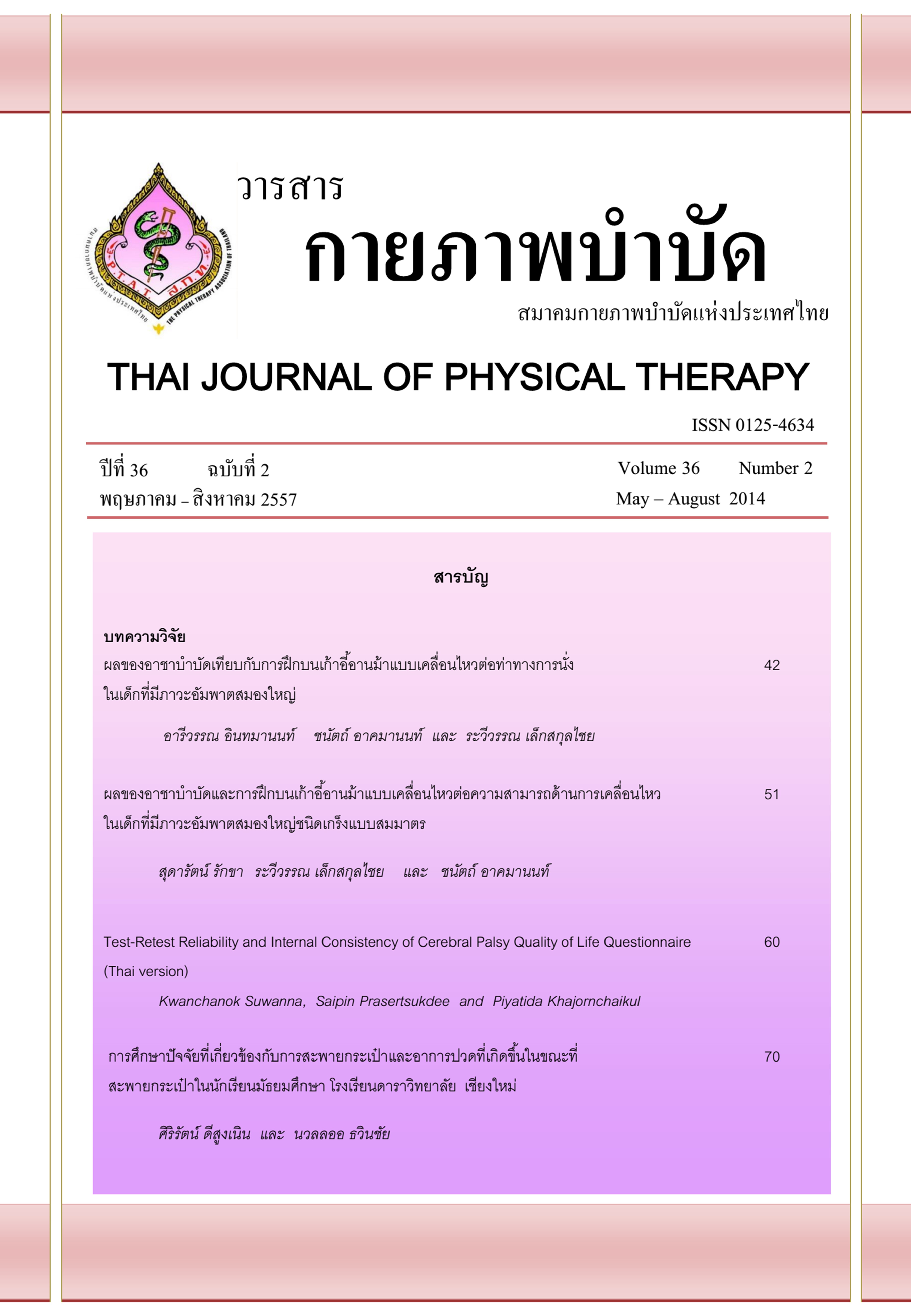
INFLUENCE OF HIPPOTHERAPY VERSUS DYNAMIC SADDLE SEAT TRAINING ON SITTING POSTURE IN CHILDREN WITH CEREBRAL PALSY
Article Sidebar
Main Article Content
Abstract
Most children with cerebral palsy (CP) have problems in controlling pelvic movements that cause them to sit with thoracic kyphosis and lead to limited upper limb functions. Therefore training methods to stimulate pelvic movements using hippotherapy (HP) and dynamic saddle seat (DS) have been introduced. These methods used characteristics of horse’s walking to facilitate pelvic motion of the rider which is similar to human walking. The objective of this study was to compare angles of hip flexion and pelvic tilt between two groups of children with CP, 5 in each group, who received six weeks of hippotherapy versus dynamic saddle seat training. The results of this study found no difference in pelvic tilt angle between two groups at baseline, 3rd and 6th week but significant difference in hip flexion angle was found at 6th week post training (p= 0.009). Participants in HP group could flex hip during sitting on bench than DS group. In addition, significant differences in hip flexion and pelvic tilt angles between baseline and the 6th week post training were found within HP and DS groups. Thus, it could be concluded that 6 weeks of hippotherapy or dynamic saddle seat training were adequate for improving hip flexion and pelvic tilt angles which affected sitting posture in children with CP.
Article Details
References
2. Granados AC, Agís IF. Why children with special needs feel better with hippotherapy sessions: a conceptual review. Journal Altern Complement Med. 2011: 17(3); 191- 7.
3. Shurtlef TL, Standeven JW, Engsberg JR. Changes in dynamic trunk/head stability and functional reach after hippotherapy. Arch Phys Med Rehabil. 2009: 90; 1185- 95.
4. Bertoti DB. Effect of therapeutic horseback riding on posture in children with cerebral palsy. Phys Ther. 1988: 68; 1505- 12.
5. Encheff JL, Armstrong C, Masterson M et al. Hippotherapy effects on trunk, pelvic, and hip motion during ambulation in children with neurological impairments. Pediatr Phys Ther. 2012; 24(3): 242- 50.
6. Silkwood-Sherer DJ, Killian CB, Long TM et al. Hippotherapy- an intervention to habilitate balance deficits in children with movement disorders: a clinical trial. Phys Ther. 2012; 92(5): 707- 17.
7. Chung J, Evans J, Lee C et al. Effectiveness of adaptive seating on sitting posture and postural control in children with cerebral palsy. Pediatr Phys Ther. 2008; 20(4):303- 17.
8. Sprigle S, Wootten M, Bresler M, Flinn N. Development of noninvasive measure of pelvic and hip angle in seat posture. Arch Phys Med Rehabil. 2002; 83(11):1597- 602.
9. Sprigle S, Flinn N, Wootten M, McCorry S. Development and testing of a pelvic goniometer designed to measure pelvic tilt and hip flexion. Clin Biomech. 2003; 18(5): 462- 5.
10. McGibbon NH, Andrade CK, Widener G et al. Effect of an equine movement therapy program on gait energy expenditure, and motor function in children with spastic cerebral palsy: a pilot study. Dev Med Child Neurol. 1998; 40: 754- 62.
