
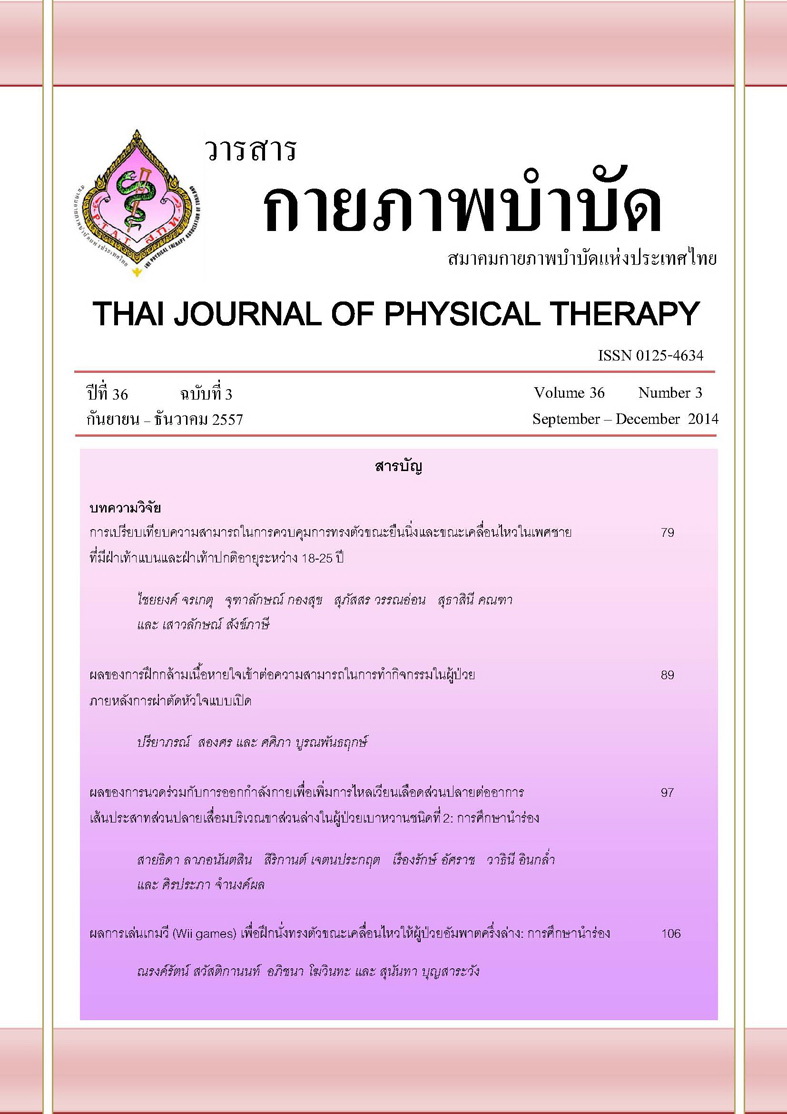
Effect of massage with peripheral vascular circulation exercise on neuropathic symptoms of lower legs in type 2 diabetic patients: a pilot study
Article Sidebar
Main Article Content
Abstract
Peripheral neuropathy is usually found in diabetes because a chronic high blood sugar level damages the blood vessels that supply to nerves. This causes sensation impairment and muscle weakness. From literature review, massage and exercise can improve blood circulation and exercise also helps to reduce blood sugar. Therefore, the study aims to determine the effects of massage with exercise for improving peripheral vascular circulation on neuropathic symptoms of lower limbs in Type 2 Diabetes. Thirteen volunteers with diabetic peripheral neuropathy (DPN), mean age 59.92±8.45 yrs, were randomized to 2 groups; 1) massage (n=9), and 2) massage with exercise (n=4). All participants were assessed neuropathic symptoms by the Michigan Neuropathy Screening Instrument (MNSI) and muscle forces of ankle dorsiflexor (DF) and plantar flexor (PF) by hand-held dynamometer before enrolled in the study. The massage group (M) was taught how to massage their feet and lower legs by themselves (40 min/time). The massage with exercise group (ME) was taught how to massage and exercise by themselves (15 min of massage plus 25 min of exercise, total 40 min/time). Both groups did the intervention as a home-program 3 times a week for 4 weeks. After 4 weeks, the MNSI, DF and PF were re-assessed. The Wilcoxon matched-pairs signed-ranks test was used to compare data within group between pre-post training. The Mann-Whitney U test was used to compare data between groups. At post-training, the MNSI scores were significantly reduced, comparing with pre-training, in both M and ME (p=0.004 and p=0.034 respectively), but there was no difference between groups. An increase in the PF force after training of ME was more than that of M significantly (p=0.045), while a significant increase in the DF force after training was found only in ME group (p=0.034). This pilot study found that massage relieved DPN symptoms in terms of sensory improvement. Whereas, the massage with exercise protocol of this study improved sensation and also forces of DF and PF significantly. However, it should be confirmed the study in a larger sample size for the more reliable results.
Article Details
References
2. สำนักระบาดวิทยากรมควบคุมโรคกระทรวงสาธารณสุข. Clinical Complication in type 2 diabetic patients 2554; 2012 [cited 2014 Oct 29]. Available from: http://www.dms.moph. go.th/imrta/images/aw.pdf.
3. Edwards JL, Vincent AM, Cheng HT, Feldman EL. Diabetic neuropathy: mechanisms to management. Pharmacol Ther, 2008; 120: 1-34.
4. Callaghan BC, Cheng HT, Stables CL, Smith AL, Feldman EL. Diabetic neuropathy: clinical manifestations and current treatments. Lancet Neurol, 2012; 11: 521-34.
5. Dinh TL, Veves A. A review of the mechanisms implicated in the pathogenesis of the diabetic foot. Int J Low Extrem Wounds, 2005; 4: 154-9.
6. Edwards BG, Palmer J. Effects of massage therapy on African Americans with type 2 diabetes mellitus: apilot study. Complementary Health Practice Review, 2010; 15: 149-55.
7. สุวัฒน์ ธนกรนุวัฒน์, Hua W, Ping F, Jiakang L, Fengxia L, Bangguo C และคณะ. ประสิทธิผลของการฝังเข็มรักษาอาการชาปลายเท้าในผู้ป่วยเบาหวาน. วารสารการแพทย์แผนไทยและการแพทย์ทางเลือก, 2555; 10: 177-86.
8. Weerapong P, Hume PA, Kolt GS. The mechanisms of massage and effects on performance, muscle recovery and injury prevention. Sports Med, 2005; 35: 235-56.
9. Kurth-Kraczek EJ, Hirshman MF, Goodyear LJ, Winder WW. 5' AMP-activated protein kinase activation causes GLUT4 translocation in skeletal muscle. Diabetes, 1999; 48: 1667-71.
10. American Diabetes Association. Diabetes mellitus and exercise. Diabetes Care, 2002; 25(suppl1): 564-8.
11. Kluding PM, Pasnoor M, Singh R, Jernigan S, Farmer K, Rucker J, et al. The effect of exercise on neuropathic symptoms, nerve function, and cutaneous innervation in people with diabetic peripheral neuropathy. J Diabetes Complications, 2012; 26: 424-9.
12. Balducci S, Iacobellis G, Parisi L, Di Biase N, Calandriello E, Leonetti F, et al. Exercise training can modify the natural history of diabetic peripheral neuropathy. J Diabetes Complications, 2006; 20: 216-23.
13. Mueller MJ, Tuttle LJ, Lemaster JW, Strube MJ, McGill JB, Hastings MK, et al. Weight-bearing versus nonweight-bearing exercise for persons with diabetes and peripheral neuropathy: a randomized controlled trial. Arch Phys Med Rehabil, 2013; 94: 829-38.
14.Hamburg NM, Balady GJ. Exercise rehabilitation in peripheral artery disease: functional impact and mechanisms of benefits. Circulation, 2011; 123: 87-97.
15. Kisner C, Colby LA. Therapeutic exercise: foundations and techniques. 2nd ed. Singapore: Info Access & Distribution; 1991.
16. Herman WH, Pop-Busui R, Braffett BH, Martin CL, Cleary PA, Albers JW, et al. Use of the Michigan neuropathy screening instrument as a measure of distal symmetrical peripheral neuropathy in type 1 diabetes: results from the diabetes control and complications trial/epidemiology of diabetes interventions and complications. Diabet Med, 2012; 29: 937-44.
17. MNSI, Michigan University. 2000 [cited 2014Oct29] Available from: http://www.med. umich.edu/mdrtc/profs/documents/svi/MNSI_ patient.pdf.
18. Moghtaderi A, Bakhshipour A, Rashidi H. Validation of Michigan neuropathy screening instrument for diabetic peripheral neuropathy. Clin Neurol Neurosurg, 2006; 108: 477-81.
19. จิตต์สกุล ศกุนะสิงห์. ประสิทธิผลของการนวดเท้าในผู้ป่วยเบาหวานที่มีอาการเท้าชา. วารสารโรงพยาบาลร้อยเอ็ด, กาฬสินธุ์, มหาสารคาม, 2012; 19: 36-44
20. Jeanette E, Thomas D. Is massage useful in the management of diabetes? Diabetic spectrum, 2001; 14: 218-224.
21. ประโยชน์ บุญสินสุข. การบำบัดด้วยมือ Manual Therapy. พิมพ์ครั้งที่1. กรุงเทพฯ: เอสพีการพิมพ์; 2552: 46-74.
22. Downer S, Mattacola C. Isometric muscle-force measurements obtained by handheld dynamometry. Athletic Therapy Today, 2003; 3: 38-40.
23. สมลักษณ์ หนูจันทร์, สมชาย รัตนทองคำ. ผลการนวดไทยและการกดจุดต่ออาการชาปลายเท้าในผู้ป่วยเบาหวาน: ศึกษากรณีที่สถานีอนามัยบ้านโพนสว่างตำบลจรเข้ อำเภอหนองเรือ จังหวัดขอนแก่น. J Med Tech Phys Ther, 2008; 20: 139-47.
24. Cole JD, Sedgwick EM. The perceptions of force and of movement in a man without large myelinated sensory afferents below the neck. J Physiol, 1992; 449: 503-15.
25. Ward RE, Caserotti P, Faulkner K, Boudreau RM, Zivkovic S, Lee C, et al. Peripheral nerve function and lower extremity muscle power in older men. Arch Phys Med Rehabil, 2014; 95: 726-33.
26. Patten C, Kamen G. Adaptations in motor unit discharge activity with force control training in young and older human adults. Eur J Appl Physiol, 2000; 83: 128-43.
27. Clamann HP. Motor unit recruitment and the gradation of muscle force. Phys Ther, 1993; 73: 830-43.
