
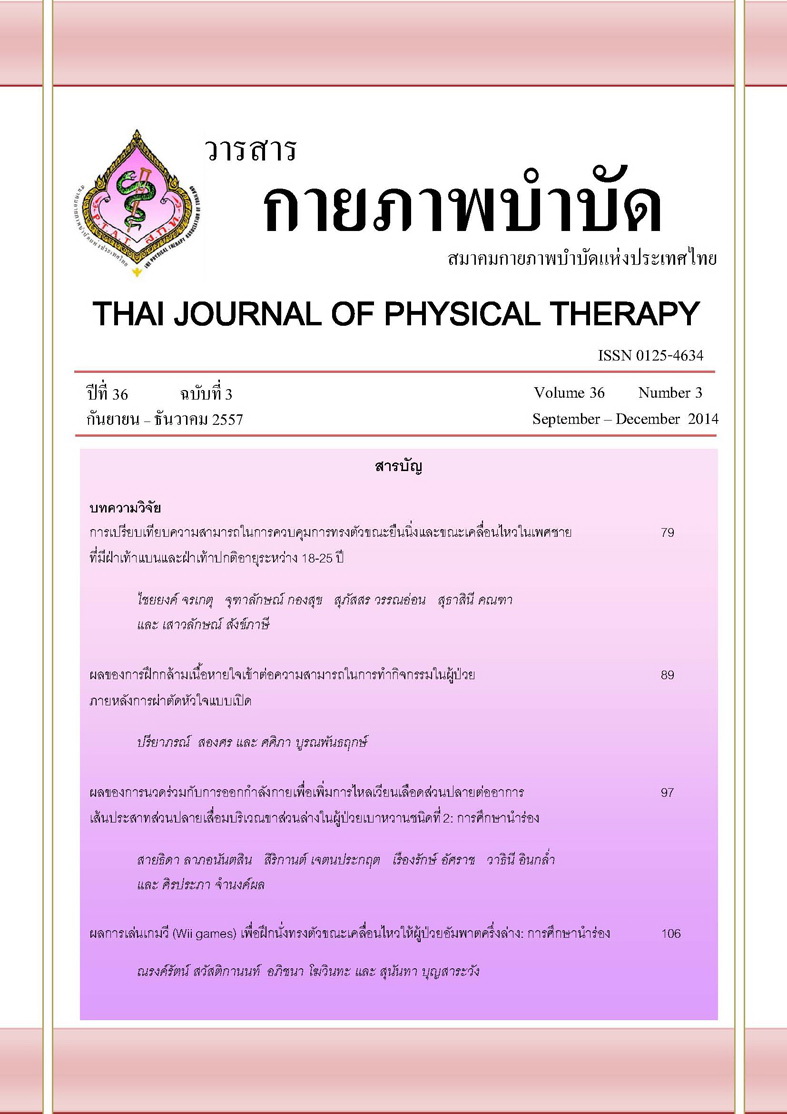
Effects of playing Wii games for dynamic sitting balance training in paraplegic patients: a pilot study
Article Sidebar
Main Article Content
Abstract
The objective of this pilot study was to compare the effectiveness in maintaining dynamic sitting Position between Wii games and a conventional sitting balance training in paraplegic patients. Eight patients with paraplegia(spinal cord injured T9-T12), ASIA impairment scale A or B, who can sit without hand support for at least 10 seconds and had poor sitting balance participated. They were randomized to either a control group (conventional program) or a study group (Wii games) for sitting balance training. Both trainings took 20 minutes per session, twice a day for 10 days. The modified maximal anterior balance range test (MMABRT) was administered to all participants pre- and post-training. The distances of MMABRT were compared between pre- and post-training for both within and between groups using non-parametric statistics. Results showed that there were no statistical significant differences of the MMABRT between pre- and post-training for both groups. In addition, there were no significant differences of the MMABRT between the two groups both at baseline and post-training. Findings from this pilot study suggests that 10-day balance training using either conventional method or Wii games did not improve the ability to move body in the anterior direction while sitting in patients with paraplegia who suffered from T9-T12 injuries and had ASIA impairment A or B. Due to small sample size and large variability of the data, further studies need to be conducted to confirm the study findings.
Article Details
References
2. Seelen HAM, Potter YJM, Drukkker J, Reulen JP, Pons C. Development of new muscle synergies in postural control in spinal cord injuryed subjects. J Electromyogr Kinesiol 1998; 8: 23-34.
3. Chen CL, Yeung KT, Bih LI, Wang CH, Chen MI, Chien JC. The relationship between sitting stability and functional performance in patients with paraplegia. Arch Phys Med Rehab 2003; 84: 1276-81.
4. Boswell-Ruys CL, Harvey LA, Barker JJ, Ben M, Middleton JW, Lord SR. Training unsupported sitting in people with chronic spinal cord injuries: a randomised controlled trial. Spinal Cord 2009; 48: 138-43.
5. Lord SR, Menz HB, Tiedemann A. A physiological profile approach to falls risk assessment and prevention. Phys Ther 2003; 83: 237-52.
6. Sturnieks DL, Arnold R, Lord SR. Validity and reliability of sway meter device for measuring postural sway. BMC Geriatrics 2011; 11: 63.
7. Wikipedia. Wii. Available at: URL:http://en.wikipedia.org/wiki/Wii/. Accessed May 26, 2010.
8. Shih CH, Shih CT, Chiang MS. A new standing posture detector to enable people with multiple disabilities to control environmental stimulation by changing their standing posture through a commercial Wii Balance Board. Res Dev Disabil 2010; 31: 281-6.
9. Mhatre PV, Vilares I, Stibb SM, Albert MV, Pickering L, Marciniak CM, Kording K, Toledo S. Wii fit balance board playing improves balance and gait in Parkinson disease. PM&R 2013; 5: 769-77.
10. Mombarg R, Jelsma D, Hartman E. Effect of Wii-intervention on balance of children with poor motor performance. Es Dev Disabil 2013; 34: 2996-3003.
11. O’Sullivan SB, Schmitz TJ. Physical rehabilitation: assessment and treatment. 5th ed. Philadelphia: F. A. Davis Company. 2007. p. 254.
12. Boswell-Ruys CL, Sturnieks DL, Harvey LA, Sherrington C, Middleton JW, Lord SR. Validity and Reliability of Assessment Tools for Measuring Unsupported Sitting in People With a Spinal Cord. Arch Phys Med Rehabil 2009; 90: 1571-7.
13. Seelen HAM, Potten YJM, Huson A, Spaans F, Reulen JPH. Impaired balance control in paraplegic subjects. J Electromyogr Kinesiol 1997; 7: 149-60.
