
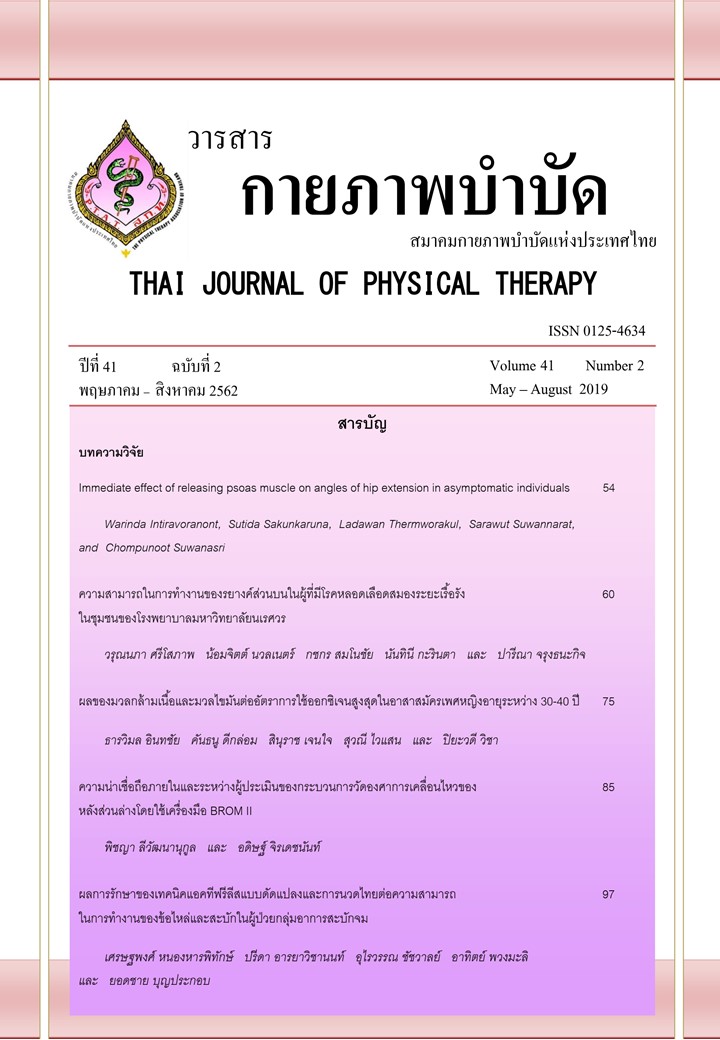
Immediate effect of releasing psoas muscle on angles of hip extension in asymptomatic individuals
Article Sidebar
Main Article Content
Abstract
Background: Releasing psoas muscle can reduce symptom in the lower back and hip pain. However, there has not been any study that evaluated the effect of releasing the psoas muscle to hip angle.
Objective: To evaluate the immediate effect of releasing psoas muscle on hip extension angles in asymptomatic subjects.
Methods: Thirty asymptomatic male and female subjects(aged 20.40 +0.10 years) received a battery of tests for physical assessment to investigate the psoas muscle tension. Participants have released the psoas muscle on the most tension side by soft tissue releasing technique, with optimal direct force to the muscle, hold for five seconds then released, ten times repeated. The angle of a hip extension was measured before and after releasing the psoas muscle.
Results: Significant increase of the hip extension angles were found between before and after releasing psoas muscles.
Conclusion: The results of this study demonstrated that releasing the psoas muscle increased the angle of hip extension in asymptomatic subjects.
Article Details
References
2. Quinn A. Hip and groin pain: Physiotherapy and rehabilitation issues. TOSMJ. 2010; 4:93-107.
3. Amir MA, Mohammad NR, Ali M. The relationship between hamstring length and gluteal muscle strength in individuals with sacroiliac joint dysfunction. J Man Manip Ther. 2011;19(1):5-10.
4. Nadler SF, Malanga GA, Feinberg JH, Prybicien M, Stitik TP, DePrince M. Relationship between hip muscle imbalance and occurrence of low back pain in collegiate athletes. A prospective study. Am J Phys Med Rehabil. 2001; 80:572-7.
5. McGill SM, Patt N, Norman RW. Measurement of the trunk musculature of active males using CT scan radiography: Implications for force and moment generating capacity about the L4/L5 joint. J Biomech.1988;21:329-41.
6. Gibbons SGT. The model of psoas major stability function. Proceedings of :1st International Conference on Movement Dysfunction. Edinburgh, Scotland. 2001; Sept. 21-3.
7. Myers TW. Anatomy trains. Myofascial meridians for manual and movement therapists. 2nd ed.Edinburgh: Churchill Livingston; 2009.
8. Bogduk N, Pearcy M, Hadfield G. Anatomy and biomechanic of psoas major. ClinBiomech.1992; 7: 109-19.
9. Andersson E, Oddsson L, Grundstrom H, Thorstensson A. The role of the psoas and iliacus muscles for stability and movement of the lumbar spine, pelvis and hip. Scand J Med Sci Sports. 1995; 5:10-6.
10. Janda V. Muscle strength in relation to muscle length, pain and muscle imbalance. In: Harms-Ringdahk K, editor. Muscle strength (International perspectives in physical therapy). Vol. 8. Edinburgh: Churchill Livingston; 1993.
11. Page P, Stewart G. Hamstring strength imbalances in athletes with chronic sacroiliac dysfunction. J Orthop Sports Phys Ther. 2000; 30(1): A-48.
12. Nahid KY, Majid M, Naser MR, Elke Z. Comparison of range of motion of knee and hip in athletes with and without patellofemoral pain syndrome. JRAS. 2014;1(3):70-7.
13. Kendall FP, McCreary EK, Provance PG. Muscle testing and function. 4thed. Baltimore: William & Wilkins; 1993.
14. Vigotsky AD, Lehman GJ, Beardsley C, Contreras B, Chung B, Feser EH.The modified Thomas test is not a valid measure of hip extension unless pelvic tilt is controlled. Peer J 2016;4: e2325.
15. Wakefield BC, Halls A, Difilippo N, Cottrell TG. Reliability of goniometric and trigonometric techniques for measuring hip-extension range of motion using the Modified Thomas test. J Athl Train. 2015; 50(5): 460–6.
16. Holm I, Bolstad B, Lutken T, Ervik A, Rokkum M, Steen H. Reliability of goniometric measurements and visual estimates of hip ROM in patients with osteoarthrosis. Physiother Res Int. 2000;5(4): 241–8.
