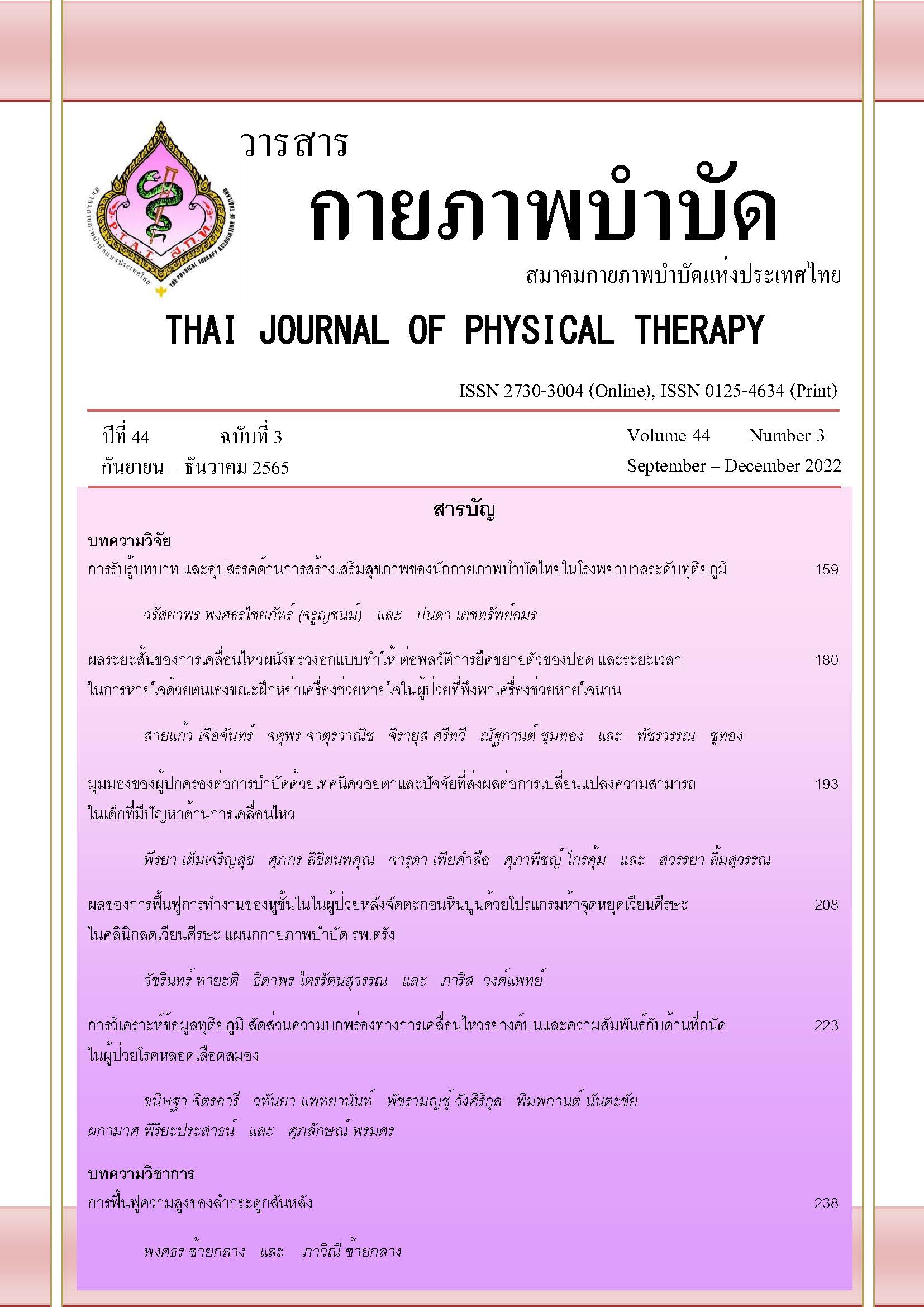
Short effect of passive chest mobilization exercise on dynamic lung compliance and spontaneous breathing time during weaning period in prolonged mechanical ventilation patients
Article Sidebar
Main Article Content
Abstract
Background: Passive chest mobilization leads to a change in the muscle length of the thoracic wall and may result in increased lung compliance in prolonged mechanical ventilation patients.
Objective: To investigate the effect of passive chest mobilization on dynamic lung compliance and spontaneous breathing time during weaning in prolonged mechanical ventilation patients.
Methods: Twenty prolonged mechanical ventilation patients were randomly divided into two groups. Ten patients in the intervention group (mean age: 62.90 ± 29.43 years) received passive chest mobilization 30 times per set, 3 sets per day, for 5 days combined with conventional chest physical therapy (deep breathing exercise, percussion vibration postural drainage and suction). Ten patients in the control group (mean age 65.30 ± 21.33 years) received only conventional chest physical therapy. Comparison of the differences in dynamic lung compliance and spontaneous breathing time before- and after-training within and between groups.
Results: Five days after the program, the intervention group found significant improvement in mean dynamic lung compliance. Before and after training, it was 26.29 ±11.29 ml/cmH2O, and after training it was 35.07± 13.09 ml/cmH2O (p<0.05). The mean of spontaneous breathing time during the weaning period showed significant improvement after the program, it was 6.41 ± 7.6 hours to 16.18 ± 9.11 hours, and the significance was different when compared with the control group (p<0.05).
Conclusion: Passive chest mobilization combined with a physiotherapy program could improve dynamic lung compliance and spontaneous breathing time in prolonged mechanical ventilator patients. Further studies should be conducted on a large population.
Article Details

This work is licensed under a Creative Commons Attribution-NonCommercial-NoDerivatives 4.0 International License.
References
O’Connor ED, Walsham J. Should we mobilise critically ill patients? A review. Crit Care Resusc. 2009;11(4):290–300.
Garzon-Serrano J, Ryan C, Waak K, Hirschberg R, Tully S, Bittner EA, et al. Early mobilization in critically ill patients: patients’ mobilization level depends on health care provider’s profession. PMR. 2011;3(4):307–13.
Mackenzie L. Core topics in mechanical ventilation. New York: Cambridge Uiversity Press; 2008.
Gosselink R, Clerckx B, Robbeets C, Vanhullebusch T, Vanpee G, Segers J. Physiotherapy in the intensive care unit. Neth J Crit Care. 2011;15:66–75.
Denehy L, Berney S, Skinner E, Edbrooke L, Warrillow S, Hawthorne G, et al. Evaluation of Exercise Rehabilitation for Survivors of Intensive Care: Protocol for a Single Blind Randomised Controlled Trial. Open Crit Care Med J. 2008;1(1):39–47.
Yang KL, Tobin MJ. A prospective study of indexes predicting the outcome of trials of weaning from mechanical ventilation. N Engl J Med. 1991;324(21):1445–50.
Chatmongkolchart S, Wansuwanakul T, Songwanthana P. Respiratory care. Songkhla: Chanmuang press; 2007.
Agmy GR, Mohammad HA, Hassanin AAM. The prognostic value of the dead-space fraction and other physiological parameters in the weaning process of mechanical ventilation in patients with obstructive air flow. Egypt J Bronchol. 2015;9(3):245–52.
Wongsa A, Whahanadhama A, Wacharasint P. Mechanical ventilation: made incredibly easy. Bangkok: Beyond Enterprise Company Limited; 2010.
Paulus F, Binnekade JM, Vroom MB, Schultz MJ. Benefits and risks of manual hyperinflation in intubated and mechanically ventilated intensive care unit patients: a systematic review. Crit Care Lond Engl. 2012;16(4):R145.
Ambrosino N, Venturelli E, Vagheggini G, Clini E. Rehabilitation, weaning and physical therapy strategies in chronic critically ill patients. Eur Respir J. 2012;39(2):487–92.
Handelsman H. Intermittent positive pressure breathing (IPPB) therapy. Health Technol Assess Rep. 1991;(1):1–9.
Leelarungrayub D, Pothongsunun P, Yankai A, Pratanaphon S. Acute clinical benefits of chest wall-stretching exercise on expired tidal volume, dyspnea and chest expansion in a patient with chronic obstructive pulmonary disease: a single case study. J Bodyw Mov Ther. 2009;13(4):338–43.
Venturelli E, Crisafulli E, Antoni F, Trianni L, Clini E. Rehabilitation in critically ILL patients. Ann Respir Med. 2011;1–7.
Thomas AJ. Physiotherapy led early rehabilitation of the patient with critical illness. Phys Ther Rev. 2011;16(1):46–57.
Burtin C, Clerckx B, Robbeets C, Ferdinande P, Langer D, Troosters T, et al. Early exercise in critically ill patients enhances short-term functional recovery. Crit Care Med. 2009;37(9): 2499–505.
Amidei C, Sole ML. Physiological responses to passive exercise in adults receiving mechanical ventilation. Am J Crit Care. 2013; 22(4):337–48.
Freitas ERFS de, Bersi RS da S, Kuromoto MY, Slembarski S de C, Sato APA, Carvalho MQ. Effects of passive mobilization on acute hemodynamic responses in mechanically ventilated patients. Rev Bras Ter Intensiva. 2012;24(1):72–8.
Leelarungrayub D. Chest Mobilization Techniques for Improving Ventilation and Gas Exchange in Chronic Lung Disease. In: Ong K, editor. Chronic Obstructive Pulmonary Disease - Current Concepts and Practice. Croatia: InTech; 2012. p. 399–422.
Park S-J, Kim S-H, Min K-O. The immediate effects of rib cage joint mobilization and chest wall stretch on muscle tone and stiffness of respiratory muscles and chest expansion ability in patients with chronic stroke. J Phys Ther Sci. 2017;29(11):1960–3.
Carlucci A, Ceriana P, Prinianakis G, Fanfulla F, Colombo R, Nava S. Determinants of weaning success in patients with prolonged mechanical ventilation. Crit Care Lond Engl. 2009;13(3):R97.
Boles J-M, Bion J, Connors A, Herridge M, Marsh B, Melot C, et al. Weaning from mechanical ventilation. Eur Respir J. 2007; 29(5):1033–56.
Chanduykit T, Patthong W, Sirikul S. The result of assessment risk of death and outcome of TBI patients in surgery and trauma intensive care unit, Nopparat Rajathanee Hospital. RTA Med J. 2009;62(3):123–30.
Rosner B. Fundamentals of biostatistics. 5th ed. Duxbery: Thomson learning; 2000. 307 p.
Ngamjarus C, Chongsuvivatwong V. n4Studies: Sample size and power calculations for iOS. The Royal Golden Jubilee Ph.D. Program- The Thailand Research Fund&Prince of Songkla University; 2014.
Ashtankar A, Kazi A. Comparative Effect of Proprioceptive Neuromuscular Facilitation (PNF) and Chest Physiotherapy with Chest Physiotherapy alone on SP02, Heart Rate, Respiratory Rate, & Lung Compliance in Mechanically Ventilated Patient. J Pharm Sci Res. 2019;11(10):3514–8.
Chang DW. Respiratory Care Calculations. USA: Delmar Publisher Inc; 1994. 22–23 p.
Frownfelter D. Chest Physical Therapy and Pulmonary Rehabilitation. 2nd ed. Chicago: Year book medical publisher; 1987.
Vassilakopoulos T, Zakynthinos S, Roussos C. Respiratory muscles and weaning failure. Eur Respir J. 1996;9(11):2383–400.
Goldstone J. The pulmonary physician in critical care • 10: Difficult weaning. Thorax. 2002;57(11):986–91.
Ninon W. Respiratory Physiology. Songkhla: Department of Physiology, Faculty of Science, Prince of Songkla University; 1996.
Thomas DC, Kreizman IJ, Melchiorre P, Ragnarsson KT. Rehabilitation of the patient with chronic critical illness. Crit Care Clin. 2002;18(3):695–715.
Needham DM. Mobilizing patients in the intensive care unit: improving neuromuscular weakness and physical function. JAMA. 2008;300(14):1685–90.
Akeson WH, Amiel D, Abel MF, Garfin SR, Woo SL. Effects of immobilization on joints. Clin Orthop. 1987;(219):28–37.
Flowers K, Michlovitz S. Assessment and management of loss of motion in orthopedic dysfunction. Postgrad Adv Phys Ther. 1988;1–12.
McDonald JW, Sadowsky C. Spinal-cord injury. Lancet Lond Engl. 2002;359(9304):417–25.
Knaus WA, Draper EA, Wagner DP, Zimmerman JE. APACHE II: a severity of disease classification system. Crit Care Med. 1985;13(10):818–29.
Wongrostrai Y, Panpakdee O, Monkong S. Clinical Nursing Practice Guideline for Successful Weaning from Mechanical Ventilation. Ramathibodi Nurs J. 2008;14(3): 347–64.
McDonald T, Stiller K. Inspiratory muscle training is feasible and safe for patients with acute spinal cord injury. J Spinal Cord Med. 2019;42(2):220–7.
