
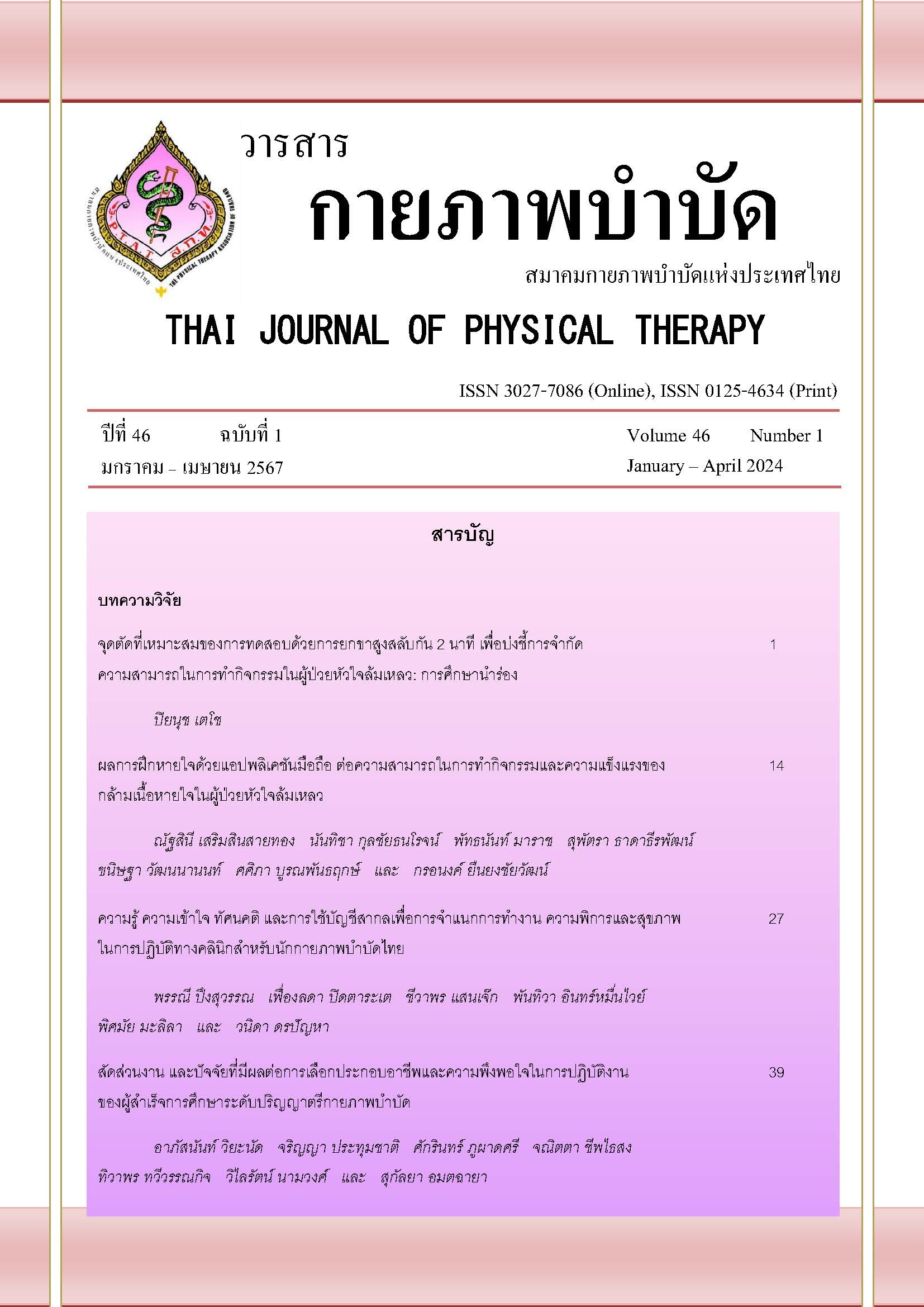
Knowledge, understanding, attitude and use of the international classification of functioning, disability and health in clinical practice among Thai physical therapists
Article Sidebar
Main Article Content
Abstract
Background: The International Classification of Functioning, Disability and Health (ICF) is a framework to provide a standardized and comprehensive way to describe and categorize information related to health and disability. In Thailand, the ICF is used as a standard manual for assessment and categorization of disability, however; there seems to be a gap in understanding and awareness of the ICF among physical therapists (PTs) in Thailand.
Objective: To explore the level of knowledge, understanding and attitudes of the ICF use, including the ICF core set in PTs, Thailand.
Methods: Three hundred forty-six PTs in hospitals of the Ministry of Public Health were invited to volunteer. To answer the questionnaire of knowledge, understanding and attitude in using ICF via Google form within 2 months. The questionnaire received recommendations from 3 experts and PTs tested before use. The data were analyzed by descriptive statistics.
Results: A total of 191 PTs responded to the questionnaire (55.20%). Most of the respondents had a moderate level of ICF knowledge (74.35 %) and did not know (25.65 %). Most of the respondents had used the ICF (52.82%) and had never trained or learned about ICF (57.59%). There is a favorable view of the use of ICF for the respondents (47.89 %), but there are barriers due to knowledge and understanding of its use.
Conclusion: This study may mention that ICF education and training needs to enhance PTs' ability to use the ICF effectively and be content in courses for institutions of physical therapy.
Article Details

This work is licensed under a Creative Commons Attribution-NonCommercial-NoDerivatives 4.0 International License.
References
World Health Organization Geneva. Classification of Work, Disability and Health: ICF. Translated by Department of Medicine, Ministry of Public Health, 2004, 1-45. (in Thai)
Nualnetr N. Clinical thinking and decision-making processes for physiotherapy. [Document for teaching physical therapy, Khon Kaen University] 2020. (in Thai)
Physiopedia. 2002. International Classification of Functioning, Disability and Health (ICF). [Online]. Available from: https://www.physiopedia.com/International _Classification_of_Functioning, Disability_and_Health_(ICF) [April 06, 2022].
Pernambuco AP, Lana RC, Polese JC. Knowledge and use of the ICF in clinical practice by physiotherapist and occupational therapist of Minas Gerais. Fisioter Pesqui. 2018; 25(2):134-42.
Farrell J, Anderson S, Hewitt K, Livingston MH, Stewart D. A survey of occupational therapists in Canada about their knowledge and use of the ICF. Can J Occup Ther. 2007;74(1):221-32.
Maini M, Nocentini U, Prevedini A, Giardini A, Muscolo E. An Italian experience in the ICF implementation in rehabilitation: Preliminary theoretical and practical considerations, Disabil Rehabil. 2008;30(15):1146-52.
Schiariti V, Longo E, Shoshmin A, Kozhushko L, Besstrashnova Y, Król M et al. Implementation of the International Classification of Functioning, Disability, and Health (ICF) Core Sets for Children and Youth with Cerebral Palsy: Global Initiatives Promoting Optimal Functioning. Int J Environ Res Public Health. 2018;15(9):1899.
Pimdee A, Nualnetr N. Applying the International Classification of Functioning, Disability and Health to guide home health care services planning and delivery in Thailand, Home Health Care Serv Q. 2017;36(2):81-95.
Tongsiri S. Functioning data based on the International Classification of Functioning, Disability and Health (ICF) classification system: implications for multidisciplinary rehabilitation plans for persons with disabilities. J Health Syst Res. 2013; 07(1):99-113.
Satangmongkol K. 2019. Review of sample size formula for Taro Yamane. [Online]. Available from: https://datarockie.com/blog/yamane-sample-size-calculation/ [April 15, 2022]. (in Thai)
Potisarn P. Likert Scale. In: Pirat B, editor. Encyclopedia of Education. P.S Pattana Publishing; 2003. Vol. 31; p. 17-20 (in Thai)
Rattanamanee N, Phasunon P. Response rate in quantitative research. JHS.TRU. 2019;13(3): 181-88. (in Thai)
Sombutteera K, Thavornpitak Y. Response rate and factors associating mailed questionnaire response rate in nursing sciences and public health research. KKU Res J (GS). 2015;15(1): 105-13. (in Thai)
Mantruad R, Puntumetakul R, Peungsuwan P. Content validity and reliability of the modified international classification of functioning, disability and health (ICF) core set for osteoarthritis (Thai version) in patients with knee osteoarthritis. J Med Tech Phy Ther. 2018;30(2): 205-15. (in Thai)
Junsorn J, Chatchawan U, Peungsuwan P. Content validity and reliability of the international classification of functioning, disability and health for falls (Thai version) in stroke patients. J Med Tech Phy Ther. 2018; 30(3):311-22. (in Thai)
Somkaew W. The use of the Functional-based data in empowerment plan of persons with disabilities in Rattanaburi district, Surin province. Med J Srisaket Surin Buriram Hosp 2020; 35(2):257-68. (in Thai)
Tongsiri S. Use of the International Classification of Functioning, Disability and Health (ICF) to develop database of persons with disabilities (PWDs). Srinagarind Med J. 2013;28(1):131-42. (in Thai)
Steiner WA, Ryser L, Huber E, Uebelhart D, Aeschlimann A, Stucki G. Use of the ICF model as a clinical problem-solving tool in physical therapy and rehabilitation medicine. Phys Ther. 2002;82(11):1098-107.
