
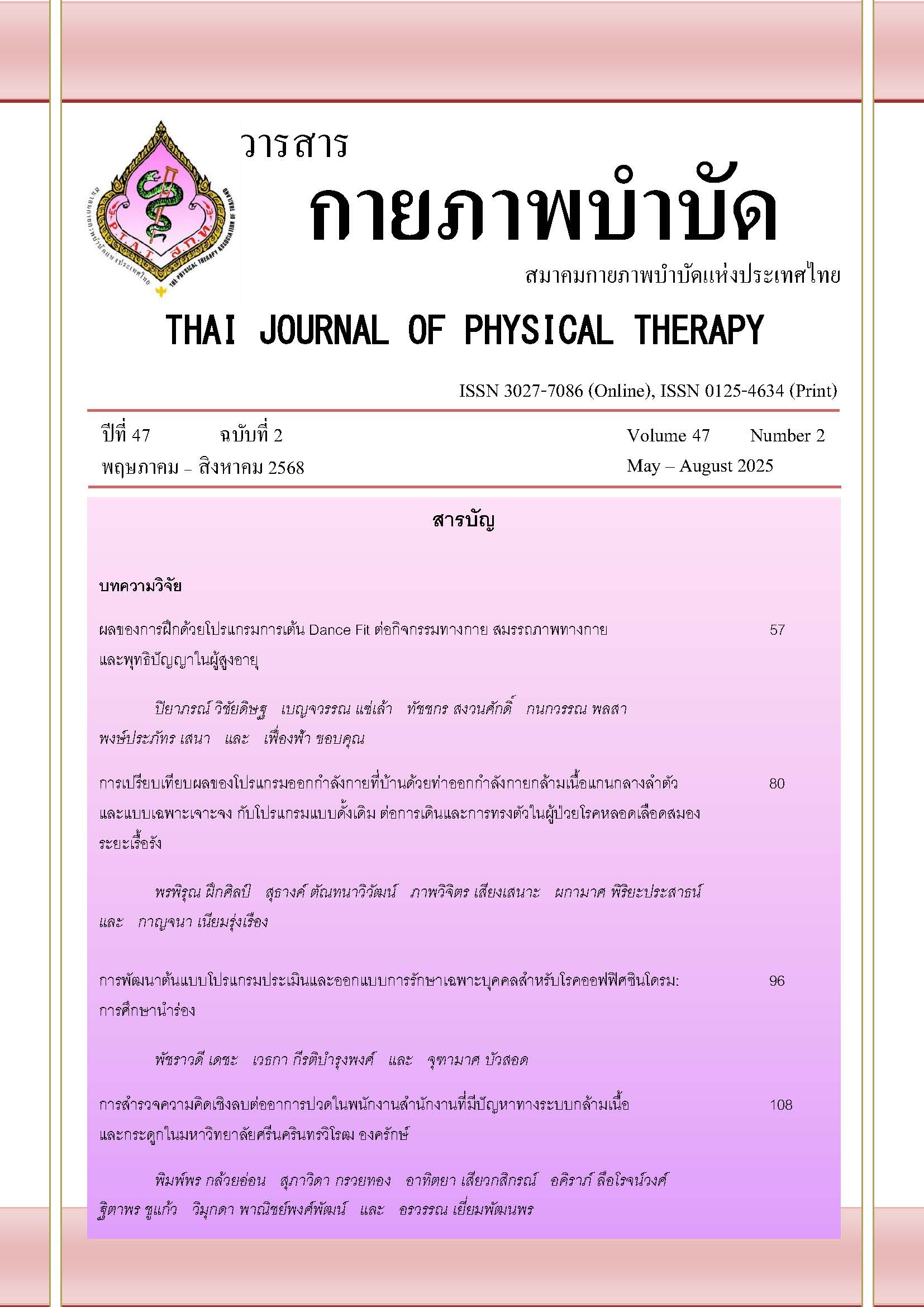
A Prototype Development of Web Application for Personalized Assessment and Design Exercises in Patients with Office Syndrome: A pilot study
Article Sidebar
Main Article Content
Abstract
Background: The office syndrome symptoms are common among office workers and are primarily caused by prolonged stationary positions and insufficient regular ergonomic movement. In the twenty-first century, with the advent of modern communication technologies, which are increasingly accessible, this study integrates cutting-edge technology to develop a web application aimed at enhancing the efficiency of physical therapy treatments.
Objective: To develop a prototype web application for personalized assessment and treatment planning for office syndrome and to evaluate its usability and clinical effectiveness.
Methods: This developmental study consisted of two main phases: 1) Prototype Development and Usability Testing: Usability was assessed using the System Usability Scale (SUS) with 30 volunteers. 2) Clinical Effectiveness Testing: Conducted with 20 volunteers, each required to adjust their ergonomic environment and perform exercises recommended by the web application for 30 minutes per day, two days per week, for a fortnight after that pain levels were measured using the Visual Analogue Scale (VAS) before and after the intervention.
Results: The SUS usability assessment consistently states a "good" rating for the application. Additionally, clinical effectiveness testing demonstrated a statistically significant reduction in pain scores (p < 0.001) after using the web application for physical therapy.
Conclusion: The study indicates that the personalized web application for office syndrome management efficiently and effectively supports self-care and significantly reduces muscle pain among users. The application is user-friendly and expeditious to learn, and users have reviewed and reported high confidence in its use.
Article Details

This work is licensed under a Creative Commons Attribution-NonCommercial-NoDerivatives 4.0 International License.
References
National Statistical Office Ministry of Digital Economy and Society. The 2022 Household Survey on The Use of Information and Communication Technology (Quarter 2). The Household Survey on the Use of Information and Communication Technology (Annually), 2022. (In Thai)
Toonsang T, Boonsiri P, Srijaroen W, Sribenchamas N, Samruayruen K, Junsakon E, et al. Factors Affected to Muscle Pain among Electronics Industries Workers in Klongluang District Pathumthani Province. EAU Heritage journal Science and Technology. 2019;13(2):254-66. (In Thai)
Dawongsa P. Cumulative Trauma Disorder. EAU Heritage journal Science and Technology. 2015;9(1):33-8. (In Thai)
Punwaree J, Klaphajone J, Kovindha A. Neck Pain in Computer Users: a Study of Ergonomic Factors. J Thai Rehabil Med. 2009;19(1):30-5. (In Thai)
Office of the Permanent Secretary for Public Health. Out-Patients According to 21 Groups of Cause from Health Service Units: Ministry of Public Health, 2021. (In Thai)
Sahin N, Karahan AY, Albayrak I. Effectiveness of physical therapy and exercise on pain and functional status in patients with chronic low back pain: a randomized-controlled trial. Turk J Phys Med Rehabil. 2017;64(1):52-8.
State of Colorado Department of Labor and Employment Division of Workers’ compensation. Cumulative Trauma Disorder (CTD) Medical Treatment Guidelines. Division of Workers’ Compensation Rule 17, Exhibit 5, 2007.
Sethpitak T. The Study of Work Conditions that Contribute to The Severity of Computer Syndrome [master’s thesis]. Bangkok: Thammasat University, 2015. (In-Thai)
Iqbal ZA, Alghadir AH. Cumulative trauma disorders: A review. J Back Musculoskelet Rehabil. 2017;30(4):663-6.
Mesas AE, González AD, Mesas CE, de Andrade SM, Magro IS, del Llano J. The Association of Chronic Neck Pain, Low Back Pain, and Migraine With Absenteeism Due to Health Problems in Spanish Workers. Spine (Phila Pa 1976). 2014;39(15):1243-53.
Elgendy SR, Elbanna M. Impact of Web-based Physical Therapy on Chronic Mechanical Neck Pain in Sedentary Female Office Workers. Nursing and Health Sciences. 2022;9(6):20-7.
Davergne T, Meidinger P, Dechartres A, Gossec L. The Effectiveness of Digital Apps Providing Personalized Exercise Videos: Systematic Review With Meta-Analysis. J Med Internet Res. 2023;25: e45207
Hoe VC, Urquhart DM, Kelsall HL, Zamri EN, Sim MR. Ergonomic interventions for preventing work-related musculoskeletal disorders of the upper limb and neck among office workers. Cochrane Database Syst Rev. 2018;10(10):CD008570.
Santos W, Rojas C, Isidoro R, Lorente A, Dias A, Mariscal G, et al. Efficacy of Ergonomic Interventions on Work-Related Musculoskeletal Pain: A Systematic Review and Meta-Analysis. Journal of Clinical Medicine. 2025;14(9):3034.
Whitehead AL, Julious SA, Cooper CL, Campbell MJ. Estimating the sample size for a pilot randomised trial to minimise the overall trial sample size for the external pilot and main trial for a continuous outcome variable. Stat Methods Med Res. 2016;25(3):1057–73.
Lewis JR, Sauro J. Item benchmarks for the system usability scale. Journal of Usability Studies. 2018; 13(3):158-67.
Nittayasupaporn B. Tohsen F. Poungpum T. Apipunyasopon L. Development and assessment of CUFastTech mobile application for plain radiograph. The Thai Journal of Radiological Technology 2021;45(1):1-7. (In Thai)
Cohen J. Statistical Power Analysis for the Behavioral Sciences (2nd ed.). Hillsdale, NJ: Lawrence Erlbaum Associates, 1988.
Sungwan P, Thathong P, Muenchan L. An Effect of Maneevej Exercise to Office Syndrome Among Office Worker of University. Thai Red Cross Nursing Journal. 2021;14(2):251-67. (In Thai)
Khawgrib S, Bunprom P, Sangsiriwut N, Lorenz S, Ngamdee O, Niyomtoon I. Ergonomic Risk Assessment of Computer Users in the Offices of a Private College in Bangkok. 2024;9(1):166-78. (In Thai)
Vinyoocharoenkul J, Pochana K. The Ergonomic Risk Assessment of Computer User by Rapid Office Strain Assessment (ROSA). Journal of Public Health. 2015;45(2):148-58. (In Thai)
Akkarakittichoke N, Jensen MP, Newman AK, Waongenngarm P, Janwantanakul P. Characteristics of office workers who benefit most from interventions for preventing neck and low back pain: a moderation analysis. Pain Rep. 2022;7(3):e1014.
Davis B, Nies M, Shehab M, Shenk D. Developing a pilot e-mobile app for dementia caregiver support: Lessons learned. Online Journal of Nursing informatics. 2014;18(1):1-10.
Mata Diz JB, de Souza JR, Leopoldino AA, Oliveira VC. Exercise, especially combined stretching and strengthening exercise, reduces myofascial pain: a systematic review. J Physiother. 2017;63(1):17-22.
Lee S, DE Barros FC, DE Castro CSM, DE Oliveira Sato T. Effect of an ergonomic intervention involving workstation adjustments on musculoskeletal pain in office workers-a randomized controlled clinical trial. Ind Health. 2021;59(2):78-85.
Katović D, Bronzin T, Horvat M, Prole B, Stipić A, Jelača N, et al. The use of AI in Human Pose Estimation Applications in Kinesiology: Taxonomy of Algorithms, Models, and Evaluation Methods. In: Proceedings of 47th MIPRO ICT and Electronics Convention (MIPRO). 2024:1163-6.
