
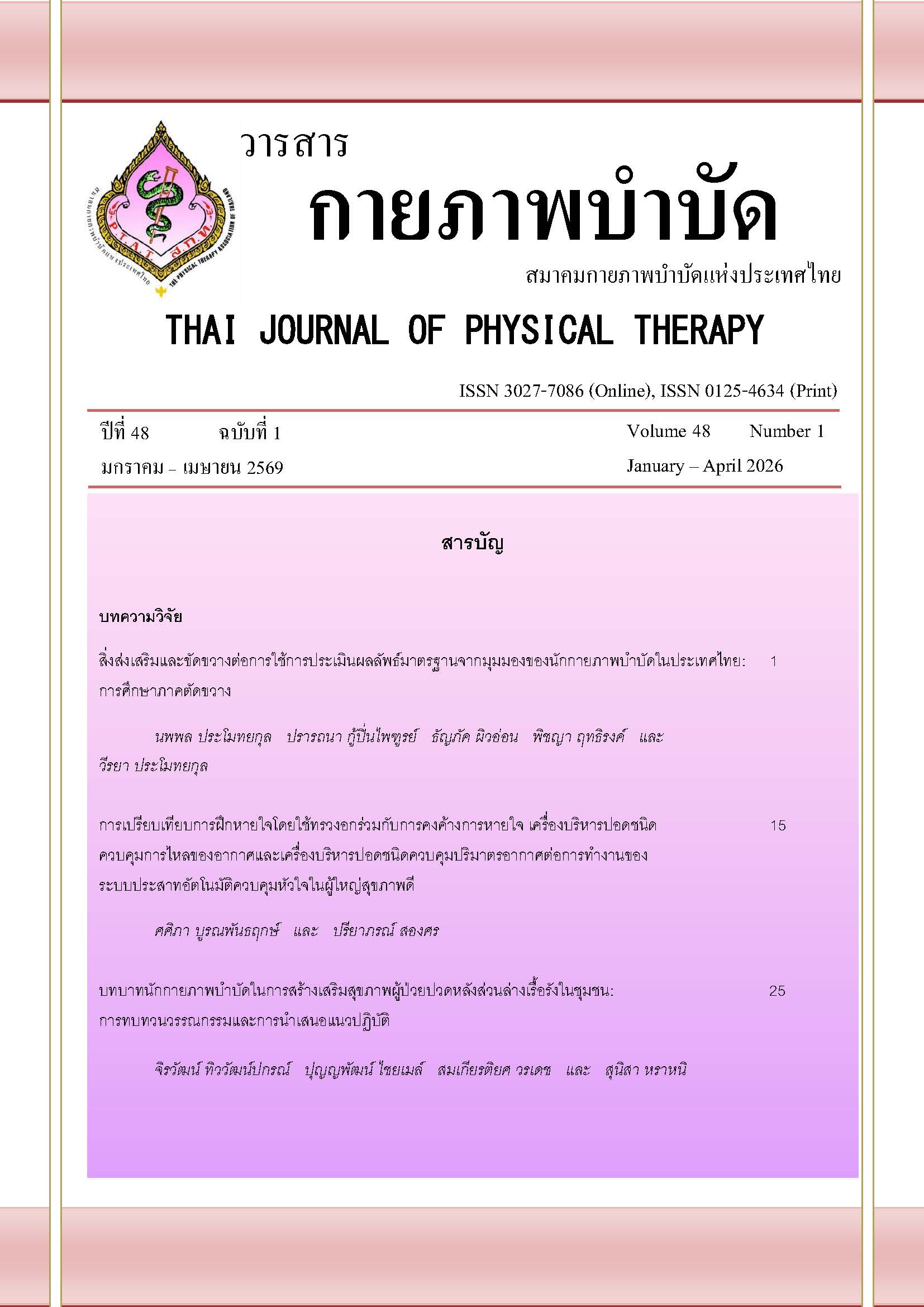
Facilitators and barriers to using standardized outcome measures from the perspective of Thai physical therapists: A cross-sectional study
Article Sidebar
Main Article Content
Abstract
Background: The implementation of standardized outcome measures is crucial for enhancing the validity of physical therapy assessments and ensuring systematic data collection. However, evidence regarding facilitators and barriers to their use from the perspective of Thai physical therapists remains limited.
Objective: To investigate facilitators and barriers to the use of standardized outcome measures among Thai physical therapists and to identify commonly used outcome assessments.
Methods: A cross-sectional survey was conducted among 205 physical therapists from 13 health regions under the Ministry of Public Health in Thailand. Data were collected using an online questionnaire.
Results: The top five facilitators for using standardized outcome measures were ease of understanding and administration (78.54%), reliability and validity (77.56%), accessibility without additional costs (75.61%), short assessment time (74.15%), and clarity of result interpretation (74.15%). The top five barriers included lengthy testing and analysis time (70.73%), difficult-to-understand assessment procedure (61.95%), substantial requirements for testers, equipment, and testing space (60.98%), insufficient knowledge and skills related to standardized outcome measures (59.51%), and difficulty in interpreting results (57.56%).
Conclusion: The appropriate use of standardized outcome measures requires supportive efforts from both academic institutions and professional organizations to reduce the limitations identified in this study, thereby contributing to the improvement of standards in physical therapy services.
Article Details

This work is licensed under a Creative Commons Attribution-NonCommercial-NoDerivatives 4.0 International License.
References
Office of Physical Therapy Service Accreditation Subcommittee on Professional Standards, Thai Physical Therapy Council. Manual for physical therapy service standards assessment: revised edition 2021 [Internet]. Bangkok: Thai Physical Therapy Council; 2021 [cited 2025 Apr 20]. Available from: https://pt.or.th/PTCouncil/file_attach/Att202010021601628217202203211647917852_1.pdf (In Thai)
Jette DU, Halbert J, Iverson C, Miceli E, Shah P. Use of standardized outcome measures in physical therapist practice: perceptions and applications. Phys Ther. 2009;89(2):125-35.
Potter K, Fulk GD, Salem Y, Sullivan J. Outcome measures in neurological physical therapy practice: part I. Making sound decisions. J Neurol Phys Ther. 2011;35(2):57-64.
Pekrun R. Self-report is indispensable to assess students’ learning. Front Learn Res. 2020;8(3): 185-93.
Nielsen LM, Kirkegaard H, Ostergaard LG, Bovbjerg K, Breinholt K, Maribo T. Comparison of self-reported and performance-based measures of functional ability in elderly patients in an emergency department: implications for selection of clinical outcome measures. BMC Geriatr. 2016;16(1):199.
Duncan EA, Murray J. The barriers and facilitators to routine outcome measurement by allied health professionals in practice: a systematic review. BMC Health Serv Res. 2012; 12:96.
Ntsiea V, Mudzi W, Maleka D, Comley-White N, Pilusa S. Barriers and facilitators of using outcome measures in stroke rehabilitation in South Africa. Int J Ther Rehabil. 2022;29(2):1-15.
Braun T, Rieckmann A, Weber F, Gruneberg C. Current use of measurement instruments by physiotherapists working in Germany: a cross-sectional online survey. BMC Health Serv Res. 2018;18(1):810.
Swinkels RA, van Peppen RP, Wittink H, Custers JW, Beurskens AJ. Current use and barriers and facilitators for implementation of standardised measures in physical therapy in the Netherlands. BMC Musculoskelet Disord. 2011;12:106.
Physical Therapy Council of Thailand. Announcement of the Physical Therapy Council on details of physical therapist competencies [Internet]. Bangkok: Physical Therapy Council of Thailand; 2022 Jun 1 [cited 2025 Aug 14]. Available from: https://www.pt.or.th/PTCouncil/ new_detail.php?id=1145. (In Thai)
Adam AM. Sample size determination in survey research. J Sci Res Rep. 2020;26(5):90-7.
Pattison KM, Brooks D, Cameron JI, Salbach NM. Factors influencing physical therapists' use of standardized measures of walking capacity poststroke across the care continuum. Phys Ther. 2015;95(11):1507-17.
Al-Muqiren TN, Al-Eisa ES, Alghadir AH, Anwer S. Implementation and use of standardized outcome measures by physical therapists in Saudi Arabia: barriers, facilitators and perceptions. BMC Health Serv Res. 2017;17(1): 748.
Pathak A, Abbott J, Bajracharya N, Gurung G, Nepal G, Sharma S. Barriers and facilitators to implementation of outcome measures among physiotherapists in Nepal: a mixed-methods study. Musculoskelet Sci Pract. 2023;68: 102859.
Lin S, Bosch P, Rowe V, Fasoli S, Langan J. Use of standardized assessments and online resources in stroke rehabilitation. Open J Occup Ther. 2019;7(4):1-22.
Bouwstra H, Smit EB, Wattel EM, van der Wouden JC, Hertogh C, Terluin B, et al. Measurement properties of the Barthel Index in geriatric rehabilitation. J Am Med Dir Assoc. 2019;20(4):420-5.e1.
Katano S, Yano T, Ohori K, Kouzu H, Nagaoka R, Honma S, et al. Barthel Index score predicts mortality in elderly heart failure – a goal of comprehensive cardiac rehabilitation. Circ J. 2021;86(1):70-8.
National Health Security Office (NHSO). Announcement of the National Health Security Office on the utilization of expenses for public health services for community-dwelling dependent persons, 2024 [Internet]. Nonthaburi: NHSO; 2024 [cited 2025 Aug 11]. Available from: https://www.nhso.go.th/th/docman-document/nhso-payment-condition/nhso-payment-service-fees-for-public-health-with-local-organizations/502-2-2567/file (In Thai)
Dajpratham P, Meenaphant R, Junthon P, Pianmanakij S, Jantharakasamjit S, Yuwan A. The inter-rater reliability of Barthel Index (Thai version) in stroke patients. J Thai Rehabil. 2006; 16(1):1-9.
Bohannon R. Six-minute walk test: a meta-analysis of data from apparently healthy elders. Top Geriatr Rehabil. 2007;23(2):155-60.
Coulshed A, Coulshed D, Pathan F. Systematic review of the use of the 6-minute walk test in measuring and improving prognosis in patients with ischemic heart disease. CJC Open. 2023; 5(11):816-25.
Li AM, Yin J, Au JT, So HK, Tsang T, Wong E, et al. Standard reference for the six-minute-walk test in healthy children aged 7 to 16 years. Am J Respir Crit Care Med. 2007;176(2):174-80.
Macchiavelli A, Giffone A, Ferrarello F, Paci M. Reliability of the six-minute walk test in individuals with stroke: systematic review and meta-analysis. Neurol Sci. 2021;42(1):81-7.
Podsiadlo D, Richardson S. The timed “Up & Go”: a test of basic functional mobility for frail elderly persons. J Am Geriatr Soc. 1991;39(2): 142-8.
Downs S, Marquez J, Chiarelli P. The Berg Balance Scale has high intra- and inter-rater reliability but absolute reliability varies across the scale: a systematic review. J Physiother. 2013;59(2):93-9.
Albarrati A, Nazer R. Utility of Timed Up and Go in outpatient cardiology clinics. Rehabil Nurs. 2020;45(1):39-44.
Carey H, Martin K, Combs-Miller S, Heathcock JC. Reliability and responsiveness of the Timed Up and Go test in children with cerebral palsy. Pediatr Phys Ther. 2016;28(4):401-8.
Chen MJ, Fan X, Moe ST. Criterion-related validity of the Borg ratings of perceived exertion scale in healthy individuals: a meta-analysis. J Sports Sci. 2002;20(11):873-99.
American College of Sports Medicine. ACSM’s guidelines for exercise testing and prescription. 6th ed. Baltimore: Lippincott Williams & Wilkins; 2000.
