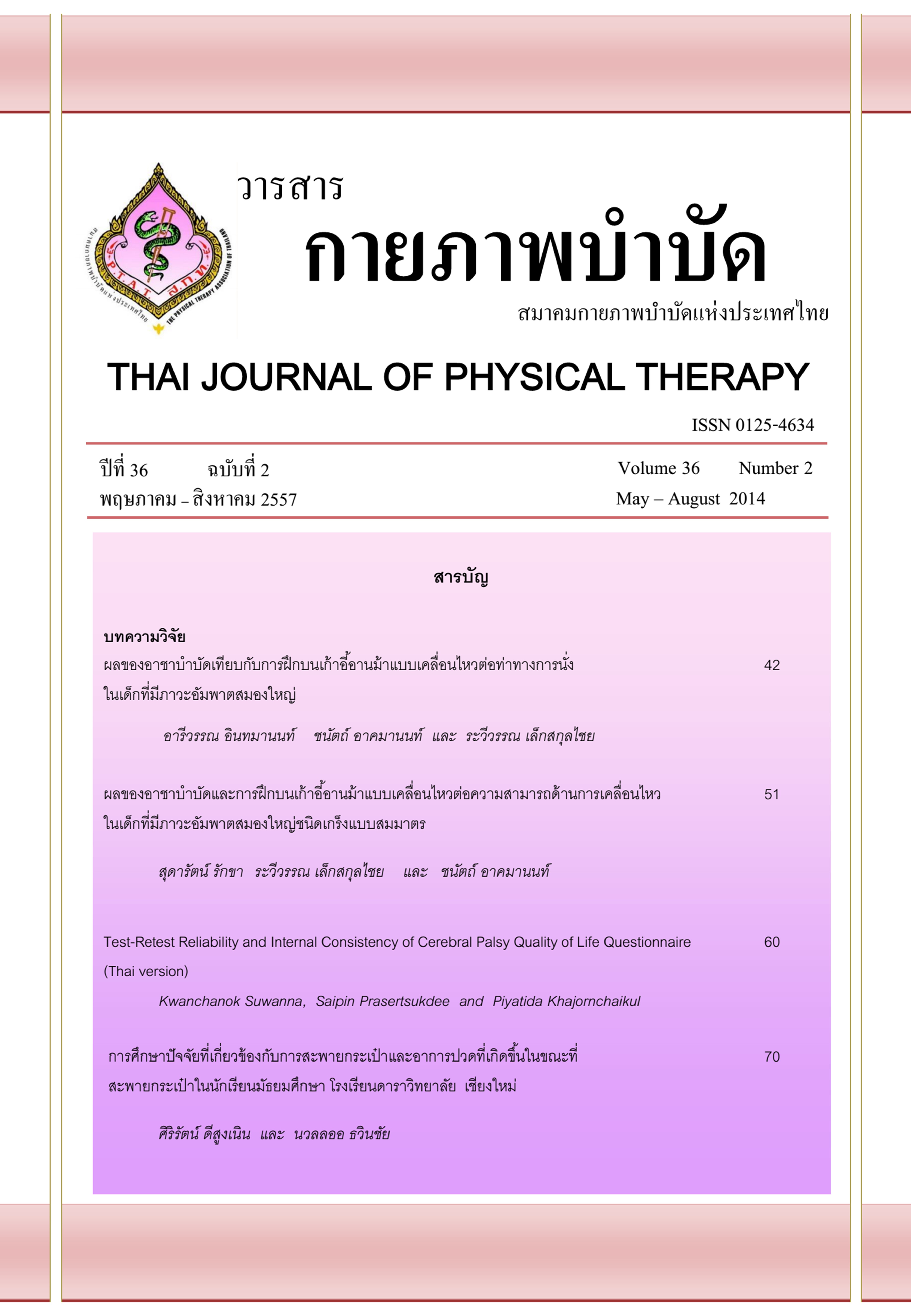
Effect of hippotherapy and dynamic saddle seat training on gross motor ability in children with bilateral spastic cerebral palsy
Article Sidebar
Main Article Content
Abstract
Various techniques to improve gross motor function ability of children with cerebral palsy (CP) have been reported. Of them, hippotherapy and dynamic saddle seat riding were proved of good benefits. However, no studies compared effects of the two techniques in children with CP. This study aimed to compare effects of the 6 week-training of HP and DS on improvement of gross motor function in children with spastic CP. Ten children with CP were randomly assigned into either HP or DS group. All children’s gross motor function abilities were assessed prior to training, at 3rd and 6th week of training. Results revealed significant improvements of all dimensions of gross motor abilities of both groups. When comparing ability scores at 3rd week between the two groups, results revealed significant difference between walking ability scores of HP and DS groups. At 6th week of training, walking ability and total scores of the two groups were different. This study suggested that both techniques can improve gross motor abilities of children with spastic CP. However, hippotherapy showed better benefit on improvement of walking ability of the children.
Article Details
References
2. Hanna SE, Rosenbaum PL, Bartlett DJ. et al. Stability and decline in gross motor function among children and youth with cerebral palsy aged 2 to 21 years. Dev Med Child Neurol 2009; 51:295-302.
3. Rosenbaum P, Paneth N, Leviton A. et al. The definition and classification of cerebral palsy. Dev Med Child Neurol 2007; 49: 8-14.
4. Granados AC, Agis IF. Why children with special needs feel better with hippotherapy sessions: a conceptual
review. J Altern Complement Med 2011; 17: 191-7.
5. Casady RL, Nichols-Larsen DS. The Effect of Hippotherapy on Ten Children with Cerebral Palsy. Pediatr Phys Ther 2004; 16 :165-72.
6. Sterba JA. Does horseback riding therapy or therapist‐directed hippotherapy rehabilitate children with cerebral palsy? Dev Med Child Neurol 2007; 49: 68-73.
7. McGibbon NH, Benda W, Duncan BR et al. Immediate and long-term effects of hippotherapy on symmetry of adductor muscle activity and functional ability in children with spastic cerebral palsy. Arch Phys Med Rehabil 2009; 90: 966-74.
8. Quint C, Toomey M. Powered Saddle and Pelvic Mobility: An investigation into the effects on pelvic mobility of children with cerebral palsy of a powered saddle which imitates the movements of a walking horse. Physiotherapy 1998; 84: 376-84
9. Pope PM, Bowes CE, Booth E. Postural control in sitting the SAM system: evaluation of use over three years. Dev Med Child Neurol 1994; 36: 241-52.
10. Temcharuensuk P. Effect of dynamic saddle riding on sitting ability and gross motor performance in children with cerebral palsy [PhD Dissertation]. Bangkok: Mahidol University, 2013.
11. Russell D, Rosenbaum P, Gowland C et al. Gross Motor Function Measure Manual. Hamilton: McMaster University, 1993.
12. Silkwood-Sherer DJ, Killian CB, Long TM, Martin KS. Hippotherapy—An Intervention to Habilitate Balance Deficits in Children With Movement Disorders: A Clinical Trial. Phys Ther 2012; 92(5):707-17.
13. Encheff JL, Armstrong C, Masterson M. et al. Hippotherapy effects on trunk, pelvic, and hip motion during ambulation in children with neurological impairments. Pediatr Phys Ther 2012; 24: 242-50.
14. Kwon JY, Chang HJ, Lee JY et al. Effects of hippotherapy on gait parameters in children with bilateral spastic cerebral palsy. Arch Phys Med Rehab 2011; 92: 774-9.
