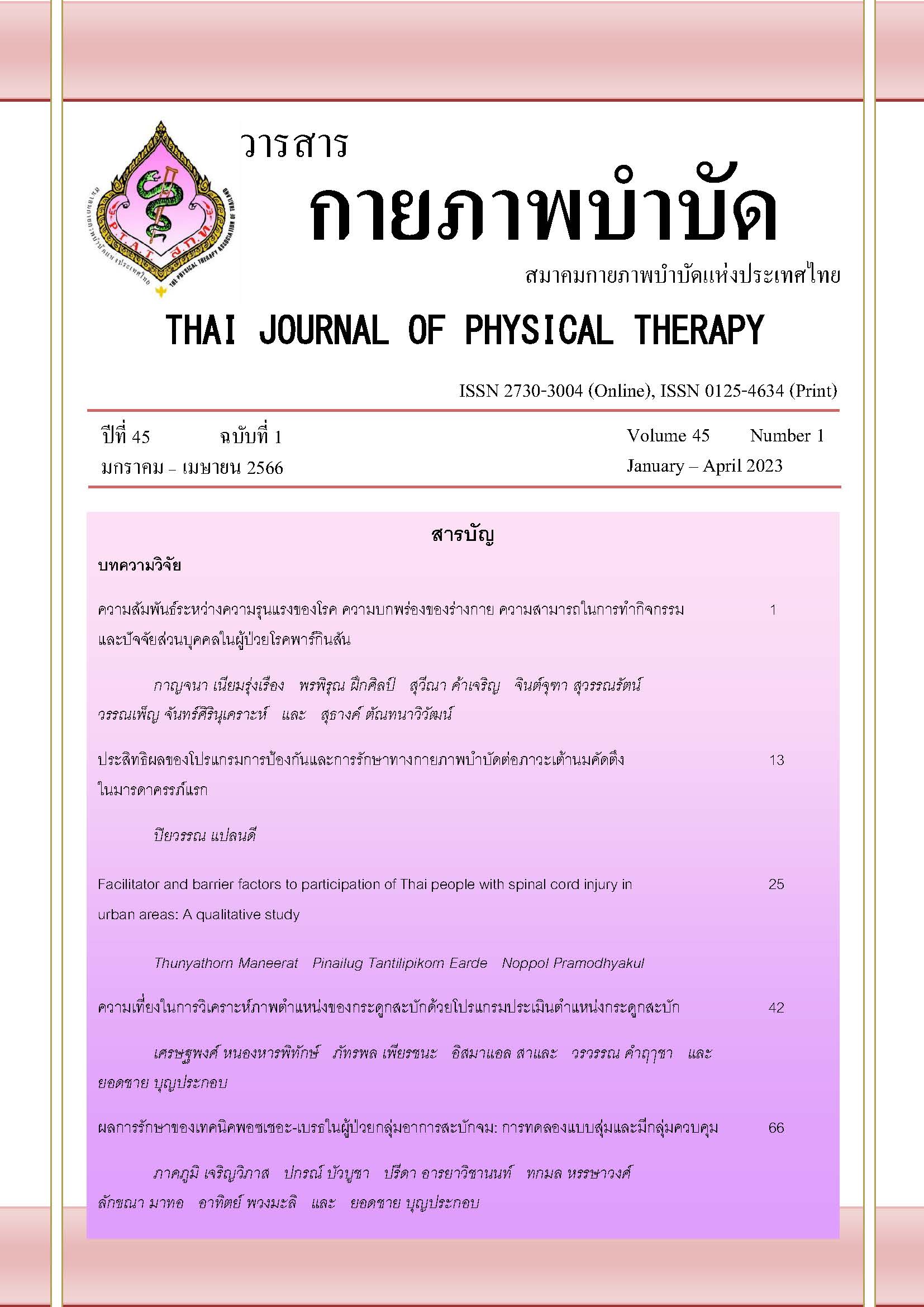
ผลการรักษาของเทคนิคพอซเชอะ-เบรธในผู้ป่วยกลุ่มอาการสะบักจม: การทดลองแบบสุ่มและมีกลุ่มควบคุม
Article Sidebar
Main Article Content
บทคัดย่อ
ที่มาและความสำคัญ: กลุ่มอาการสะบักจมเป็นอาการปวดกล้ามเนื้อเรื้อรัง ที่มีพยาธิกำเนิดซับซ้อน ปัจจุบันยังไม่มีการสรุปชัดเจนถึงวิธีการรักษามาตรฐาน จากพื้นฐานทางชีวกลศาสตร์พบว่า กลุ่มกล้ามเนื้อสะบักที่ปวด ส่วนหนึ่งเป็นกล้ามเนื้อทรงท่า ซึ่งมีหน้าที่สำคัญสองประการ คือ การทรงท่า และการหายใจ ผู้วิจัยจึงออกแบบวิธีการออกกำลังกายสะบักร่วมกับการหายใจ หรือเทคนิคพอซเชอะ-เบรธ เพื่อพิสูจน์ผลการรักษาผู้ป่วยกลุ่มอาการสะบักจมเกี่ยวกับการลดปวด และการปรับเปลี่ยนการทำงานของระบบประสาทอัตโนมัติ
วัตถุประสงค์: เพื่อเปรียบเทียบประสิทธิผลการรักษาระหว่างเทคนิคพอซเชอะ-เบรธ และการออกกำลังกายทั่วไปสำหรับกล้ามเนื้อรอบสะบักที่มีต่ออาการปวด และความแปรผันของอัตราการเต้นหัวใจในผู้ป่วยกลุ่มอาการสะบักจม
วิธีการวิจัย: ผู้ป่วยกลุ่มอาการสะบักจม จำนวน 47 คน สุ่มตัวอย่างเป็นกลุ่มย่อยแบบภาคชั้น ออกเป็น 2 กลุ่ม ซึ่งได้รับการรักษาพื้นฐานทางกายภาพบำบัดเหมือนกัน (แผ่นประคบร้อน และคลื่นเหนือเสียง) แต่แตกต่างกันเพียงชนิดการออกกำลังกาย คือ เทคนิคพอซเชอะ-เบรธ และการออกกำลังกายทั่วไป ตามลำดับ เวลาและความถี่ของการรักษาแต่ละกลุ่มคือ 46 นาที ต่อหนึ่งครั้ง และ 3 ครั้งต่อสัปดาห์ ในระยะเวลา 3 สัปดาห์ ตัวแปรที่ใช้ในการศึกษา ได้แก่ ระดับกั้นความปวด ระดับอาการปวดขณะพัก ระดับอาการปวดเฉลี่ยใน 24 ชั่วโมงที่ผ่านมา และความแปรผันของอัตราการเต้นหัวใจ โดยประเมินก่อน และหลังการรักษาครั้งแรก และหลังการรักษาครั้งสุดท้าย (สัปดาห์ที่ 3) การวิเคราะห์ภายในกลุ่มและผลความแตกต่างระหว่างกลุ่มในแต่ละช่วงเวลาใช้สถิติ Mixed-model ANOVA
ผลการวิจัย: เมื่อเปรียบเทียบภายในกลุ่ม กลุ่มพอซเชอะ-เบรธ มีระดับกั้นความปวดเพิ่มขึ้นเฉพาะผลระยะสั้นอย่างมีนัยสำคัญทางสถิติ (p<0.05) ส่วนระดับอาการปวดขณะพัก และระดับอาการปวดเฉลี่ยใน 24 ชั่วโมงที่ผ่านมา ของทั้งสองกลุ่ม เริ่มลดลงอย่างมีนัยสำคัญทางสถิติตั้งแต่หลังการรักษาครั้งแรก สำหรับค่าความแปรผันของอัตราการเต้นหัวใจ มีเพียงผลทันทีของกลุ่มพอซเชอะ-เบรธ ที่มีค่าเพิ่มขึ้นอย่างมีนัยสำคัญทางสถิติ อย่างไรก็ตาม เมื่อเปรียบเทียบระหว่างกลุ่มพบว่า ค่าตัวแปรทุกค่าไม่มีความแตกต่างกันอย่างมีนัยสำคัญทางสถิติ (p>0.05)
สรุปผล: การรักษาพื้นฐานทางกายภาพบำบัดร่วมกับเทคนิคพอซเชอะ-เบรธ สามารถเพิ่มระดับกั้นความปวดที่ผลระยะสั้น ลดระดับอาการปวดตั้งแต่หลังการรักษาครั้งแรก และไม่กระทบต่อความสมดุลของระบบประสาทอัตโนมัติในผู้ป่วยกลุ่มอาการสะบักจม ทั้งนี้ผลการรักษาทั้งหมด ยกเว้นระดับกั้นความปวด ไม่แตกต่างจากการรักษาพื้นฐานทางกายภาพบำบัดร่วมกับการออกกำลังกายทั่วไป
Article Details

อนุญาตภายใต้เงื่อนไข Creative Commons Attribution-NonCommercial-NoDerivatives 4.0 International License.
เอกสารอ้างอิง
Abrams BM. Scapulocostal syndrome. In: Waldman SD, ed. Pain management. 2nd ed. Philadelphia: WB Saunders, 2011: 588–92.
Waldman SD. Scapulocostal Syndrome. In: Waldman SD, ed. Atlas of Common Pain Syndromes. 4th ed. Philadelpshia: Elsevier, 2019: 142–5.
Fourie LJ. The scapulocostal syndrome. South African Med J. 1991; 79(12): 721–4.
Hruska R, Anderson J. Postural respiration: an integrated approach to treatment of patterned thoraco-abdominal pathomechanics. Lincoln: Postural Restoration Institute; 2019.
Srijessadarak T, Arayawichanon P, Kanpittaya J, Boonprakob Y. Diaphragmatic Mobility and Chest Expansion in Patients with Scapulocostal Syndrome: A Cross-Sectional Study. Healthcare (Basel). 2022; 10(5): 950.
Malik M, Bigger JT, Camm AJ, Kleiger RE, Malliani A, Moss AJ, et al. Heart rate variability: Standards of measurement, physiological interpretation, and clinical use. Eur Heart J. 1996; 17(3): 354–81.
Buttagat V, Eungpinichpong W, Chatchawan U, Kharmwan S. The immediate effects of traditional Thai massage on heart rate variability and stress-related parameters in patients with back pain associated with myofascial trigger points. J Bodyw Mov Ther. 2011; 15(1): 15–23.
Boonprakob Y, Phadungkit S, Nongharnpitak S, Srijessadarak T, Supasatean W, Nakhengrit C. Trigger point: Curable or palliative symptoms. Bull Chiang Mai Assoc Med Sci. 2016; 49(1): 155–66.
Simons DG, Travell JG, Simons LS. Travell & Simons’ myofascial pain and dysfunction: upper half of body. Philadelphia: Lippincott Williams & Wilkins, 1999.
Nongharnpitak S, Arayawichanon P, Chatchawan U, Paungmali A, Boonprakob Y. Therapeutic effects of modified active release technique and traditional Thai massage on functional capacity of shoulder and scapula in patients with scapulocostal syndrome. Thai J Phys Ther. 2018; 41(2): 97–111.
Nongharnpitak S, Arayawichanon P, Chatchawan U, Mato L, Puangmali A, Boonprakob Y, et al. Comparative study of the immediate therapeutic effects between modified active release technique and traditional Thai massage on pain alteration in patient with scapulocostal syndrome. J Assoc Med Sci. 2017; 50(3): 391–403.
Wannapong N, Boonprakob Y, Chatchawan U, Wanpen S, Phadungkit S. Immediate and short term effect of modified active release technique (mART) in patients with scapulocostal syndrome. Bull Chiang Mai Assoc Med Sci. 2016; 49(1): 134–45.
Kanhachon W, Boonprakob Y. Modified-active release therapy in patients with scapulocostal syndrome and masticatory myofascial pain: A stratified-randomized controlled trial. Int J Environ Res Public Health. 2021; 18(16): 1-13.
Buttagat V, Eungpinichpong W, Chatchawan U, Arayawichanon P. Therapeutic effects of traditional Thai massage on pain, muscle tension and anxiety in patients with scapulocostal syndrome: A randomized single-blinded pilot study. J Bodyw Mov Ther. 2012; 16(1): 57–63.
Fernández-de-las-Peñas C, Cleland JA, Dommerholt J, editors. Manual therapy for musculoskeletal pain syndromes: An evidence-and clinical-informed approach. London: Churchill Livingstone, 2015.
Mata Diz JB, de Souza JRLM, Leopoldino AAO, Oliveira VC. Exercise, especially combined stretching and strengthening exercise, reduces myofascial pain: a systematic review. J Physiother. 2017; 63(1): 17–22.
Buttagat V, Taepa N, Suwannived N, Rattanachan N. Effects of scapular stabilization exercise on pain related parameters in patients with scapulocostal syndrome: A randomized controlled trial. J Bodyw Mov Ther. 2016; 20(1): 115–22.
Watthanasrimongkol S, Chatchawan U, Wanpen S, Sumranpat Brady W, Boonprakob Y. Comparative study between scapular stabilization exercise and general exercise on pain reduction in patients with scapulocostal syndrome: A randomized clinical trial. kku Res J. 2022; 22(1): 186–99.
Sahrmann SA, Bloom N. Update of Concepts Underlying Movement System Syndromes. In: Sahrmann S, editor. Movement System Impairement Syndromes of Extremities, cervical and Thoracic Spine. Missouri: Mosby, 2010: 1–34.
Boyle K. Postural Restoration. Musculoskeletal Physiotherapy Australia InTouch Magazine, 2007: 13–5.
Waldron JL, McKenney MA, Samuel MN, Girouard TJ, Turner CL, Radzak KN. The Use of Postural Restoration for Treatment of Chronic Rotator Cuff Pathology: a Case Report. Int J Sports Phys Ther. 2020; 15(5): 832–9.
Bernard R. Hypothesis testing two-sample inference. In: Fundamentals of Biostatistics. 8th ed. Duxbery: Thomson learing, 2000: 307.
Fischer AA. Pressure algometry over normal muscles. Standard values, validity and reproducibility of pressure threshold. Pain. 1987; 30(1): 115–26.
Kulsawad N, Meema P, Chatchawan U, Hunsawong T, Eungpinichpong W. Validity and reliability of digital WE algometer in subjects with myofascial trigger points on trapezius muscle. J Med Tech Phy Ther. 2019; 31(2): 123–9.
Boonstra AM, Schiphorst Preuper HR, Reneman MF, Posthumus JB, Stewart RE. Reliability and validity of the visual analogue scale for disability in patients with chronic musculoskeletal pain. Int J Rehabil Res. 2008; 31(2): 165–9.
Tiaprapong K, Eungpinichpong W, Wanpen S, Hunsawong T, Manimmanakorn N. The immediate effects of the self-foot massage using coconut shell on perceived foot fatigue, and heart rate variability in sedentary healthy subjects. J Med Technol Phys Ther. 2017; 29(2): 179–93.
Knuiman P, Hopman MTE, Mensink M. Glycogen availability and skeletal muscle adaptations with endurance and resistance exercise. Nutr Metab (Lond). 2015; 12(1): 59.
Sluka KA, Kalra A, Moore SA. Unilateral intramuscular injections of acidic saline produce a bilateral, long-lasting hyperalgesia. Muscle Nerve. 2001; 24(1): 37–46.
Baskurt Z, Baskurt F, Gelecek N, Ozkan MH. The effectiveness of scapular stabilization exercise in the patients with subacromial impingement syndrome. J Back Musculoskelet Rehabil. 2011; 24(3): 173-9.
Pacheco-Barrios K, Gianlorenço AC, Machado R, Queiroga M, Zeng H, Shaikh E, et al. Exercise-induced pain threshold modulation in healthy subjects: a systematic review and meta-analysis. Princ Pract Clin Res. 2020; 6(3): 11–28.
Gallagher EJ, Bijur PE, Latimer C, Silver W. Reliability and validity of a visual analog scale for acute abdominal pain in the ED. Am J Emerg Med. 2002; 20(4): 287–90.
Bartley J. Breathing and temporomandibular joint disease. J Bodyw Mov Ther. 2011; 15(3): 291–7.
Zautra AJ, Fasman R, Davis MC, Craig AD Bud. The effects of slow breathing on affective responses to pain stimuli: An experimental study. Pain. 2010; 149(1): 12–8.
James DVB, Munson SC, De Ste Croix MBA, Maldonado-Martin S. Heart rate variability: Effect of exercise intensity on postexercise response. Res Q Exerc Sport. 2012; 83(4): 533–9.
