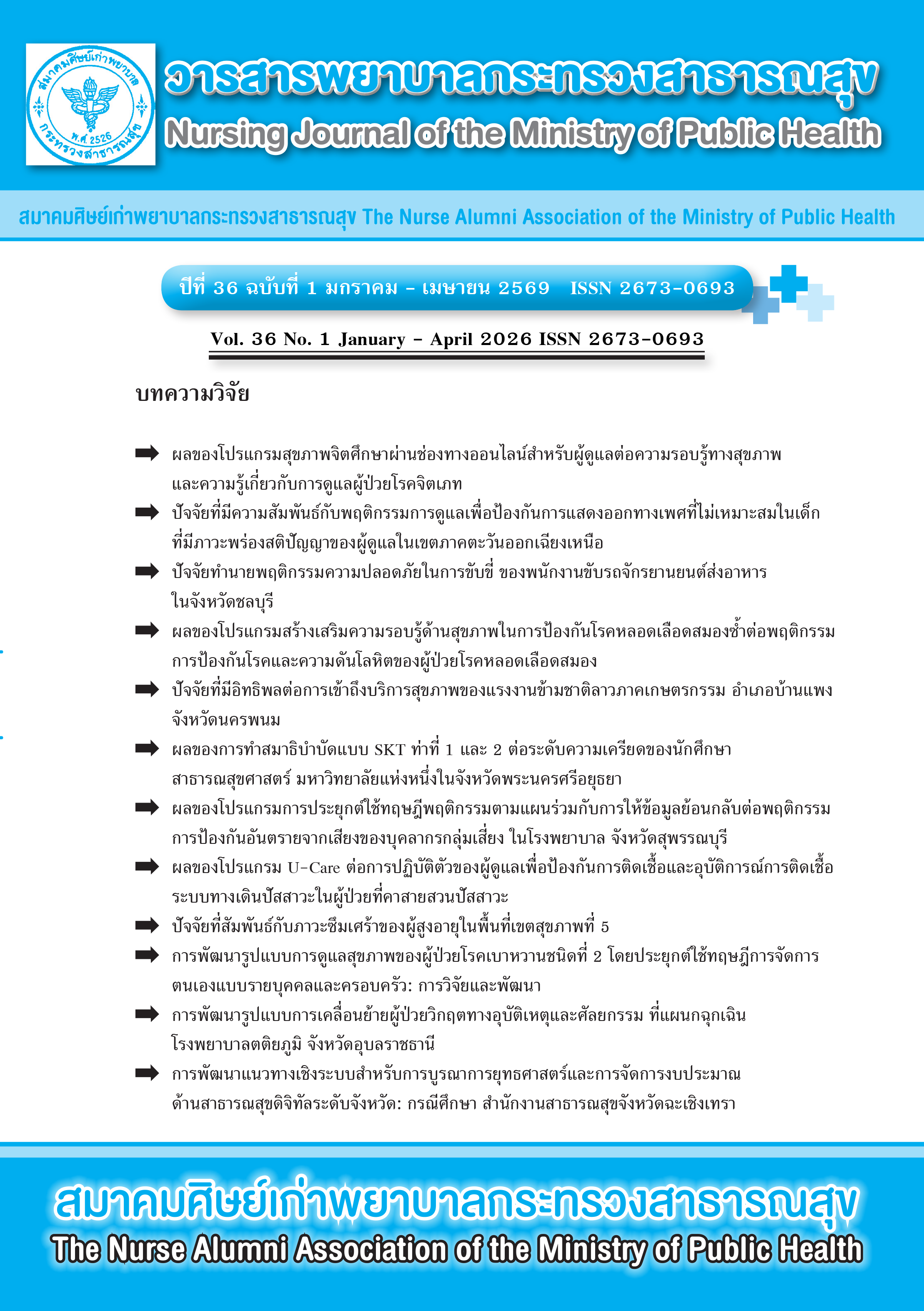
Factors Associated with Caregiving Prevention Behaviors to Inappropriate Sexual Behaviors among Family Caregivers of Children with Intellectual Disability in Northeast Thailand
Keywords:
care behaviors; caregivers; children with intellectual disability; inappropriate sexual behaviorsAbstract
Children with intellectual disabilities are often at risk of engaging in inappropriate sexual behaviors, and caregivers play a crucial role in preventing such actions. This study aimed to examine factors associated with caregivers' preventive behaviors regarding inappropriate sexual expression in children with intellectual disabilities in the Northeast region. The participants consisted of 127 caregivers, selected through multi-stage random sampling. The research instruments included a personal information questionnaire, a questionnaire on knowledge of appropriate sexual expression, a self-efficacy scale for preventive care, and a questionnaire on caregiving behaviors to prevent inappropriate sexual expression. Data were analyzed using descriptive statistics, Spearman’s rank correlation coefficient, and point-biserial correlation. The results revealed that caregivers had a low level of knowledge about appropriate sexual expression (mean=12.50, SD=3.90), a moderate level of self-efficacy perception regarding prevention of inappropriate sexual expression (mean=42.50, SD=10.50), and a moderate level of preventive care behaviors for inappropriate sexual expression (mean=42.30, SD=8.30). Factors significantly associated with preventive care behaviors for inappropriate sexual expression in children with intellectual disabilities included caregivers' education level (r=.226, p<.05), knowledge of appropriate sexual expression (r=.509, p<.001), and self-efficacy perception regarding prevention of inappropriate sexual expression (r=.686, p<.001). Therefore, programs developed to prevent inappropriate sexual expression in children with intellectual disabilities should focus on enhancing both the knowledge and self-efficacy of their caregivers.
References
Glidden LM, Abbeduto L, McIntyre LL, Tasse MJ. APA handbook of intellectual and developmental disabilities: Foundations. American Psychological Association; 2021.
American Association on Intellectual and Developmental Disabilities. Definition of intellectual disability [Internet]. Washington, DC: AAIDD; 2021 [cited 18 Mar 2025]. Available from: https://www.aaidd.org/intellectual-disability/definition
Zablotsky B, Ng AE, Black LI, Blumberg SJ. Diagnosed developmental disabilities in children aged 3–17 years: United States, 2019–2021. NCHS Data Brief, no 473. Hyattsville, MD: National Center for Health Statistics. 2023.
Ministry of Social Development and Human Security, Department for Empowerment of Persons with Disabilities. Report on the situation of persons with disabilities in Thailand [Internet]. 2020 [cited 18 Jan 2025]. Available from: https://dep.go.th/th/law-academic/knowledge-base/disabled-person-situation. (in Thai)
National Statistical Office. The 2022 Disability Survey [internet]. 2023 [cited 18 Jan 2025]. Available from: https://www.unicef.org/thailand/media/11376/file/Disability%20Survey%20Report%20202
Schaafsma D, Kok G, Stoffelen JMT, Curfs LMG. People with intellectual disabilities talk about sexuality: implications for the development of sex education. Sexuality and disability. 2017;35(1):21-38.
Rajanukul Institute, Department of Mental Health, Ministry of Public Health. Sexuality and special needs children: parent edition. Bangkok: Beyond Publishing; 2017. (in Thai)
Wissink IB, van Vugt E, Moonen X, Stams GJ, Hendriks J. Sexual abuse involving children with an intellectual disability (ID): a narrative review. Research in developmental disabilities. 2015; 36:20-35.
Corbett A, Cottis T, Lloyd E. The survival and development of a traumatized clinic for psychotherapy for people with intellectual disabilities. In: Hopper E. Trauma and organizations. Routledge: Taylor & Francis Group, 2018;111-26.
Brkic-Jovanovic N, Runjo V, Tamas D, Slavkovic S, Milankov V. Persons with Intellectual Disability: Sexual Behavior, Knowledge and Assertiveness. Zdravstveno varstvo. 2021; 60(2):82-9.
Chamidah AN, Hartini S, Herini ES. Sexual behavior problems in adolescents with intellectual disabilities: a systematic review. Journal of Medical Sciences. 2021 May 14; 9F:163-70.
Limprasert S, Rujipark V, Thipphayamongkoludom Y. Sexual abuse among children and youth. Journal of Social Science and Buddhist Anthropology. 2020;5(9):230-46. (in Thai)
Schalock RL, Luckasson R, Tasse MJ. Intellectual disability: definition, diagnosis, classification, and planning supports (12nd ed.). American Association on Intellectual and Developmental Disabilities. 2021.
World Health Organization. Atlas: Global resources for persons with intellectual disabilities. Geneva: WHO. 2007.
Mestre TD, Lopes MJ, Pedro Costa A, Caldeira EV. Family self-care pattern in families with children with intellectual disabilities: A pilot study. Healthcare. 2025; 13:791.
Tamas D, Brkic Jovanovic N, Rajic M, Glumbic N, Nikolic G, Randic U, et al. Professionals, parents and the general public: attitudes towards the sexuality of persons with intellectual disability. Sexuality and Disability. 2019; 37:245-58.
Pelleboer-Gunnink HA, van Oorsouw WMWJ, van Weeghel J, Embregts PJCM. Stigma research in the field of intellectual disabilities: a scoping review on the perspective of care providers. International journal of developmental disabilities. 2019;67(3):168-87.
Chaiwat I, Benjayamas P, Songkran N, Somsamorn R, Chinnakorn D, Pathomporn P. Caring for the health and empowerment of people with intellectual disabilities: lessons learned from the development of a learning center for rehabilitation of the disabled. Nakhon Phanom University Journal 25th Anniversary Academic Conference Edition. 2018:223-31. (in Thai)
Nattida P, Sangtong T, Somnuk S. Factors associated with caregiving behaviors of family caregivers of children with cerebral palsy in Bangkok. Thai Journal of Nursing and Midwifery Practice. 2019;6(1):5-18. (in Thai)
Tamala B, Daranee S, Paitoon P. Learning experience management with parental involvement model to enhance the self-help skills of children with cerebral palsy. Srinakharinwirot Academic Journal of Education. 2016; 17:1-15. (in Thai)
Wimonnan P. Nursing care for children and adolescents with intellectual disabilities. In: Psychiatric nursing. Bangkok: Amarin Printing and Publishing; 2015. (in Thai)
Bandura A. Self-efficacy: the exercise of control. New York: W.H. Freeman and Company; 1997.
Bloom S. Human characteristics and school learning. New York: McGraw-Hill; 1976.
Best JW. Research In Education 3rd ed. Englewood Cliff; 1995.
Oliveira C, Ozorio S, Gomes V, Araujo S, Lopes J. Sex education for individuals with intellectual development disorder (IDD): a scoping review. Education Sciences. 2025; 15(6):685.
Jiratheerarat P, Phetrasuwan S, Putdivarnichapong W. Factors predicting parental self-efficacy in parenting children with autism spectrum disorder. Nursing Science Journal of Thailand. 2025;43(4):362-76. (in Thai)
Svae GB, Hassel B, Sondenaa E. People with intellectual disabilities and harmful sexual behaviour: Professionals' views on the barriers to prevent harm. Journal of applied research in intellectual disabilities. 2023;36(1):176-85.
Stobbe KJ, Scheffers M, van Busschbach JT, Didden R. Prevention and intervention programs targeting sexual abuse in individuals with mild intellectual disability: a systematic review. Journal of Mental Health Research in Intellectual Disabilities. 2021;14(2):135–58.
Goli F, Khazaei T, Dehghani K, Sanei P, Alipour M. Comparing the effect of two educational interventions on mothers’ awareness, attitude, and self-efficacy regarding sexual health care of educable intellectually disabled adolescent girls: A cluster randomized control trial. BMC Psychiatry. 2021;21(1):120.
Bandura, A. On the Functional Properties of Perceived Self-Efficacy Revisited. Journal of Management. 2011; 38(1):9-44.
Downloads
Published
How to Cite
Issue
Section
License

This work is licensed under a Creative Commons Attribution-NonCommercial-NoDerivatives 4.0 International License.
บทความและรายงานวิจัยในวารสารพยาบาลกระทรวงสาธารณสุข เป็นความคิดเห็นของ ผู้เขียน มิใช่ของคณะผู้จัดทำ และมิใช่ความรับผิดชอบของสมาคมศิษย์เก่าพยาบาลกระทรวงสาธารณสุข ซึ่งสามารถนำไปอ้างอิงได้


