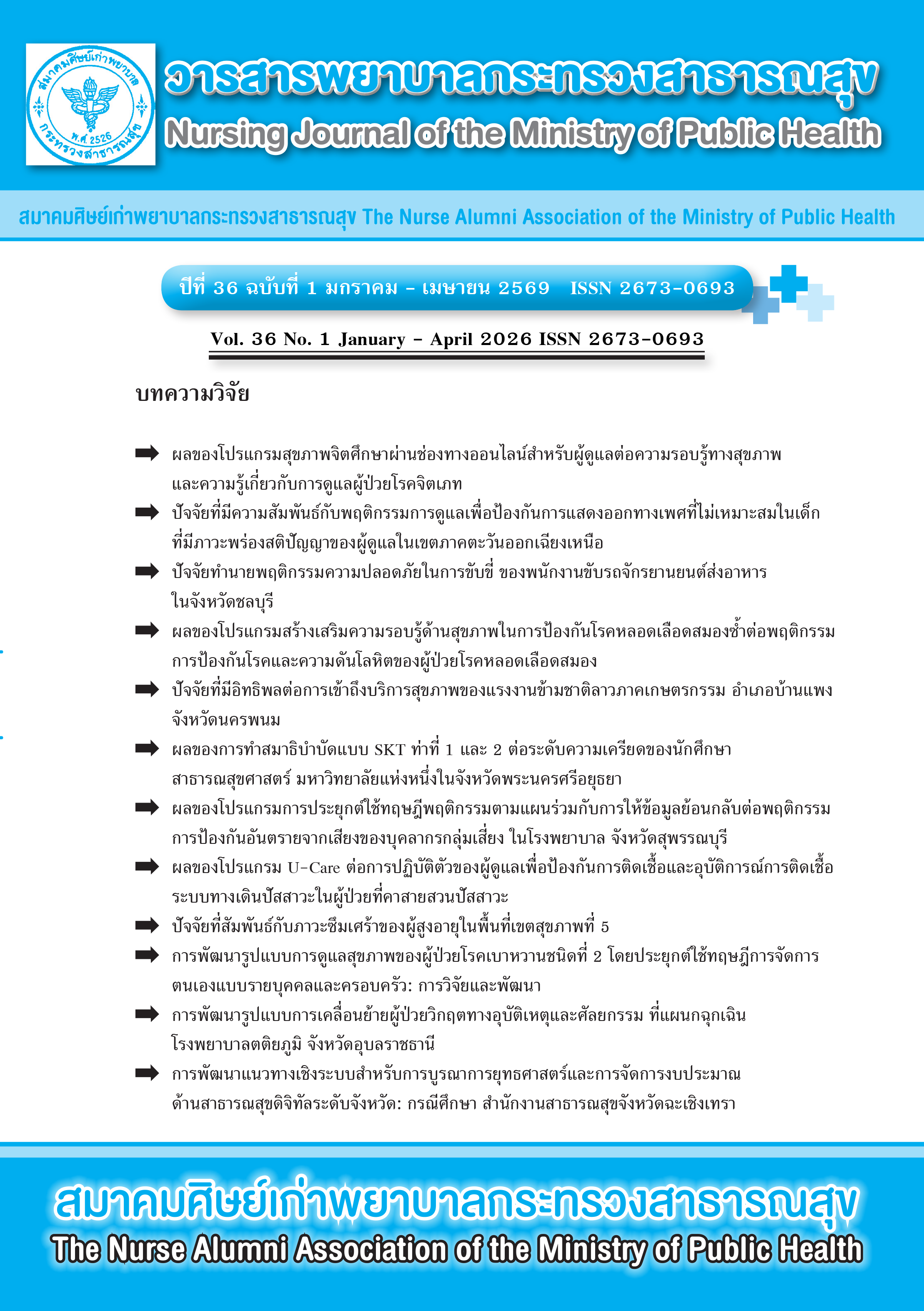
The Effects of a Health Literacy Program for Recurrent-Stroke Prevention on Preventive Behaviors and Blood Pressure of Stroke Patients
Keywords:
health literacy; health promotion program; preventive behavior; strokeAbstract
Health literacy is a fundamental basis that enables patients to access, understand, question, make informed decisions, and take appropriate actions. This quasi-experimental research aimed to evaluate the effects of a health literacy program for recurrent stroke prevention on preventive behaviors and blood pressure among stroke patients. The sample consisted of 60 individuals (both male and female), aged 35 years and older, who were diagnosed with a first-time stroke. They were divided into an experimental group and a control group, with 30 participants in each group, selected through simple random sampling combined with pair matching. The experimental group participated in the program for 12 weeks, while the control group received standard care. Research instruments included a health literacy program for recurrent-stroke prevention with a health literacy manual, a health literacy questionnaire, and a preventive behavior assessment form. All assessment tools were validated for content validity (I-CVI = .86–1.00), and reliability was confirmed with Cronbach’s alpha coefficients of .93 for the health literacy questionnaire and .89 for the preventive behavior assessment form. Data were analyzed using descriptive statistics and t-tests. The results showed that the experimental group had significantly higher post-intervention scores in health literacy and preventive behaviors compared to their pre-intervention scores and those of the control group. Additionally, their blood pressure was significantly lower than that of the control group. In conclusion, the program was effective in promoting health and can be applied as recurrent stroke prevention guidelines.
References
Chulamet P. Nursing care for elderly patients with stroke. Nakhon Pathom: Vanida Partnership; 2022. (in Thai)
Prasat Neurological Institute, Department of Medical Services, Ministry of Public Health. Clinical practice guideline for the treatment of ischemic stroke for physicians. Bangkok: Thana Press Co., Ltd.; 2019. (in Thai)
Department of Disease Control. Department of Disease Control campaigns for World Stroke Day 2023; 2023. Available from: https://www.ddc.moph.go.th/odpc9/news.php?deptcode= odpc9&news=37947&news_views=2609 (in Thai)
Kolmos M, Christoffersen L, Kruuse C. Recurrent ischemic stroke – a systematic review and meta-analysis. J Stroke Cerebrovasc Dis. 2021;30(8):105935. doi:10.1016/j.jstrokecerebrovasdis.2021.105935
Nasan Municipal Public Health Service Center. Registry of stroke patient data for 2024 [Unpublished data]. Nasan: Nasan Municipal Public Health Service Center; 2024. (in Thai)
Boehme AK, Esenwa C, Elkind MSV. Stroke risk factors, genetics, and prevention. Circ Res. 2017;120(3):472–495. doi:10.1161/CIRCRESAHA.116.308398.
Johnson KE, Li H, Zhang M, Springer MV, Galecki AT, Whitney RT, Gottesman RF, Hayward RA, Sidney S, Elkind MSV, Longstreth WT, Heckbert SR, Gerber Y, Sullivan KJ, Levine DA. Cumulative systolic blood pressure and incident stroke type variation by race and ethnicity. JAMA Netw Open. 2024;7(5):e248502. doi:10.1001/jamanetworkopen.2024.8502
Khumsa-ard S, Thiangtham V, Suwan-ampai P. Behavioral factors related to recurrence stroke. Journal of Public Health Nursing. 2017; 31:6–9. (in Thai)
Chuamworakul W. Vascular risk factors for recurrent stroke in Nonsung hospital. ECH Journal of Environment and community Health. 2024;9(2):527-34. (in Thai)
Manatura O. Result of the health literacy development program of stroke alert and the access to an emergency medical service in high-risk patients with hypertension and their relatives in Tambon Chakkarat, Chakkarat district, Nakhon Ratchasima. Regional Health Promotion Center 9 Journal. The Journal for Health Promotion and Environmental Health. 2019;13(32):206-21. (in Thai)
Kaewdumkoeng K. Health literacy: process, practice, and assessment tools. Bangkok: ID All Digital Print; 2021. (in Thai)
Boonchavee P, Nunthaitaweekul P. The effect of health literacy enhancement program on stroke preventive behaviors among stroke patients on recovery stage. Thai Journal of Nursing. 2024;73(2):51-60. (in Thai)
Sriyasak A, et al. The development of health literacy for health management of older adults with diabetes and hypertension in primary care cluster context: case study in Phetchaburi province. Journal of Health Systems Research. 2021;15(2):115–73. (in Thai)
Poopang S. Model of health literacy promotion in changing health behaviors of hypertension risk groups Kuddon Subdistrict Health Promoting Hospital. ECH Journal of Environment and community Health. 2024;9(4):526–34. (in Thai)
Waisayarat T. Effect of a health literacy promotion program on cardiovascular disease prevention behaviors among individuals at high risk for cardiovascular disease [master’s thesis]. Songkhla: Prince of Songkla University; 2023. (in Thai)
Tepsuwan J, Leelhakul V, Torsakulkaew T. The effects of recurrent prevention program for stroke patients at a tertiary level hospital in Nakhon Pathom province. J Thai Stroke Soc. 2018;17(1):5-18. (in Thai)
Downloads
Published
How to Cite
Issue
Section
License

This work is licensed under a Creative Commons Attribution-NonCommercial-NoDerivatives 4.0 International License.
บทความและรายงานวิจัยในวารสารพยาบาลกระทรวงสาธารณสุข เป็นความคิดเห็นของ ผู้เขียน มิใช่ของคณะผู้จัดทำ และมิใช่ความรับผิดชอบของสมาคมศิษย์เก่าพยาบาลกระทรวงสาธารณสุข ซึ่งสามารถนำไปอ้างอิงได้


