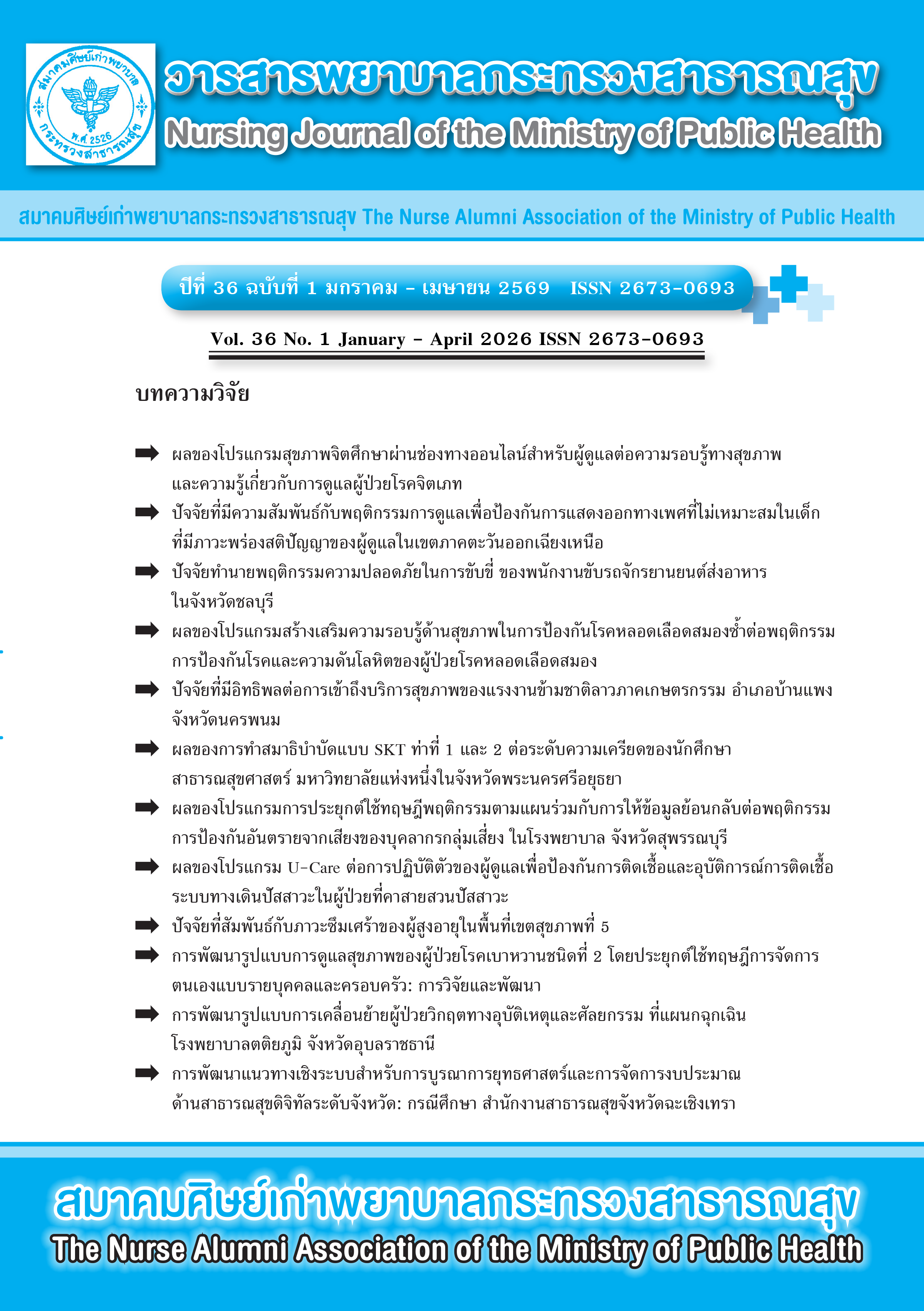
Development of a Model for Transportation Critical Accident and Surgical Patient at the Emergency Department of a Tertiary Hospital in Ubon Ratchathani Province
Keywords:
critical patient; critical patient transportation; model for transportationAbstract
The transfer technique for critical accident and surgical patients is crucial for patient safety. This study aimed to develop and evaluate the effectiveness of a model for transporting critical accident and surgical patients at the emergency department. The study framework integrated the Clinical Practice Guideline Development Framework of the National Health and Medical Research Council (NHMRC), Australia, with the 7 Aspects Model of Care. The research was conducted in two phases: Phase I, the model development phase, consisting of 5 participants (1 physician and 4 nurses); and Phase II, the implementation and evaluation phase, involving 43 personnel (13 nurses and 30 porter staff) and 50 critically ill patients (25 in the pre-implementation group and 25 in the post-implementation group). Data were analyzed using descriptive statistics, relative risk (RR), Fisher’s exact test, and the Wilcoxon signed-rank test. The results revealed that the developed model comprised three phases: pre-transportation, during-transportation, and post-transportation. These phases integrated the dimensions of the 7 Aspects Model of Care to identify and prevent 30 common adverse events in the Emergency Department. Post-test results revealed that undesirable incidents among critically ill patients were significantly reduced from 44.00% to 8.00% [RR = .18; 95% CI (.05, 0.74); p < .05]. The experimental results indicate that the developed model reduced the risk of adverse events by 82.00% compared to the pre-implementation period. Furthermore, nursing competencies, as well as the satisfaction levels of nurses and stretcher-bearer staff, showed significant improvement. Therefore, it can be concluded that this model is clinically feasible and effective in enhancing nursing safety during the transfer of critically ill patients in the emergency department.
References
Murata M, Nakagawa N, Kawasaki T, Yasuo S, Yoshida T, Ando K, et al. Adverse events during intrahospital transport of critically ill patients: A systematic review and meta-analysis. Am J Emerg Med. 2022 Feb;52:13–9.
Blakeman TC, Branson RD. Inter- and intra-hospital transport of the critically ill. Respir Care. 2013 June 1;58(6):1008–23.
Canellas M, Palma I, Pontífice-Sousa P, Rabiais I. Checklist para o transporte intra-hospitalar seguro do doente crítico: A scoping review. Enferm Glob. 2020 Sept 21;19(4):525–72.
Jia L, Wang H, Gao Y, Liu H, Yu K. High incidence of adverse events during intra-hospital transport of critically ill patients and new related risk factors: a prospective, multicenter study in China. Crit Care. 2016 Jan 18;20(1):12.
Schumaker J, Taylor W, McGonigle T. The emergency, trauma, and transport nursing workforce: Highlights of a benchmark 2019 survey. Nurs Manag (Harrow). 2019 Dec;50(12):20.
Veiga VC, Postalli NF, Alvarisa TK, Travassos PP, Vale RTDS, Oliveira CZD, et al. Adverse events during intrahospital transport of critically ill patients in a large hospital. Rev Bras Ter Intensiva [Internet]. 2019 [cited 2025 Nov 9];31(1). Available from: https://criticalcarescience.org/article/adverse-events-during-intrahospital-transport-of-critically-ill-patients-in-a-large-hospital/
Zirpe KG, Tiwari AM, Kulkarni AP, Govil D, Dixit SB, Munjal M, et al. Adverse events during intrahospital transport of critically ill patients: A multicenter, prospective, observational study (I-TOUCH study). Indian J Crit Care Med Peer-Rev Off Publ Indian Soc Crit Care Med. 2023;27(9):635.
Nonami S, Kawakami D, Ito J, Ouchi K, Miyoshi Y, Tatebe M, et al. Incidence of adverse events associated with the in-hospital transport of critically ill patients. Crit Care Explor. 2022;4(3):e0657.
Ringdal M, Chaboyer W, Warrén Stomberg M. Intrahospital transports of critically ill patients: critical care nurses’ perceptions. Nurs Crit Care. 2016 May;21(3):178–84.
Bergman LM, Pettersson ME, Chaboyer WP, Carlström ED, Ringdal ML. Safety hazards during intrahospital transport: a prospective observational study. Crit Care Med. 2017;45(10):e1043–9.
Wongnaikot P, Saensom D. Development of an intrahospital transfer clinical nursing practice guideline for critically ill trauma patients. In: Proceedings of National Seminar on research presentation Khonkan: Khonkan University. 2017. (in Thai)
Williams P, Karuppiah S, Greentree K, Darvall J. A checklist for intrahospital transport of critically ill patients improves compliance with transportation safety guidelines. Aust Crit Care. 2020;33(1):20–4.
Jarden RJ, Quirke S. Improving safety and documentation in intrahospital transport: development of an intrahospital transport tool for critically ill patients. Intensive Crit Care Nurs. 2010;26(2):101–7.
Kamsuk S, Siriwat R, Rojtinnakorn N, Pokpoonsrap J. Development of a nursing practice guideline for intrahospital transfer of critically ill emergency patients in the Division of Emergency and Trauma Nursing, Maharaj Nakhon Ratchasima Hospital. R Thai Police Nurs J. 2020 June 16;12(1):36–47. (in Thai)
Nursing Division. Quality assurance in hospital nursing. inpatient nursing services. 1st ed. Vol. 2001. Nonthaburi: Ministry of Public Health; 2001. (in Thai)
Sanjondee S, Phuangphaiboon P, Hemchanan N. Development of a nursing care model for patients with acute ischemic stroke using the 7 Aspects model of care. J Health Sci Bormarajonani Coll Nurs Sunpasittiprasong. 2022 Oct 20;6(3):1–18. (in Thai)
National Health and Medical Research Council. A guide to the development, implementation and evaluation of clinical practice guidelines [Internet]. Canberra: Commonwealth of Australia [internet]. 1999 [cited 2026 Mar 29]. Available from: https://www.nhmrc.gov.au/sites/default/files/images/a-guide-to-the-development-and-evaluation-of-clinical-practice-guidelines.pdf
Srisatidnarakul B. The Methodology In Nursing Research [Internet]. 5th ed. Vol. 2010. Bangkok: U & I Inter Media [internet]. 2010 [cited 2025 Nov 9]. Available from: https://opac.sru.ac.th/bibitem?bibid=b00067274. (in Thai)
Nantachaipan P. The CPGs quality evaluation questionnaire. Faculty of Nursing, Chiang Mai University; 2006. (in Thai)
The Joanna Briggs Institute. New JBI levels of evidence. 2014. Available from: https://jbi.global/sites/default/files/2019-05/JBI-Levels-of-evidence_2014_0.pdf
Bergman L, Pettersson M, Chaboyer W, Carlström E, Ringdal M. In safe hands: Patients’ experiences of intrahospital transport during intensive care. Intensive Crit Care Nurs. 2020;59:102853.
Downloads
Published
How to Cite
Issue
Section
License

This work is licensed under a Creative Commons Attribution-NonCommercial-NoDerivatives 4.0 International License.
บทความและรายงานวิจัยในวารสารพยาบาลกระทรวงสาธารณสุข เป็นความคิดเห็นของ ผู้เขียน มิใช่ของคณะผู้จัดทำ และมิใช่ความรับผิดชอบของสมาคมศิษย์เก่าพยาบาลกระทรวงสาธารณสุข ซึ่งสามารถนำไปอ้างอิงได้


