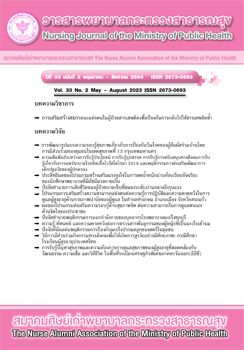
การเสริมสร้างการรับรู้ความสามารถของตนเองในผู้ป่วยสารเสพติด เพื่อป้องกันการกลับไปใช้สารเสพติดซ้ำ
คำสำคัญ:
การรับรู้ความสามารถของตนเอง; การบำบัดรักษาผู้ใช้สารเสพติด; ป้องกันการเสพซ้ำบทคัดย่อ
ปัญหาสารเสพติดถือเป็นปัญหาที่สำคัญของประเทศไทยมายาวนาน และมีแนวโน้มการระบาดรุนแรง ขยายวงกว้างออกไปในทุกสาขาอาชีพและทุกกลุ่มวัยมากขึ้น ผู้ป่วยที่ผ่านการบำบัดสารเสพติดยังคงมีอัตราการกลับไปใช้สารเสพติดซ้ำค่อนข้างสูงถือเป็นปัญหาที่สำคัญ และพบว่าปัจจัยที่มีผลต่อการกลับไปใช้สารเสพติดซ้ำมากที่สุดคือ ปัจจัยด้านบุคคล ได้แก่ อาการอยากยา การขาดแรงจูงใจในการเลิกใช้สารเสพติด การขาดทักษะการปฏิเสธ การขาดทักษะในการเผชิญกับสถานการณ์เสี่ยงต่อการใช้สารเสพติด และการรับรู้ความสามารถของตนเองในการเลิกใช้สารเสพติด ปัจจุบันมีรูปแบบการบำบัดที่หลากหลายที่นำมาใช้ในการป้องกันการกลับไปใช้สารเสพติดซ้ำ ซึ่งการเสริมสร้างการรับรู้ความสามารถของตนเองในการเลิกใช้สารเสพติด เป็นอีกหนึ่งวิธีที่สำคัญที่นำมาใช้ในผู้ป่วยสารเสพติด บทความวิชาการนี้มีวัตถุประสงค์เพื่อนำเสนอความรู้เกี่ยวกับการเสริมสร้างการรับรู้ความสามารถของตนเองในผู้ป่วยสารเสพติด เพื่อให้พยาบาลและบุคคลที่เกี่ยวข้องสามารถนำมาประยุกต์ใช้ในการดูแลและติดตามผู้ป่วยสารเสพติด ให้เกิดการรับรู้ความสามารถของตนเองในการเลิกใช้สารเสพติดและป้องกันการกลับไปใช้สารเสพติดซ้ำ ทำให้ผู้ป่วยสามารถกลับไปใช้ชีวิตร่วมกับสังคมอย่างปกติสุข
เอกสารอ้างอิง
Office of the Narcotics Control Board. Narcotics prevention in the community [Internet]. 2021 [cited 5 March 2023]. Available from: https://www.oncb.go.th/SitePages/ narcotics_effect.aspx
Office of Secretary of National Addiction treatment & Rehabilitation Committee, Ministry of Public Health [Internet].2023 [cited 13 June 2023]. Available from: https://antidrugnew.moph.go.th/Runtime/Runtime/Form/FrmReports/
Choosunthia W, Pinitsuntorn S. The impact of drug addiction on patients admitted to Thanyarak hospital, Udonthani: a case study. Community Health Development Quarterly Khon Kaen University 2017;5(3):523-33.(in Thai)
Sonhong N. Psychiatric comorbidity with substance use disorder patients at Songkhla Rajanagarindra psychiatric hospital. Journal of Somdet Chaopraya Institute of Psychiatry 2016;10(1):52-63.(in Thai)
Princess Mother National Institute on Drug Abuse Treatment. Therapist manual: Outpatient drug addiction treatment based on cognitive-behavioral therapy model [Internet]. 2012 [cited 5 March 2023]. Available from: https://udo.moph.go.th/Net_Narcotic/Manual/ 2%20Patient%20 workbook[1].pdf
Purahong G. Factors affecting relapsing drug addicted patients in Pathumthani province. Journal of Public Health Nursing 2018;32(2):23-40.(in Thai)
Chatu-hong S, Tan-sri-sa-kul S. Factors affecting relapse drug users with competency rehabilitation in Treatment compulsory system as a case study of office of probation, Roi-ed province. Chophayom Journal 2018;29(1):199-209.(in Thai)
Sirinual S, Suphunnakul P, Noosorn N, Wongsawad P. Factors affecting amphetamine relapse among drug addicts after treatment. Journal of Health Science 2016;10(1):39-45.(in Thai)
Bandura A. Social Foundation of Thought and Action: A Social Cognitive Theory. Englewood Cliffs, New Jersey: Rrentice-Hall;1986.
Marlatt GA, Gordon JR. Relapse prevention: Maintenance strategies in the treatment of addictive behaviors. New York: Guilford Press.1985.10
Chokrung P, Hengudomsub P, Vatanasin D, Pratoomsri W. The effect of program to enhance perceived drug abstinence self-efficacy on intention to drug abstinence among persons with amphetamine dependence. Journal of Boromarajonani College of Nursing, Bangkok 2016;32(3):37-50.(in Thai)
Bashirian S, Barati M, Mohammadi Y, Zarnagh HG, Bagheri S. Predictors of drug abuse relapse for Iranian addicted women: an application of social cognitive theory. Addictive Disorders & Their Treatment 2021;20(4):260-7. DOI: 10.1097/ADT.0000000000000249.
Puntong B, Kimsungnoen N. Effectiveness of self-efficacy and family support program on addiction behaviors in patients with amphetamine dependence in the national institute of drug abuse treatment. Journal of Health Science 2014;23(1):61-8.(in Thai)
Panya S. Study on the risk factors for repeated drug addiction among drug addiction patient at a drug addiction Rehabilitation Center in the Northeast. The 2st National Conference Ubon Ratchathani 2017;4.(in Thai)
Saengduenchai S, Nilban S, Jaipatum W, Konghom S, Jhinpracha Y, Singhtho T. The effect of cognitive behavior therapy on relapse prevention of methamphetamine dependence among in-patients. Nonthaburi:The Graphico Systems. 2014.(in Thai)
Department of Mental Health, Ministry of Public Health. Guidelines for the treatment and rehabilitation of alcohol/drug/substance dependence with psychotic symptoms and psychiatric comorbidities, department of mental health. Nonthaburi:Dee na doo media plus. 2021.(in Thai)
Pittayaruengnon W, Vivatthanaporn A. Problems of addiction treatment: a case study of public hospitals. Journal of Dhammasuksa Research 2022;5(2):94-102.(in Thai)
Panya S, Thajang S, Chapik N, Kanchanabut S, Mongkolsawad J. The relationship between personal factors, psychosocial factors, and environmental factors among repeated methamphetamine recurrence in Thanyarak hospital. Nursing Journal 2021;48(2):273-82.(in Thai)
Samputtanon J, Yunibhand J.Factors related to self-efficacy for amphetamine relapse prevention among male adolescents, government drug abuse treatment centers. Journal of Nursing and Health Care 2018;36(1):6-14.(in Thai)
Sirited P, Thammaseeha N. Self-efficacy theory and self-healthcare behavior of the elderly. Journal of The Royal Thai Army Nurses 2019;20(2):58-65.(in Thai)
Tongtub K, Uthis P. The effect of coping skills training in relapse prevention program on amphetamine abstinence self-efficacy of amphetamine users. The Journal of Psychiatric Nursing and Mental Health 2014;28(2):88-99.(in Thai)
ดาวน์โหลด
เผยแพร่แล้ว
รูปแบบการอ้างอิง
ฉบับ
ประเภทบทความ
สัญญาอนุญาต

อนุญาตภายใต้เงื่อนไข Creative Commons Attribution-NonCommercial-NoDerivatives 4.0 International License.
บทความและรายงานวิจัยในวารสารพยาบาลกระทรวงสาธารณสุข เป็นความคิดเห็นของ ผู้เขียน มิใช่ของคณะผู้จัดทำ และมิใช่ความรับผิดชอบของสมาคมศิษย์เก่าพยาบาลกระทรวงสาธารณสุข ซึ่งสามารถนำไปอ้างอิงได้


