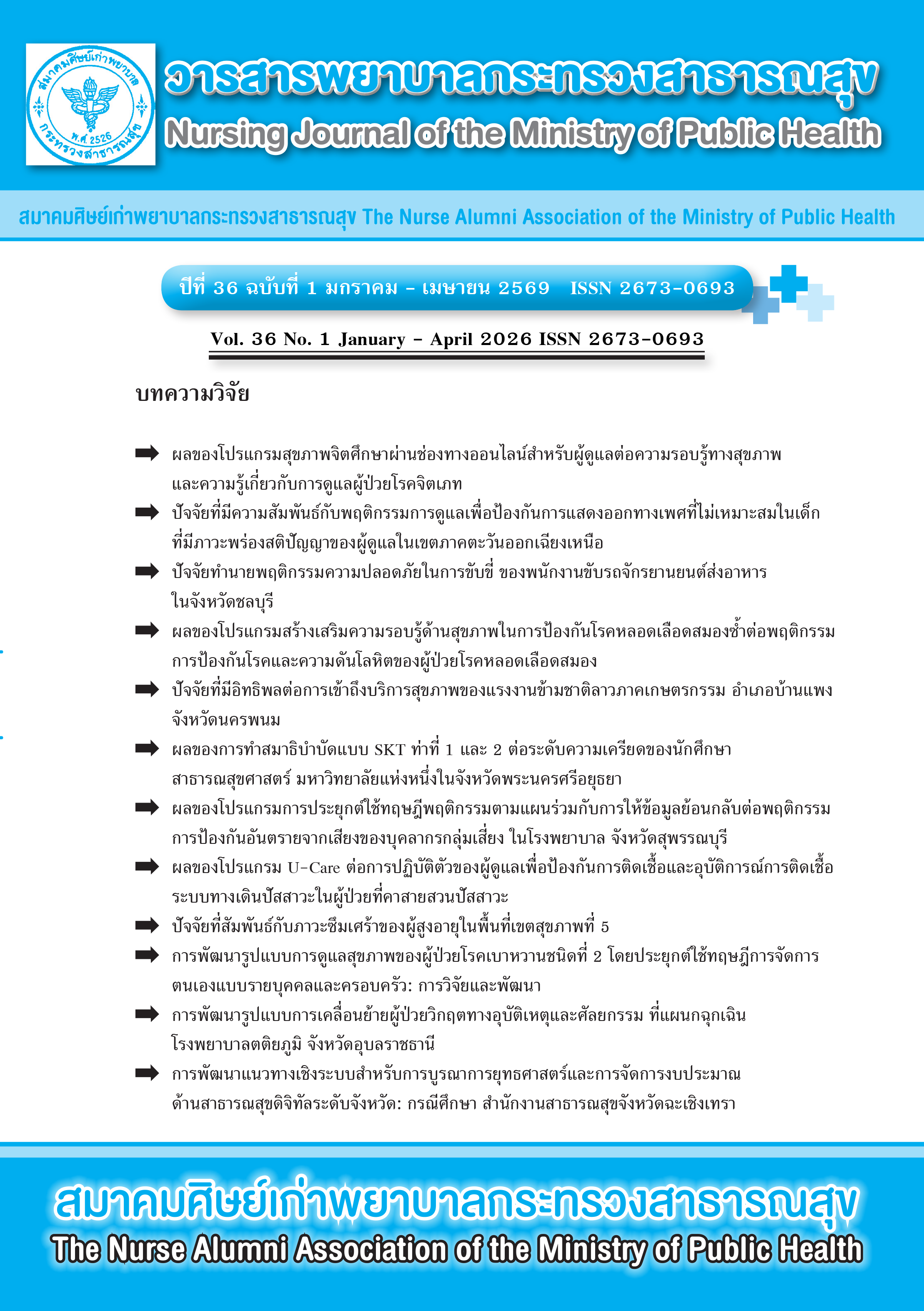
ผลของโปรแกรม U-Care ต่อการปฏิบัติตัวของผู้ดูแลเพื่อป้องกันการติดเชื้อและ อุบัติการณ์การติดเชื้อระบบทางเดินปัสสาวะในผู้ป่วยที่คาสายสวนปัสสาวะ
ผลของโปรแกรม U-Care ต่อการปฏิบัติตัวของผู้ดูแลเพื่อป้องกันการติดเชื้อและ อุบัติการณ์การติดเชื้อระบบทางเดินปัสสาวะในผู้ป่วยที่คาสายสวนปัสสาวะ
คำสำคัญ:
การป้องกันการติดเชื้อ; ผู้ป่วยที่คาสายสวนปัสสาวะ; อุบัติการณ์การติดเชื้อบทคัดย่อ
การปฏิบัติของผู้ดูแลมีความสำคัญต่อการป้องกันการติดเชื้อและอุบัติการณ์การติดเชื้อในผู้ป่วย
ที่คาสายสวนปัสสาวะโดยตรง การวิจัยกึ่งทดลองนี้มีวัตถุประสงค์เพื่อศึกษาผลของโปรแกรม U-Care ต่อการปฏิบัติของผู้ดูแลเพื่อป้องกันการติดเชื้อและอุบัติการณ์การติดเชื้อระบบทางเดินปัสสาวะในผู้ป่วย
ที่คาสายสวนปัสสาวะ กลุ่มตัวอย่างเป็นผู้ดูแลผู้ป่วยที่คาสายสวนปัสสาวะที่บ้าน จำนวนทั้งสิ้น 60 คน แบ่งเป็นกลุ่มทดลอง 30 คน และกลุ่มควบคุม 30 คน กลุ่มทดลองได้รับโปรแกรมฯ เป็นระยะเวลา 3 เดือน ส่วนกลุ่มควบคุมได้รับการดูแลตามปกติ เก็บรวบรวมข้อมูลด้วยแบบวัดการปฏิบัติของผู้ดูแลเพื่อป้องกันการติดเชื้อระบบทางเดินปัสสาวะในผู้ป่วยฯ ซึ่งมีค่าความเชื่อมั่น (Cronbach’s alpha) เท่ากับ .91 วิเคราะห์ข้อมูลด้วยสถิติพรรณนา สถิติ Independent t-test, Mann-Whitney U test, Wilcoxon Signed Ranks test, Chi-square test และ Fisher's exact test หลังจากการนำโปรแกรม U-Care ไปใช้ พบว่า คะแนนเฉลี่ยการปฏิบัติของผู้ดูแลเพื่อป้องกันการติดเชื้อระบบทางเดินปัสสาวะในผู้ป่วยฯ ในภาพรวมสูงกว่าก่อนเข้าร่วมโปรแกรม และสูงกว่ากลุ่มควบคุมอย่างมีนัยสำคัญทางสถิติ และอุบัติการณ์การติดเชื้อระบบทางเดินปัสสาวะในผู้ป่วยฯ ของกลุ่มทดลองต่ำกว่ากลุ่มควบคุมอย่างมีนัยสำคัญทางสถิติ โดยการติดเชื้อระบบทางเดินปัสสาวะในผู้ป่วยที่คาสายสวนปัสสาวะมีอัตราร้อยละ 3.33 หรือ .37 ครั้งต่อ 1,000 วันคาสายสวน ผลการวิจัยแสดงให้เห็นว่าโปรแกรม U-Care สามารถนำมาใช้เพื่อปรับเปลี่ยนการปฏิบัติของผู้ดูแลเพื่อป้องกันการติดเชื้อและลดอุบัติการณ์การติดเชื้อในผู้ป่วยที่คาสายสวนปัสสาวะได้อย่างมีประสิทธิภาพ
เอกสารอ้างอิง
Centers for Disease Control and Prevention (CDC). Urinary Tract Infection (Catheter-Associated Urinary Tract Infection [CAUTI] and Non-Catheter-Associated Urinary Tract Infection [UTI]) Events [Internet]. 2025 [cited 2025 Jun 8]. Available from: https://www.cdc.gov/nhsn/pdfs/pscmanual/7psccauticurrent.pdf
Infection Prevention and Control and Antimicrobial Resistance Surveillance program. Incidence of healthcare associated infections in Thailand. 2025 [cited 2025 Jun 8]. Available from:
At Samat Hospital. Hospital infection surveillance report 2024 [internal report]. Roi Et: At Samat Hospital; 2024.
Nethichai P. The development of a teaching program and caregivers’ skill development to prevent urinary tract infections in patients with urinary catheterization at home. Journal of Health and Environmental Education 2024;9(1):576-586. (in Thai)
Buaprasert S. The effect of urinary catheterized care program on caregivers in urinary catheterized patients. Kanchanaburi Medical Journal 2023;11(33):30-43. (in Thai)
Luejunda B, PaerKao C. Factors predicting catheter-associated urinary tract infections in critically ill internal medicine patients. Journal of Nursing Science and Health 2025;48(1):
-141. (in Thai)
Wongsri P, Thongmaha S, Butsing N, Skuntaniyom S, Wongprikorn A. Risk factors of catheter-associated urinary tract infection in a tertiary-care medical center. Nursing Research and Innovation Journal 2023;29(3):303-318. (in Thai)
Anothayanonth Y. Factors that affecting catheter-associated urinary tract infection in tertiary hospital. Journal of the Police Nurses 2023;12(1):48-57. (in Thai)
Seesok T. The development of patient care model with urinary catheterization at home to prevent urinary tract infections. Journal of Boromarajonani College of Nursing, Surin 2024;14(2):
-77. (in Thai)
Rukyou S, Lueboonthavatchai O, Navicharern R. The effect of coaching program on caregivers’ agency in urinary catheterized care for spinal cord injured patients. Thai Journal of Cardio-Thoracic Nursing 2015;26(1):44-56. (in Thai)
Sirithichakorn P, Wongkhumkaew P, Kumphirat P. Effects of a health literacy promotion program on behavior to prevent urinary tract infection. Journal of Nursing Division 2025;52(1):17-28. (in Thai)
Bamrasnaradura Infection Diseases Institute. The national strategic action plan for hospital-associated infection prevention and control 2023-2027 Thailand. Bangkok: Aksorn graphic and design.2022. (in Thai)
The Nosocomial Infection Control Group of Thailand, Department of Disease Control, Bamrasnaradura Infection Diseases Institute. Updating IPC Guidelines for Thailand 2024. Bangkok: Aksorn graphic and design.2024. (in Thai)
Infectious disease association of Thailand. Clinical practice guidelines for the management of urinary tract infections, 2025[Internet].2025[cited 2025 Jun 8].Available from: https://idthai.org/Contents/Views/?d=!17!9!!1045!
Bamrasnaradura Infection Diseases Institute. Hospital-Acquired Infection (HAI) diagnostic manual. Bangkok: Aksorn graphic and design.2018. (in Thai)
Mazi WAM, Bondad M, Althumali M, Alzahrani T. Reducing catheter-associated urinary tract infection in high dependency unit: an eighteen-month quality improvement intervention study period. Infect Prev Pract. 2024;6:100362.
Silva JLA, Silva MR, Almeida THRC, Barbosa DA. Educational interventions to prevent urinary infections in institutionalized elderly people. Invest Educ Enferm. 2024;42(1):e05.
ดาวน์โหลด
เผยแพร่แล้ว
รูปแบบการอ้างอิง
ฉบับ
ประเภทบทความ
สัญญาอนุญาต

อนุญาตภายใต้เงื่อนไข Creative Commons Attribution-NonCommercial-NoDerivatives 4.0 International License.
บทความและรายงานวิจัยในวารสารพยาบาลกระทรวงสาธารณสุข เป็นความคิดเห็นของ ผู้เขียน มิใช่ของคณะผู้จัดทำ และมิใช่ความรับผิดชอบของสมาคมศิษย์เก่าพยาบาลกระทรวงสาธารณสุข ซึ่งสามารถนำไปอ้างอิงได้


