
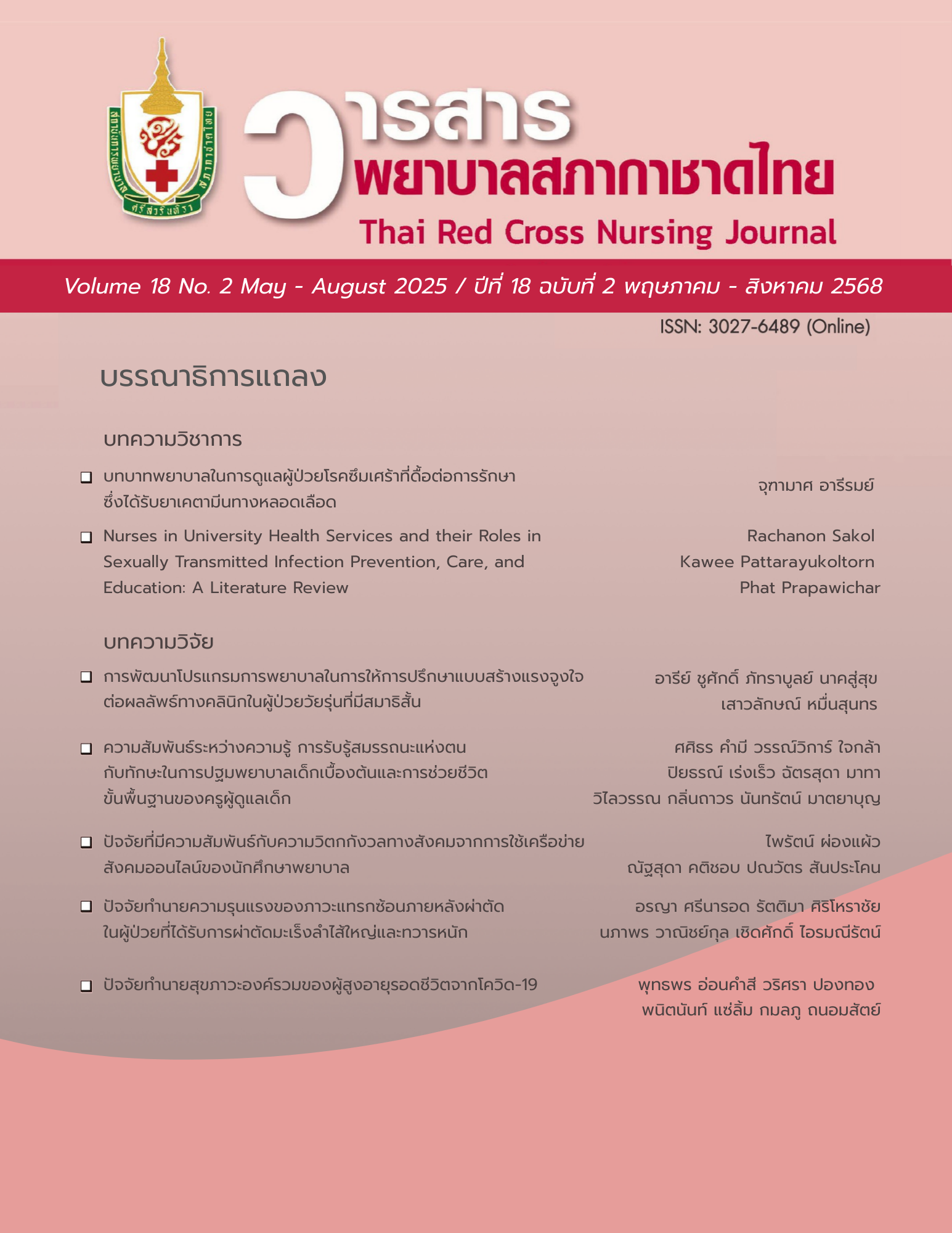
Factors Predicting Severity of Postoperative Complications among Colorectal Cancer Surgery Patients
DOI:
https://doi.org/10.64767/trcn.2025.271404Keywords:
colorectal cancer, postoperative complications, nutritional status, health literacy, person-centered careAbstract
This study aimed to examine the severity and predictive factors of postoperative complications within 30 days among colorectal cancer patients who met specific selection criteria. A total of 143 colorectal cancer patients attended postoperative appointments at a university hospital outpatient clinic. Data were collected through interviews using a questionnaire package that included personal data, nutritional status, perceived person-centered care, health literacy, and the severity of postoperative complications. The reliability of the perceived person-centered care and health literacy assessments was confirmed with Cronbach’s alpha coefficients of 0.92 and 0.95, respectively, and inter-rater reliability using the intraclass correlation coefficient of 0.94. Descriptive statistics, Pearson’s product-moment correlation coefficient, point-biserial correlation coefficient, and multiple regression analysis were used for data analysis.
The findings indicated that the average severity of postoperative complications was low (Mean = 17.82, S.D. = 7.56). Nutritional status, perceived person-centered care, and health literacy significantly predicted complication severity, accounting for 28% of the variance (Adjusted R2 = 28, F (4, 138) = 14.60, p <.05). Nutritional status (β = -.28, p <.001) and perceived person-centered care (β =-.28, p<.001) were the strongest predictors, followed by health literacy (β = -.24, p <.05).
The findings of this study provide a foundational framework for developing evidence-based guidelines to enhance preoperative nutritional status, implement person-centered care, and improve health literacy among surgical patients. These efforts aim to mitigate the severity of postoperative complications within the first 30 days following surgery.
Downloads
References
American Cancer Society. Colorectal cancer facts & figures 2020-2022 [Internet]. Atlanta: American Cancer Society; 2020 [cited 2024 Mar 28]. 48 p. Available from: https://www.cancer.org/content/dam/cancer-org/research/cancer-facts-and-statistics/colorectal-cancer-facts-and-figures/colorectal-cancer-facts-and-figures-2020-2022.pdf
Medical Digital Division of National Cancer Institute. Hospital-based cancer registry 2022 [Internet]. Bangkok: National Cancer Institute; 2024 [cited 2024 Jan 9]. Available from: https://nci.go.th/th/cancer_record/download/Hosbased-2022-1.pdf
Tominaga T, Nonaka T, Takamura Y, Oishi K, Hashimoto S, Shiraishi T, et al. Risk factors for pulmonary complications after colorectal cancer surgery: a Japanese multicenter study. Int J Colorectal Dis 2024;39(1):76. DOI: https://doi.org/10.1007/s00384-024-04652-5
Abd El Aziz MA, Perry WR, Grass F, Mathis KL, Larson DW, Mandrekar J, et al. Predicting primary postoperative pulmonary complications in patients undergoing minimally invasive surgery for colorectal cancer. Updates Surg 2020;72(4):977-83. DOI: https://doi.org/10.1007/s13304-020-00892-6
Hou TY, Gan HQ, Zhou JF, Gong YJ, Li LY, Zhang XQ, et al. Incidence of and risk factors for surgical site infection after colorectal surgery: a multiple-center prospective study of 3,663 consecutive patients in China. Int J Infect Dis 2020;96:676-81. DOI: https://doi.org/10.1016/j.ijid.2020.05.124
Wako G, Teshome H, Abebe E. Colorectal anastomosis leak: rate, risk factors and outcome in a tertiary teaching hospital, addis ababa Ethiopia, a five year retrospective study. Ethiop J Health Sci 2019;29(6):767-74. DOI: https://doi.org/10.4314/ejhs.v29i6.14
Suwa K, Ushigome T, Ohtsu M, Narihiro S, Ryu S, Shimoyama Y, et al. Risk factors for early postoperative small bowel obstruction after anterior resection for rectal cancer. World J Surg 2018;42(1):233-8. DOI: https://doi.org/10.1007/s00268-017-4152-y
Suttipong C, Sindhu S, Utriyaprasit K, Iramaneerat C. Quality of life in postoperative colorectal cancer survivors: a structural equation model. SMJ 2021;73(9):576-86. DOI: https://doi.org/10.33192/Smj.2021.75
Jin HY, Hong I, Bae JH, Lee CS, Han SR, Lee YS, et al. Predictive factors of high comprehensive complication index in colorectal cancer patients using enhanced recovery After Surgery protocol: role as a safety net in early discharge. Ann Surg Treat Res 2021;101(6):340. DOI: https://doi.org/10.4174/astr.2021.101.6.340
Ortiz-Lopez D, Marchena-Gomez J, Nogues-Ramia E, Sosa-Quesada Y, Arencibia-Perez B, Artiles-Armas M, et al. Utility of a new prognostic score based on the Comprehensive Complication Index (CCI(R)) in patients operated on for colorectal cancer (S-CRC-PC score). Surg Oncol 2022;42:101780. DOI: https://doi.org/10.1016/j.suronc.2022.101780
Slankamenac K, Graf R, Barkun J, Puhan MA, Clavien PA. The comprehensive complication index: a novel continuous scale to measure surgical morbidity. Ann surg 2013;258(1):1-7. DOI: https://doi.org/10.1097/SLA.0b013e318296c732
Irvine D, Sidani S, Hall LM. Linking outcomes to nurses' roles in health care. Nurs Econ 1998;16(2):58-64.
Louis M, Johnston SA, Churilov L, Ma R, Marhoon N, Burgess A, et al. The hospital costs of complications following colonic resection surgery: a retrospective cohort study. Ann Med Surg (Lond) 2020;54:37-42. DOI: https://doi.org/10.1016/j.amsu.2020.03.013
Lei PR, Liao JW, Ruan Y, Yang XF, Hu KP, Liu J-P, et al. Risk factors analysis for surgical site infection following elective colorectal resection: a retrospective regression analysis. Chin Med J 2020;133(5):571-6. DOI: https://doi.org/10.1097/CM9.0000000000000670
Xu F, Meng C, Yang Z, Li H, Gao J, Sun L, et al. Prognostic nutrition index predicts short-term surgical complications in patients with rectal cancer after laparoscopic surgery. Front Surg 2022;9:1000108. DOI: https://doi.org/10.3389/fsurg.2022.1000108
Theiss LM, Wood T, McLeod MC, Shao C, Santos Marques ID, Bajpai S, et al. The association of health literacy and postoperative complications after colorectal surgery: a cohort study. Am J Surg 2022;223(6):1047-52. DOI: https://doi.org/10.1016/j.amjsurg.2021.10.024
Liu Y, Fu M, Zhou Q, Tian M, Zhang X, Wang Z. The application of patient-centered care bundle significantly reduces incidence of perioperative respiratory complications in hip fracture patients aged 80 and over. Geriatr Nurs 2022;43:213-8. DOI: https://doi.org/10.1016/j.gerinurse.2021.11.014
Griffiths J, Puttinoi S, Pongsaksri M. The general practitioner assessment of cognition; GPCOG (Thai Version): Validity and Reliability. In: 9th Pan-Pacific Conference on Rehabilitation cum 21st Annual Congress of Gerontology; 2014 Nov 29-30; Hongkong. Kowloon: The Hong Kong Polytechnic University; 2014. p. B65 (in Thai)
Cohen J. Statistical power analysis for the behavioral sciences. 2nd ed. Hillsdale (NJ): Lawrence Erlbaum Associates; 1988.
Brodaty H, Pond D, Kemp NM, Luscombe G, Harding L, Berman K, et al. The GPCOG: a new screening test for dementia designed for general practice. J Am Geriatr Soc 2002;50(3):530-4. DOI: https://doi.org/10.1046/j.1532-5415.2002.50122.x
Onodera T, Goseki N, Kosaki G. Prognostic nutritional index in gastrointestinal surgery of malnourished cancer patients. Nihon Geka Gakkai Zasshi 1984;85(9):1001-5.
Wanitkun N, Pattaramongkolrit S, Vichathai C, Bhechrung B, Kloyahem S, Batterham R, et al. Thai health literacy [Internet]. Nonthaburi: Health Systems Research Institute; 2014 [cited 2024 Mar 28]. Available from: http://kb.hsri.or.th/dspace/handle/11228/3987 (in Thai)
Little P, Everitt H, Williamson I, Warner G, Moore M, Gould C, et al. Observational study of effect of patient centredness and positive approach on outcomes of general practice consultations. BMJ 2001;323(7318):908-11. DOI: https://doi.org/10.1136/bmj.323.7318.908
Choocherd S, Wanitkun N, Danaidusadeekul S, Yottasurodom C. Relationships among health literacy, severity of disease, patient engagement, perception of person-centered Care and Quality of Life in Patients after Coronary Artery Bypass Graft Surgery. J Nurs Sci 2016;34(Suppl 1):94 -106. (in Thai)
Charlson ME, Charlson RE, Peterson JC, Marinopoulos SS, Briggs WM, Hollenberg JP. The Charlson comorbidity index is adapted to predict costs of chronic disease in primary care patients. J Clin Epidemiol 2008;61(12):1234-40. DOI: https://doi.org/10.1016/j.jclinepi.2008.01.006
Rattanamongkol C, Sindhu S, Toskulkao T, Iramaneerat C. Factors related to the severity of postoperative complications in patients with primary gastrointestinal (stomach, liver, bile duct, colon, and rectum) cancer. Thai Journal of Nursing Council 2016;31(3):97-109. (in Thai)
Field A. Discovering statistics using IBM SPSS statistics. 4th ed. London: SAGE; 2013.
Durak D, Alkurt EG, Turhan VB, Tutan B, Sahiner IT, Kendirci M, et al. Comparison of short-term results of laparoscopic and open surgeries for colorectal cancer: a single-center experience. Cureus 2022;14(5):e24635. DOI: https://doi.org/10.7759/cureus.24635
Irani JL, Hedrick TL, Miller TE, Lee L, Steinhagen E, Shogan BD, et al. Clinical practice guidelines for enhanced recovery after colon and rectal surgery from the American society of colon and rectal surgeons and the society of American gastrointestinal and endoscopic surgeons. Dis Colon Rectum 2023;66(1):15-40. DOI: https://doi.org/10.1097/DCR.0000000000002650
Leigard E, Hertzberg D, Konrad D, Bell M. Increasing perioperative age and comorbidity: a 16-year cohort study at two University hospital sites in Sweden. Int J Surg 2024;110(7):4124-31. DOI: https://doi.org/10.1097/JS9.0000000000001326
Ng O, Keeler BD, Mishra A, Simpson JA, Neal K, Al-Hassi HO, et al. Iron therapy for preoperative anaemia. Cochrane Database Syst Rev 2019;12(12):CD011588. DOI: https://doi.org/10.1002/14651858.CD011588.pub3
Olsen BC, Sakkestad ST, Pfeffer F, Karliczek A. Rate of anastomotic leakage after rectal anastomosis depends on the definition: pelvic abscesses are significant. Scand J Surg 2019;108(3):241-49. DOI: https://doi.org/10.1177/1457496918812223
Khoyun S, Chokpinyoworapong N, Poothawee W, Thoin P. The effects of empowerment program on knowledge toward colostomy care and self-care ability in patients undergoing colostomy surgery and families. RTN Med J 2021;48(3):650-66. (in Thai)
Downloads
Published
How to Cite
Issue
Section
License
Copyright (c) 2025 Srisavarindhira Thai Red Cross Institute of Nursing

This work is licensed under a Creative Commons Attribution-NonCommercial-NoDerivatives 4.0 International License.
เนื้อหาบทความหรือข้อคิดเห็นต่างๆ ในวารสารพยาบาลสภากาชาดไทยนี้ เป็นความคิดเห็นของผู้เขียนบทความ ไม่ใช่ความเห็นของกองบรรณาธิการ หรือสถาบันการพยาบาลศรีสวรินทิรา สภากาชาดไทย


