
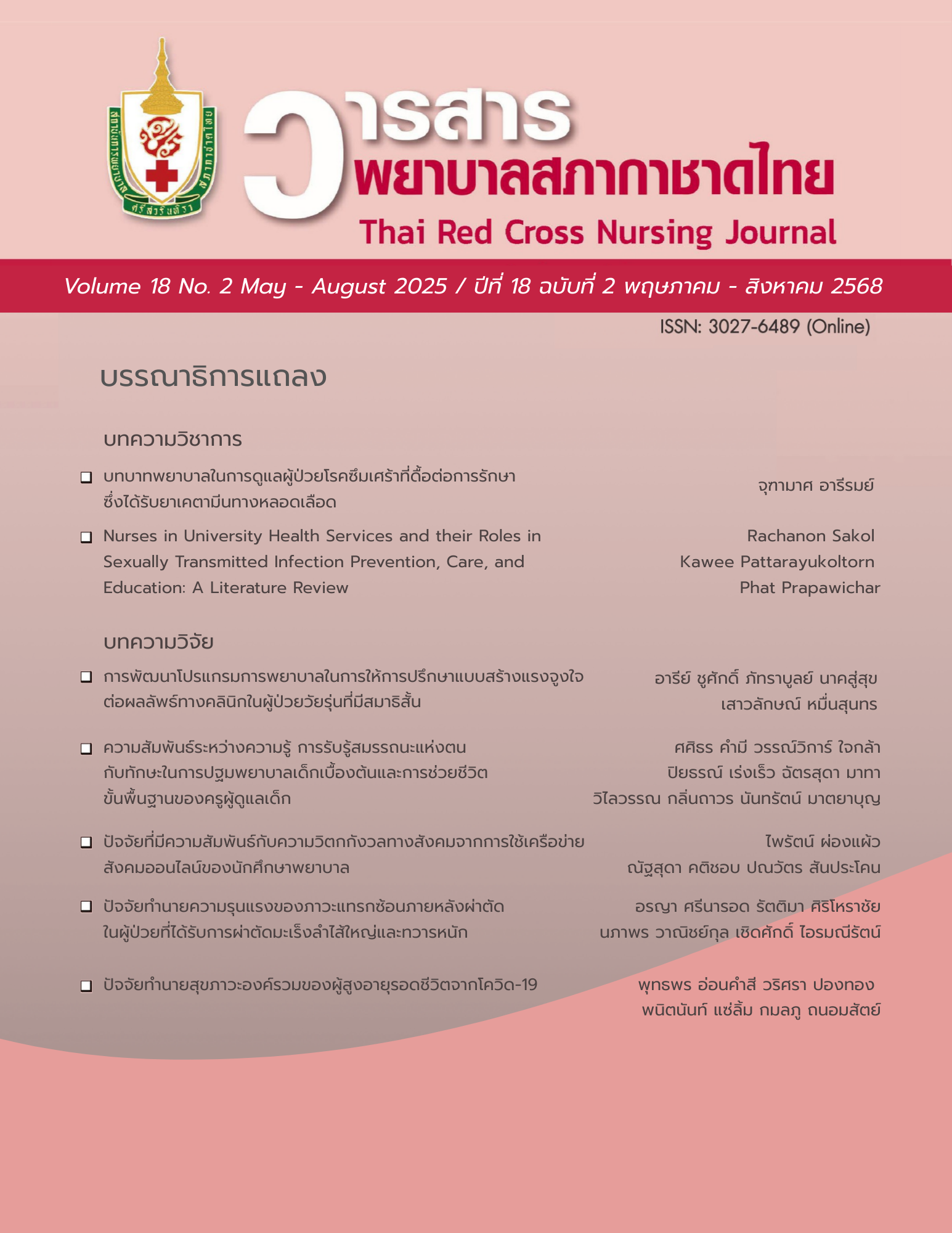
Nurses in University Health Services and their Roles in Sexually Transmitted Infection Prevention, Care, and Education: A Literature Review
DOI:
https://doi.org/10.64767/trcn.2025.271922Keywords:
university nurses, sexually transmitted infections, sexual health education, peer support, inclusive careAbstract
Background: The prevalence of sexually transmitted infections (STIs) is increasing globally, with a particularly alarming rise in Thailand, especially among young people. This trend poses significant repercussions for their health, academic performance, and overall quality of life. This integrative literature review endeavors to elucidate the multifaceted roles of university nurses in the realms of prevention, care, and education pertaining to sexual health, tailored to the distinct needs of students. Methods: A comprehensive systematic search was executed across PubMed, CINAHL, Scopus, and ThaiJO for scholarly publications spanning from 2015 and 2025, using the PICO framework. Studies were included if they concentrated on university health services focusing on prevention, care, and sexual health education for the student population. A total of 13 studies met the inclusion criteria and were analyzed. Results: Three major roles of university nurses were identified: (1) prevention strategies that increased service utilization, though male students were less engaged; (2) educational interventions that improved knowledge, attitudes, condom negotiation skills, and testing practices; and (3) supportive health services that reduced stigma and enhanced accessibility, especially when integrated with mental health and sexual violence care. Conclusion: This literature review underscores the efficacy of a nurse-led, student-centered paradigm within university health services. Fundamental components encompass screening, sexual education, provision of condoms, peer support, an inclusive clinic environment, and comprehensive follow-up care. Future research should explore the long-term ramifications, systemic capacity, and cost-effectiveness of these interventions.
Downloads
References
UNAIDS. UNAIDS data 2022. Geneva: UNAIDS; 2022.
Harfouche M, AlMukdad S, Alareeki A, Osman AMM, Gottlieb S, Rowley J, et al. Estimated global and regional incidence and prevalence of herpes simplex virus infections and genital ulcer disease in 2020: mathematical modelling analyses. Sex Transm Infect 2025;101(4):214-23. DOI: https://doi.org/10.1136/sextrans-2024-056307
Unemo M, Lahra MM, Escher M, Eremin S, Cole MJ, Galarza P, et al. WHO global antimicrobial resistance surveillance for Neisseria gonorrhoeae 2017-2018: a retrospective observational study. Lancet Microbe 2021;2(11):e627-36. DOI: https://doi.org/10.1016/S2666-5247(21)00171-3
Bray F, Ferlay J, Soerjomataram I, Siegel RL, Torre LA, Jemal A. Global cancer statistics 2018: GLOBOCAN estimates of incidence and mortality worldwide for 36 cancers in 185 countries. CA Cancer J Clin 2018;68(6):394-424. DOI: https://doi.org/10.3322/caac.21492
World Health Organization. Report on global sexually transmitted infection surveillance. Switzerland: WHO; 2018.
Department of Disease Control, Ministry of Public Health. Five-dimension surveillance: sexually transmitted infections, fiscal year 2023 [Internet]. 2024. [cited 2025 Jul 30]. Available from: https://odpc5ratchaburi.com/manual/post.php?id=88 (in Thai).
Putthawong P, Jantaramanee S, Yingyong T. Situation report of gonorrhea, 2024. WESR 2025;56(2):1-3.
World Health Organization. Global health sector strategy on sexually transmitted infections, 2016-2021. Geneva: World Health Organization; 2016.
Benchamas J, Senahad N, Padchasuwan NH, Laoraksawong P, Phimha S, Banchonhattakit P. Factors associated with risky sexual behaviors among undergraduate students in Thailand. BMC Public Health 2024;24(1):2967. DOI: https://doi.org/10.1186/s12889-024-20429-5
Baokhumkong C, Kata S. Factors associated with risk behavior of HIV infection and sexually transmitted diseases of students: the case study in Ubon Ratchathani Rajabhat University. Journal of the Office of Disease Prevention and Control, 7 Khon Kaen 2019;26(1):66-74. (in Thai)
Thammarakcharoen S, Saengrit T, Risa S, Khamewong S, Jampawan S, Sukserm T, et al. Preventive behavior of sexually transmitted diseases among vocational college students in Kalasin province. Journal of the Office of Disease Prevention and Control, 7 Khon Kaen 2023;30(3):181-92. (in Thai)
Pandee P. The factors affecting sexually transmitted disease preventive behaviors among youth MSM in higher education institutions [thesis]. Pathum Thani: Thammasat University, Faculty of Nursing; 2023. (in Thai)
Becker A. Nurse-run sexually transmitted infections screening clinics on a university campus [dissertation]. Amherst (MA): University of Massachusetts, Amherst College of Nursing; 2017.
Camino AF, Whitfield M, Pridgen K, Van Der Pol B, Van Wagoner N. Embedding a dedicated sexual health clinic in a university’s health services expands sexually transmitted infection screening options. Sex Transm Dis 2023;50(7):462-6. DOI: https://doi.org/10.1097/OLQ.0000000000001804
Boonkaewwan A, Punthmatharith B, Wiroonpanich W, Williams KA. Effects of a nurse’s support for the adolescent-led HIV/AIDS sexual transmission prevention program using social media. Walailak J Sci & Tech 2021;18(11):10010. DOI: https://doi.org/10.48048/wjst.2021.10010
Nakamura T. A survey of digital content required for STD prevention education taught by school nurses. Health 2024;16:350-70. DOI: https://doi.org/10.4236/health.2024.164025
Newman PA, Akkakanjanasupar P, Tepjan S, Boborakhimov S, van Wijngaarden JWL, Chonwanarat N. Peer education interventions for HIV prevention and sexual health with young people in Mekong Region countries: a scoping review and conceptual framework. Sex Reprod Health Matters 2022;30(1):2129374. DOI: https://doi.org/10.1080/26410397.2022.2129374
Frank MD, Simon-Uriah PA, Otobo EN, Akpan-Idiok PA, Atakwulu FO, Benard S. Knowledge and attitude towards sexually transmitted infections preventive strategies among undergraduate student nurses in a tertiary institution, south-south, Nigeria. Obstet Gynecol Int J 2025;16(1):14-20. DOI: https://doi.org/10.15406/ogij.2025.16.00781
Grant W, Adan MA, Samurkas CA, Quigee D, Benitez J, Gray B, et al. Effect of participative web-based educational modules on HIV and sexually transmitted infection prevention competency among medical students: single-arm interventional study. JMIR Med Educ 2023;9:e42197. DOI: https://doi.org/10.2196/42197
Pak SHL, Wang MP, Teitelman AM, Wong JYH, Fong DYT, Choi EPH. Nurse-led brief intervention for enhancing safe sex practice among emerging adults in Hong Kong using instant messaging: feasibility study. JMIR Form Res 2024;8:e52695. DOI: https://doi.org/10.2196/52695
Jaya ZN, Mapanga W, Moetlhoa B, Mashamba-Thompson TP. Nurses’ perspectives on user-friendly self-sampling interventions for diagnosis of sexually transmitted infections among young women in eThekwini district municipality: a nominal group technique. BMC Health Serv Res 2024;24:106. DOI: https://doi.org/10.1186/s12913-023-10353-6
Barrow RY, Ahmed F, Bolan GA, Workowski KA. Recommendations for providing quality sexually transmitted diseases clinical services, 2020. MMWR Recomm Rep 2020;68(5):1-20. DOI: https://doi.org/10.15585/mmwr.rr6805a1
Gianelis KA, Butler JM. Improving equitable access to inclusive sexual healthcare in a small urban college health setting. Nurs Forum 2022;57(4):686-93. DOI: https://doi.org/10.1111/nuf.12708
Mundie A, Mullens AB, Fein EC, Bell SFE, Debattista J, Ariana A, et al. University students’ access and use of sexual and reproductive health services in Australia. Cult Health Sex 2024:1-17. DOI: https://doi.org/10.1080/13691058.2024.2410834
Valentine JA, Mena L, Millett G. Telehealth services: implications for enhancing sexually transmitted infection prevention. Sex Transm Dis 2022;49(11 Suppl 2):S36-S40. DOI: https://doi.org/10.1097/OLQ.0000000000001699
Downloads
Published
How to Cite
Issue
Section
License
Copyright (c) 2025 Srisavarindhira Thai Red Cross Institute of Nursing

This work is licensed under a Creative Commons Attribution-NonCommercial-NoDerivatives 4.0 International License.
เนื้อหาบทความหรือข้อคิดเห็นต่างๆ ในวารสารพยาบาลสภากาชาดไทยนี้ เป็นความคิดเห็นของผู้เขียนบทความ ไม่ใช่ความเห็นของกองบรรณาธิการ หรือสถาบันการพยาบาลศรีสวรินทิรา สภากาชาดไทย


