
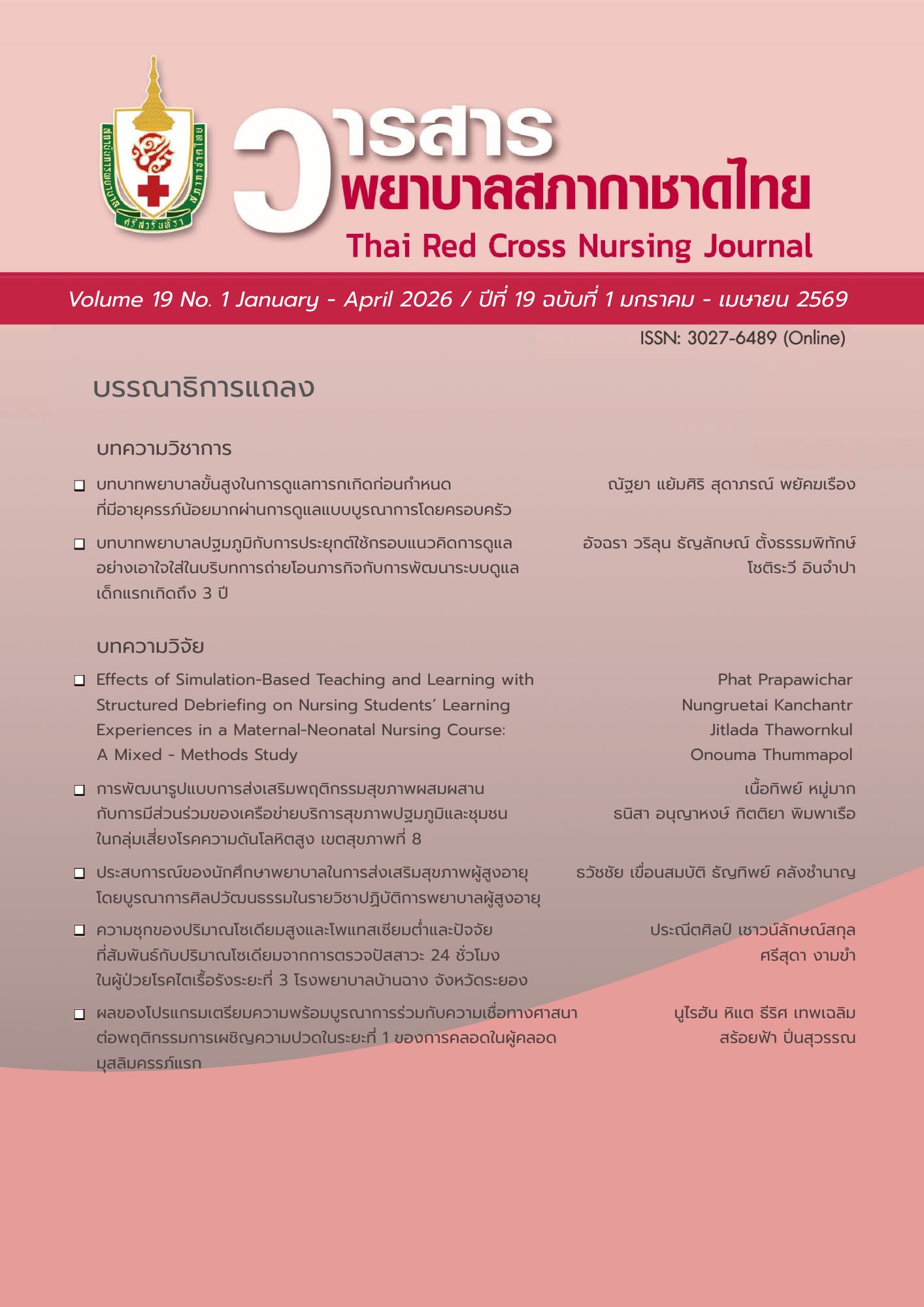
ผลของโปรแกรมเตรียมความพร้อมบูรณาการร่วมกับความเชื่อทางศาสนาต่อพฤติกรรมการเผชิญความปวดในระยะที่ 1 ของการคลอดในผู้คลอดมุสลิมครรภ์แรก
DOI:
https://doi.org/10.64767/trcn.2026.279500คำสำคัญ:
การเตรียมความพร้อมก่อนคลอด, ความกลัวการคลอด, ความปวดระยะคลอด, พฤติกรรมการเผชิญความปวด, ผู้คลอดมุสลิมครรภ์แรกบทคัดย่อ
การวิจัยกึ่งทดลองนี้มีวัตถุประสงค์ เพื่อเปรียบเทียบคะแนนเฉลี่ยพฤติกรรมการเผชิญความปวดในระยะที่ 1 ของการคลอดระหว่างผู้คลอดมุสลิมครรภ์แรกที่ได้รับโปรแกรมเตรียมความพร้อมบูรณาการร่วมกับความเชื่อทางศาสนากับผู้คลอดที่ได้รับการพยาบาลตามปกติ กลุ่มตัวอย่างคือ ผู้คลอดมุสลิมครรภ์แรก ณ โรงพยาบาลระดับทุติยะภูมิ จังหวัดยะลา จำนวน 41 ราย แบ่งเป็นกลุ่มทดลอง 20 ราย และกลุ่มควบคุม 21 ราย จัดกลุ่มตามลำดับเวลา เครื่องมือที่ใช้ในการทดลองคือ โปรแกรมที่พัฒนาจากแนวคิดวงจรความกลัว ความเครียด ความปวด ของ Dick-Read ร่วมกับหลักปฏิบัติทางศาสนาอิสลาม (CVI = .90) ดำเนินการในระยะตั้งครรภ์และระยะคลอด เครื่องมือเก็บรวบรวมข้อมูลคือแบบสังเกตพฤติกรรมการเผชิญความปวด 5 ด้าน ปรับปรุงจากแบบสังเกตพฤติกรรมการเผชิญความเจ็บปวดในระยะคลอด และแบบวัดความกลัวและความปวดประเมินด้วยสายตา เป็นเครื่องมือกำกับการทดลอง วิเคราะห์ข้อมูลด้วยสถิติ Mann-Whitney U test และ Bonferroni correction (α = .025)
ผลการวิจัยพบว่ากลุ่มทดลองมีค่ามัธยฐานของพฤติกรรมการเผชิญความปวดสูงกว่ากลุ่มควบคุมอย่างมีนัยสำคัญทางสถิติทั้งในระยะปากมดลูกเปิดเร็ว (Mdn = 5.0 และ 4.0, U = 90.0, p < .001, r = .49) และระยะเปลี่ยนผ่าน (Mdn = 4.0 และ 0.0, U = 55.0, p < .001, r = .63) ผลการวิจัยชี้ให้เห็นว่าโปรแกรมที่บูรณาการความเชื่อทางศาสนาอิสลามสามารถส่งเสริมพฤติกรรมการเผชิญความปวดได้ และควรพัฒนาเป็นแนวปฏิบัติการพยาบาลสำหรับผู้คลอดมุสลิมในบริบทที่มีความหลากหลายทางวัฒนธรรม
Downloads
เอกสารอ้างอิง
Nilsson C, Lundgren I, Karlström A, Hildingsson I. Self reported fear of childbirth and its association with women's birth experience and mode of delivery: a longitudinal population-based study. Women Birth 2012;25(3):114-121. DOI: https://doi.org/10.1016/j.wombi.2011.06.001
Dencker A, Nilsson C, Begley C, Jangsten E, Mollberg M, Patel H, et al. Causes and outcomes in studies of fear of childbirth: a systematic review. Women Birth 2019;32(2):99-111. DOI: https://doi.org/10.1016/j.wombi.2018.07.004
O’Connell MA, Leahy-Warren P, Khashan AS, Kenny LC, O’Neill SM. Worldwide prevalence of tocophobia in pregnant women: systematic review and meta-analysis. Acta Obstet Gynecol Scand 2017;96(8):907-20. DOI: https://doi.org/10.1111/aogs.13138
Dick-Read G. Childbirth without fear: the principles and practice of natural childbirth. 2nd ed. London: Pinter & Martin; 2013.
Whitburn LY, Jones LE, Davey MA, McDonald S. The nature of labour pain: an updated review of the literature. Women Birth 2019;32(1):28-38. DOI: https://doi.org/10.1016/j.wombi.2018.03.004
Hutchison J, Mahdy H, Jenkins SM, Hutchison J. Normal labor: physiology, evaluation, and management [Internet]. StatPearls 2026. Available from: https://www.ncbi.nlm.nih.gov/books/NBK544290/
Aziato L, Acheampong AK, Umoar KL. Labour pain experiences and perceptions: a qualitative study among post-partum women in Ghana. BMC Pregnancy Childbirth 2017;17(1):73. DOI: https://doi.org/10.1186/s12884-017-1248-1
Alizadeh-Dibazari Z, Abdolalipour S, Mirghafourvand M. The effect of prenatal education on fear of childbirth, pain intensity during labour and childbirth experience: a scoping review using systematic approach and meta-analysis. BMC Pregnancy Childbirth 2023;23(1):541. DOI: https://doi.org/10.1186/s12884-023-05867-0
Adams SS, Eberhard-Gran M, Eskild A. Fear of childbirth and duration of labour: a study of 2206 women with intended vaginal delivery. BJOG 2012;119(10):1238-46. DOI: https://doi.org/10.1111/j.1471-0528.2012.03433.x
Inkaew S, et al. Pain coping behavior during labor of hill tribe women. Thai Journal of Nursing Council 2001;16(2):15–24. (in Thai)
Dinç S, Erdoğan E, Doğan RA. The effect of mindfulness-based childbirth education intervention on fear of childbirth: systematic review and meta-analysis. Rev Assoc Med Bras 2024;70(7):e20240167. DOI: https://doi.org/10.1590/1806-9282.20240167
Hassanzadeh R, Abbas-Alizadeh F, Meedya S, Mohammad-Alizadeh-Charandabi S, Mirghafourvand M. Fear of childbirth, anxiety, and depression in three groups of primiparous pregnant women not attending, irregularly attending, and regularly attending childbirth preparation classes. BMC Women’s Health 2020;20(1):180. DOI: https://doi.org/10.1186/s12905-020-01048-9
Desmawati D, Kongsuwan W, Chatchawet W. The effects of childbirth preparation nursing intervention integrating Islamic praying program on duration of labor and neonatal outcomes in primiparous Muslim women. Walailak J Sci & Technol 2020;17(10):1048-59. DOI: https://doi.org/10.48048/wjst.2020.5456
Brixval CS, Axelsen SF, Lauemøller SG, Andersen SK, Due P, Koushede V. The effect of antenatal education in small classes on obstetric and psycho-social outcomes - a systematic review. Syst Rev 2015;4:20. DOI: https://doi.org/10.1186/s13643-015-0010-x
Golnazari F, Heydarpour S, Foroughi A, Heydarpour F. The comparison of the effect of childbirth preparation classes and spirituality-based counseling on childbirth fear among nulliparous pregnant women: a quasi-experimental study. Health Sci Rep 2026;9(2):e71879. DOI: https://doi.org/10.1002/hsr2.71879
Athinaidou AM, Vounatsou E, Pappa I, Harizopoulou VC. Influence of antenatal education on birth outcomes: a systematic review focusing on primiparous women. Cureus 2024 ;16(7):e64508. DOI: https://doi.org/10.7759/cureus.64508
Kaple GS, Patil S. Effectiveness of Jacobson relaxation and Lamaze breathing techniques in the management of pain and stress during labor: an experimental study. Cureus 2023;15(1):e33212. DOI: https://doi.org/10.7759/cureus.33212
Maasoumi R, Dastaran F, Faghihiniya F, Haghani S, Sabetghadam S. The effect of spiritual self-care intervention with a blended learning approach on anxiety in women with preterm labor: a randomized controlled trial. Int J Community Based Nurs Midwifery 2023;11(2):85-95.
Levett KM, Smith CA, Bensoussan A, Dahlen HG. The Complementary therapies for labour and birth study: making sense of labour and birth-experiences of women, partners and midwives of a complementary medicine antenatal education course. Midwifery 2016;40:124-31. DOI: https://doi.org/10.1016/j.midw.2016.06.011
Kocak MY, Göçen NN, Akin B. The effect of listening to the recitation of the Surah Al-Inshirah on labor pain, anxiety and comfort in Muslim women: a randomized controlled study. J Relig Health 2022;61(4):2945-59. DOI: https://doi.org/10.1007/s10943-021-01356-w
Japakeeya N, Phumdoung S, Chunuan S. Effects of listening to Holy Quran and Zikrullah recitation on stress and physiological stress responses among Muslim pregnant women with premature uterine contractions: a randomized controlled trial. Songklanagarind Journal of Nursing 2021;41(4):1-14. (in Thai)
Dusitkul Y. The effects of enhancing coping with labor pain program on pain levels and pain coping behaviors in primiparous women. Nursing, Health, and Public Health Journal 2022;1(3):31-9. (in Thai)
Polit DF. Statistics and data analysis for nursing research. 2nd ed. London: Pearson Education; 2014.
Pallant J. SPSS survival manual: a step-by-step guide to data analysis using IBM SPSS. 6th ed. London: McGraw-Hill Education; 2016.
Cohen J. Statistical power analysis for the behavioral sciences. 2nd ed. New York: Routledge; 1988.
Lazarus RS, Folkman S. Stress, appraisal, and coping. New York: Springer Publishing; 1984.
Nuraihan H, Sureeporn K, Warangkana C. The effects of an educational program with recitation of the Zikrullah on fear, pain and duration of first stage labor among Muslim primiparous women. Princess of Naradhiwas University Journal 2023;15(1):121-36. (in Thai)
Lohitthai S, Jemmama N, Siriphan S. Effects of reading Al-Koran involving family support on pain level in the first stage of labor and perception of family support among Muslim primiparous women. J Southern Coll Netw Nurs Public Health 2017;4(Suppl):115-30. (in Thai).
Moriarty O, McGuire BE, Finn DP. The effect of pain on cognitive function: a review of clinical and preclinical research. Prog Neurobiol 2011;93(3):385-404. DOI: https://doi.org/10.1016/j.pneurobio.2011.01.002
Faul F, Erdfelder E, Lang AG, Buchner A. G*Power 3: a flexible statistical power analysis program for the social, behavioral, and biomedical sciences. Behav Res Methods 2007;39(2):175-91. DOI: https://doi.org/10.3758/BF03193146
ดาวน์โหลด
เผยแพร่แล้ว
รูปแบบการอ้างอิง
ฉบับ
ประเภทบทความ
สัญญาอนุญาต
ลิขสิทธิ์ (c) 2026 สถาบันการพยาบาลศรีสวรินทิรา สภากาชาดไทย

อนุญาตภายใต้เงื่อนไข Creative Commons Attribution-NonCommercial-NoDerivatives 4.0 International License.
เนื้อหาบทความหรือข้อคิดเห็นต่างๆ ในวารสารพยาบาลสภากาชาดไทยนี้ เป็นความคิดเห็นของผู้เขียนบทความ ไม่ใช่ความเห็นของกองบรรณาธิการ หรือสถาบันการพยาบาลศรีสวรินทิรา สภากาชาดไทย


