
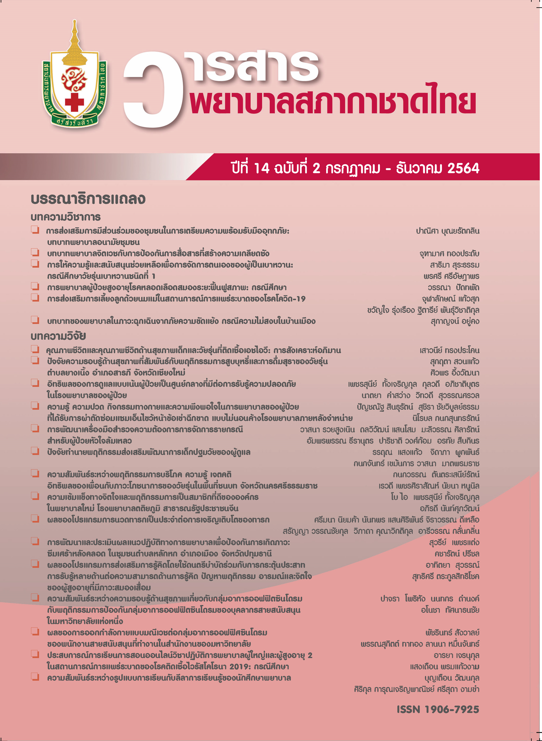
Development and Evaluation of a Clinical Nursing Practice Guideline for Prevention of Postpartum Depression in the Community of Lak Hok Sub-District, Muang District, Pathumthani Province
Keywords:
clinical nursing practice guideline, postpartum depression in the community, prevention postpartum depressionAbstract
This research aimed to develop clinical nursing practice guidelines (CNPG) for the prevention of postpartum depression. The conceptual framework was based on 4 phases of the Soukup model (2000), which consist of 1) Evidence–triggered phase - explored and identified problems. 2) Evidence supported phase - draft of CNPG was validated t by experts. Contents of CNPG consisted of 2.1) Screening risk factors of postpartum depression and diagnosis 2.2) Nursing intervention in pregnancy stage and postpartum stage. 2.3) Evaluation of postpartum depression by The Edinburgh Postnatal Depression Scale (EPDS) tool every 4 weeks, 8 weeks, and 12 weeks 2.4) Referral for a consultation with the physician who assessed postpartum depression 3) Evidence observed phase - implemented a pilot study involving 20 postpartum women, 10 pregnant women, and 2 nurses. 4) Evidence-based phase - trialed the use of CNPG in Primary health care and presented teamwork.
The results of the pilot study revealed that the CNPG has 100 percent quality and reliability, and most of the women involved in the study had an increase in the mean score of knowledge to prevent postpartum depression to 100% and behaviors for preventing postpartum depression were 100 %. It was also found that 100% of them had a high level of satisfaction with the family and nurses involved.
Downloads
References
Letourneau N, Stewart M, Dennis CL, Hegadoren K, Duffett-Leger L, Watson B. Effect of home-based peer support on maternal-infant interactions among woman with postpartum depression: a randomized controlled trial. Int J Ment Health Nurs 2011; 20(5):345-57.
Goyal D, Wang EJ, Shen J, Wong EC, Palaniappan LP. Clinically identified postpartum depression in Asian American mothers. J Obstet Gyneco Neonatal Nurse 2012;41(3):408-16.
Xie RH, Lei J, Wang S, Xie H, Walker M, Wen SW. Cesarean section and postpartum depression in a cohort of Chinese woman with a high cesarean delivery rate. J Womens Health 2011;20(12):1881-6.
Tamaki A. Effectiveness of home visits by mental health nurses for Japanese women with post-partum depression. Int J Ment Health Nurs 2008;17(6):419-27.
Chongpanish D, Kaewprom C, Pisaipan P, Pratoom L. Survey of understaning and attitudes amongst relatives regarding postpartum depression. The Journal of Boromarajonani College of Nursing, Nakhonratchasima 2014;20(1):44-54. (in Thai)
Zadeh MA, Khajehei M, Sharif F, Hadzic M. High-risk pregnancy: effects on postpartum depression and anxiety. Br J Midwifery 2012;20(2):104-13.
Lowdermilk DL. Postpartum complications: postpartum psychologic complication. In: Perry SE, Hockenberry MJ, Lowdermilk DL, Wilson D. Maternal and child nursing care 8th ed. Maryland Heighte, M: Mosby Elsever; 2010. p.741-50
Srisaeng P. Postpartum depression: What nurses need to know. Journal of Nursing Science & Health 2006;29(1):46-53. (in Thai)
Sawasdipanich W. Postpatum nursing care. 7th ed. Chonburi: Srisillapakarnpim; 2011. (in Thai)
Prechon K. Postpartum depression: prevention and care. Thai Red Cross Nursing Journal 2016;9(2):24-35. (in Thai)
Chousawai S, Worraruktananun N. Prevalence rated and factors of postpartum depression in Takhli Hospital, Nakhon Sawan. Sawanpracharak Medical Journal 2013;10(3):103-18. (in Thai)
American Psychiatric Assoiciation. Depresssivv disorder. In: Diagnostic and statistical manual of mental disorder. 5th ed. Arlington, VA: American Psychiatric Assoiciation; 2013. 155-88.
National Health Security Office. Health promotion and disease prevention services for basic services. National Health Security Fund Administration Manual. Arun Printing Co., Ltd; 2018. 49-50. (in Thai)
Vacharaporn K, Pitanupong J, Samangsri N. Development of The Edinburgh Postnatal depression scale Thai version. Journal of Mental Health of Thailand 2003;11(3):164-9. (in Thai)
Soukup SM. The center for advanced nursing practice evidence-based practice model: promoting the scholarship of practice. Nurs Clin North Am 2000;35(2):301-9.
Polit DF, Beck CT. Nursing research: principle and methods. Philadelphia: Lippincott Williams & Wilkins; 2004.
Zlotnick C, Tzilos G, Miller I, Seifer R, Stout R. Randomized controlled trail to preventpostpartum depression in mothers on public assistance. J Affect Disord 2016;189: 263-8.
Pessagno RA, Hunker D. Using short-term group psychotherapy as an evidence-based intervention for first-time mothers at risk for postpartum depression. Perspect Psychiatric Care 2013;49(3):202-9.
Downloads
Published
How to Cite
Issue
Section
License

This work is licensed under a Creative Commons Attribution-NonCommercial-NoDerivatives 4.0 International License.
เนื้อหาบทความหรือข้อคิดเห็นต่างๆ ในวารสารพยาบาลสภากาชาดไทยนี้ เป็นความคิดเห็นของผู้เขียนบทความ ไม่ใช่ความเห็นของกองบรรณาธิการ หรือสถาบันการพยาบาลศรีสวรินทิรา สภากาชาดไทย


