ความสัมพันธ์ระหว่างความรอบรู้ด้านสุขภาพและพฤติกรรมป้องกันการหกล้มของผู้สูงอายุในชุมชนอำเภอเมือง จังหวัดสุราษฎร์ธานี
คำสำคัญ:
ความรอบรู้ด้านสุขภาพ, การป้องกันการหกล้ม, ผู้สูงอายุบทคัดย่อ
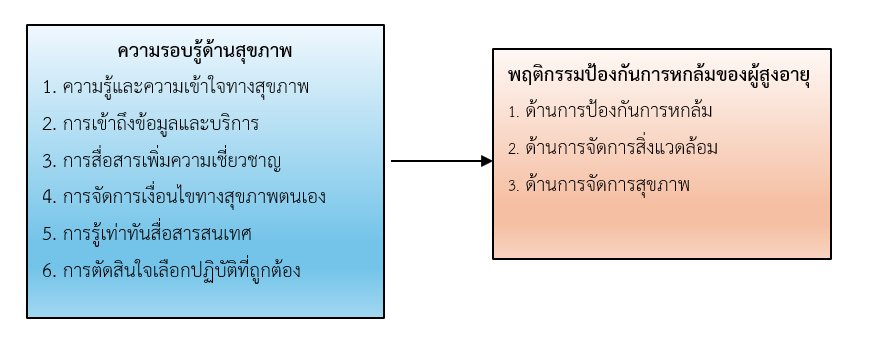
การวิจัยเชิงพรรณนาแบบภาคตัดขวางมีวัตถุประสงค์เพื่อศึกษา 1) ความรอบรู้ด้านสุขภาพในการป้องกันการหกล้ม 2) พฤติกรรมป้องกันการหกล้ม และ 3) ความสัมพันธ์ระหว่างความรอบรู้ด้านสุขภาพกับพฤติกรรมป้องกันการหกล้มของผู้สูงอายุในชุมชน อำเภอเมือง จังหวัดสุราษฎร์ธานี กลุ่มตัวอย่าง 365 คน เครื่องมือที่ใช้ในการวิจัยเป็นแบบสอบถาม ผ่านผู้ทรงคุณวุฒิ 3 ท่าน มีค่าความตรงเชิงเนื้อหาเท่ากับ 0.80 และ 0.82 ค่าความเชื่อมั่น เท่ากับ 0.86 และ 0.80 วิเคราะห์ข้อมูลด้วยสถิติเชิงพรรณนา และสหสัมพันธ์ของเพียร์สัน
ผลการศึกษาพบว่า ความรอบรู้ด้านสุขภาพทุกด้านอยู่ในระดับดีมาก โดยด้านความรู้และความเข้าใจในการป้องกันการหกล้ม มีค่าเฉลี่ยสูงสุด รองลงมาคือ การรู้เท่าทันสื่อการป้องกันการหกล้ม การจัดการเงื่อนไขทางสุขภาพตนเอง การสื่อสารในการป้องกันการหกล้ม การตัดสินใจการป้องการหกล้ม และการเข้าถึงข้อมูลและบริการป้องกันการหกล้ม ตามลำดับผู้สูงอายุมีพฤติกรรมป้องกันการหกล้ม อยู่ในระดับดีมาก โดยความรอบรู้ด้านสุขภาพ ในการป้องกันการหกล้มมีความสัมพันธ์ทางบวกกับพฤติกรรมป้องกันการหกล้มของผู้สูงอายุในทุกด้าน โดยด้านการสื่อสารเพื่อเพิ่มความเชี่ยวชาญ (r= 0.494) ด้านการจัดการเงื่อนไขทางสุขภาพตนเอง (r= 0.445) ด้านการรู้เท่าทันสื่อสารสนเทศ (r= 0.426) ด้านความรู้และความเข้าใจทางสุขภาพ (r= 0.389) และด้านการตัดสินใจเลือกปฏิบัติที่ถูกต้อง (r= 0.386) มีความสัมพันธ์ในระดับปานกลางทั้งหมด สำหรับด้านการเข้าถึงข้อมูลและบริการมีความสัมพันธ์ในระดับต่ำ (r= 0.285)
ดังนั้น ควรมีการจัดกิจกรรมพัฒนาความรอบรู้ด้านสุขภาพ ให้กับผู้สูงอายุในการสร้างความเข้าใจ การค้นหาข้อมูลทางสุขภาพ การให้คำแนะนำที่เฉพาะเจาะจง และเหมาะสมกับบริบทชีวิตของผู้สูงอายุแต่ละรายเพื่อนำไปสู่ การเปลี่ยนแปลงพฤติกรรมการป้องกันการหกล้มของผู้สูงอายุ และควรมีการจัดกิจกรรมพัฒนาทักษะการตัดสินใจเลือกปฏิบัติทางสุขภาพที่เหมาะสมกับผู้สูงอายุที่สามารถนำไปปฏิบัติใช้ในชีวิตประจำวันได้
เอกสารอ้างอิง
Chatchaisucha, S., & Ananpatiwet, S. (2023). Health literacy in elderly: Guidelines for health promotion in the 21st century. Journal of the Police Nurses, 15(1), 135–142.
Department of Older Persons. (2023). Situation of the Thai older persons 2023. Department of Older Persons. Retrieved 2025, January 9 from https://www.dop.go.th/th/know/side/1/1/2449. (in Thai)
Department of Older Persons. (2023). General information for the elderly. Retrieved 2025, January 9 from https://www.dop.go.th/th/statistics_page?cat=1&id=1. (in Thai)
Department of Disease Control, Ministry of Public Health. (2024). [FP] Fall data (W00–W19). Retrieved 2025, January 9 from https://ddc.moph.go.th/dip/news.php?news=23567&deptcode. (in Thai)
Davis, J. A. (1971). Elementary survey analysis. New Jersey: Prentice Hall.
Foundation of Thai Gerontology Research and Development Institute (TGRI). (2023). Situation of the Thai older persons 2022. Bangkok: Amarin Corporations Public Company Limited. (in Thai)
Hongchuvech, Y. (2024). Reducing the risk factors of falls in the elderly. EAU Heritage Journal of Science and Technology, 18(1), 32–43.
Intarakamhaeng, U. (2017). Creating and developing of Thailand Health Literacy Scales. (Research report). Bangkok: The Behavioral Science Research Institute, Srinakharinwirot University. (in Thai)
Kittipimpanon, K., & Kraithaworn, P. (2021). Association between personal factors, health status, and health literacy about falling, with fall prevention behaviors among older adults living in the community. Ramathibodi Nursing Journal, 27(3), 331–342.
Kaeodumkoeng, K. (2018). Health literacy: access, understanding, and application. 2nded. Bangkok: Amarin Printing and Publishing Public. (in Thai).
Krejcie, R. V., & Morgan, D. W. (1970). Determining sample size for research activities. Educational and Psychological Measurement, 30(3), 607–610.
Krearprasert, R., Kengganpanich, M., & Pekale, A. (2023). The predictive factors associated with fall prevention behavior of elderly people in Bang Khen Subdistrict Health Promoting Hospital Area, Nonthaburi province. Thai Journal of Health Education, 46(1), 94–106.
Liu, F., Yu, H., Xu, Q., Gong, J., Huo, M., & Huang, F. (2024). Risk Assessment of Falls Among Older Adults Based on Probe Reaction Time During Water-Carrying Walking. Clinical interventions in aging, 19, 21–29.
Luehan, S., Narin, R., & Sripetwandee, N. (2024). Effect of a health literacy for fall prevention enhancing program on practices of recurrent fall prevention among the elderly in communities. Nursing Journal CMU, 51(2), 150–164.
Mark, J. A., Henry, A., Moreland, B., Dobash, D., & Bergen, G. (2025). Assessing older adults’ readiness for adopting fall prevention recommendations using the Transtheoretical Stages of Change. Journal of Applied Gerontology, 44(5), 726–736.
Nutbeam, D. (2000). Health literacy as a public health goal: A challenge for contemporary health education and communication strategies into the 21st century. Health Promotion International, 15(3), 259–267.
Nutbeam, D. (2008). The evolving concept of health literacy. Social Science & Medicine, 67(12), 2072-8.
Pensuk, P., Valaisathien, J., & Thangtham, N. (2025). The effects of enhancing health literacy program on falls prevention behaviors among village health volunteer in a community, Nakhon Ratchasima province. Journal of the Office of Disease Prevention and Control 9 Nakhon Ratchasima, 31(2), 5–17.
Poomriew, R. (2022). Fall prevention in Thai older adults. Thai Journal of Health Education, 45(2), 1–10.
Sawangbumrung, M., Chaiarporn, N., & Vongverapant, M. (2024). Literature synthesis on falls of the elderly in the year 2013–2022. Regional Health Promotion Center 9 Journal, 18(3), 918–934.
Saengkeaw, S., & Chansong, S. (2024). Scale development of digital health literacy for the elderly. Journal of Business, Innovation and Sustainability (JBIS), 19(3), 136–150.
Sarapun, A., Sirisopon, N., Kainaka, P., Onsiri, S., Outayanik, B., Threrawachjareanchai, S., & Sukomol, N. (2017). Factors Ralated to a Fall Prevention Behaviors of Elderly. Journal of The Royal Thai Army Nurses, 18(Suppl. 1), 215–222.
Saenwa, S., Wattanaburanon, A., & Maharachpong, N. (2022). Effect of fall prevention program based on health belief model and social support on fall prevention behaviors among the elderly in Kochan district Chonburi. Province Research and Development Health System Journal, 15(2), 214–227.
Srisa-ard, B. (2017). Preliminary research. (10th ed.). Bangkok: Suweeriya Sarn. Stormacq, C., Wosinski, J., Boillat, E., & Van den Broucke, S. (2020). Effects of health literacy interventions on health-related outcomes in socioeconomically disadvantaged adults living in the community: A systematic review. JBI Evidence Synthesis, 18(7), 1389–1469.
Tasuwanin, T. (2016). Falls in the elderly. UBRU Journal for Public Health Research, 5(2), 119–131.
Tiparat, W., Rodniam, J., & Suwanweala, P. (2022). The effects of an enhancing health literacy program with family participation on health literacy of caregivers, fall prevention behaviours, and balance of older adults at risk for fall. Princess of Naradhiwas University Journal, 14(3), 72–91.
Wungrath, J., & Mongkol, P. (2020). Effectiveness of a health literacy enhancement program for caregivers of dependent older persons in a community of the Northern Part, Thailand. Journal of Public Health and Development, 18(2), 24–36.
World Health Organization (WHO). (2023). Thailand’s leadership and innovations towards healthy ageing. Retrieved 2025, January 9 from https://www.who.int/southeastasia/news/feature-stories/detail/thailands-leadership-and-innovation-towards-healthy-ageing
Wisetkaew, S., & Suwan, P. (2024). The causal relationship model of factors influencing fall prevention behaviors of the elderly in Lopburi Province. Journal of Medical and Public Health Region 4, 14(2), 1–12.
Zolbin, M. G., Huvila, I., & Nikou, S. (2022). Health literacy, health literacy interventions and decision-making: A systematic literature review. Journal of Documentation, 78(7), 405–428.
ดาวน์โหลด
เผยแพร่แล้ว
รูปแบบการอ้างอิง
ฉบับ
ประเภทบทความ
สัญญาอนุญาต
ลิขสิทธิ์ (c) 2025 วิทยาลัยพยาบาลบรมราชชนนี นครศรีธรรมราช

อนุญาตภายใต้เงื่อนไข Creative Commons Attribution-NonCommercial-NoDerivatives 4.0 International License.
บทความที่ได้รับการตีพิมพ์เป็นลิขสิทธิ์ของ วิทยาลัยพยาบาลบรมราชชนนี นครศรีธรรมราช
ข้อความที่ปรากฏในบทความแต่ละเรื่องในวารสารวิชาการเล่มนี้เป็นความคิดเห็นส่วนตัวของผู้เขียนแต่ละท่านไม่เกี่ยวข้องกับวิทยาลัยพยาบาลบรมราชชนนี นครศรีธรรมราช และบุคคลากรท่านอื่น ๆ ในวิทยาลัยฯ แต่อย่างใด ความรับผิดชอบองค์ประกอบทั้งหมดของบทความแต่ละเรื่องเป็นของผู้เขียนแต่ละท่าน หากมีความผิดพลาดใดๆ ผู้เขียนแต่ละท่านจะรับผิดชอบบทความของตนเองแต่ผู้เดียว