ปัจจัยทำนายความรอบรู้ด้านสุขภาพของผู้สูงอายุโรคความดันโลหิตสูง อำเภอเมืองชัยภูมิ จังหวัดชัยภูมิ
คำสำคัญ:
ความรอบรู้ด้านสุขภาพ, การรับรู้สมรรถนะแห่งตน, โรคความดันโลหิตสูง, แรงสนับสนุนทางสังคม, ผู้สูงอายุบทคัดย่อ
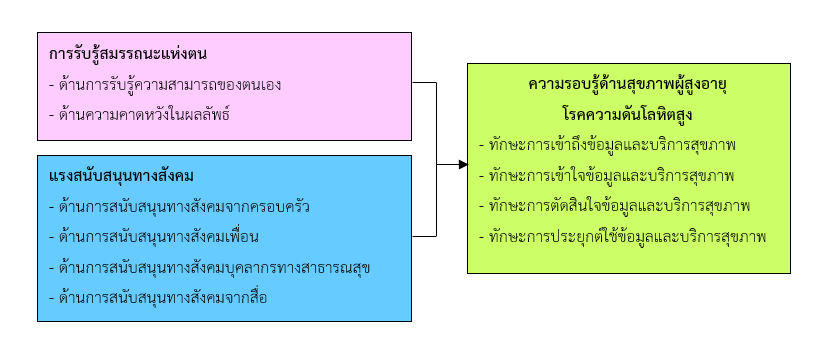
การวิจัยเชิงพรรณาแบบภาคตัดขวางนี้มีวัตถุประสงค์เพื่อศึกษาปัจจัยทำนายความรอบรู้ด้านสุขภาพของผู้สูงอายุโรคความดันโลหิตสูง กลุ่มตัวอย่าง คือ ผู้สูงอายุที่มีอายุ 60 ปีขึ้นไป ที่ได้รับการวินิจฉัยว่าเป็นโรคความดันโลหิตสูงในเขตอำเภอเมือง จังหวัดชัยภูมิ จำนวน 410 คน สุ่มตัวอย่างแบบหลายขั้นตอน เครื่องมือที่ใช้ในการวิจัยเป็นแบบสอบถาม ผ่านผู้ทรงคุณวุฒิ 3 ท่าน ดัชนีความสอดคล้องระหว่างข้อคำถามระหว่าง 0.67 – 1.00 ตรวจสอบความเชื่อมั่นโดยวิธีสัมประสิทธิ์แอลฟาของครอนบาคเท่ากับ 0.81, 0.83 และ 0.84 ตามลำดับ วิเคราะห์ข้อมูลด้วยสถิติเชิงพรรณนา และสถิติถดถอยเชิงเส้นพหุแบบขั้นตอน
ผลการวิจัยพบว่า ระดับความรอบรู้ด้านสุขภาพของผู้สูงอายุโรคความดันโลหิตสูงโดยรวมอยู่ในระดับพอใช้ (M= 50.73, SD= 14.66) การรับรู้สมรรถนะแห่งตนอยู่ระดับปานกลาง (M= 3.01, SD= 0.39)แรงสนับสนุนทางสังคมอยู่ระดับปานกลาง (M= 3.06, SD= 0.49) ปัจจัยที่สามารถพยากรณ์ความรอบรู้ด้านสุขภาพได้อย่างมีนัยสำคัญทางสถิติ ได้แก่ การรับรู้สมรรถนะแห่งตน (Beta= 0.58) แรงสนับสนุนทางสังคมจากบุคลากรสาธารณสุข (Beta= 0.39) ความคาดหวังในผลลัพธ์ (Beta= -0.265) และแรงสนับสนุนทางสังคมจากสื่อ (Beta= -0.17) ปัจจัยทั้งหมดสามารถร่วมกันพยากรณ์ความรอบรู้ด้านสุขภาพได้ร้อยละ 34.40 (R² = 0.344) และมีความคลาดเคลื่อนจากการพยากรณ์ เท่ากับ 11.94 โดยปัจจัยที่มีอิทธิพลมากที่สุดคือ การรับรู้สมรรถนะแห่งตน
ฉะนั้น ควรส่งเสริมให้ผู้สูงอายุมีการรับรู้สมรรถนะแห่งตนในการดูแลสุขภาพร่วมกับการสนับสนุนทางสังคมที่เหมาะสม โดยเฉพาะจากบุคลากรสาธารณสุข และพัฒนาสื่อสุขภาพที่มีความน่าเชื่อถือเพื่อใช้ในการส่งเสริมความรอบรู้ด้านสุขภาพ องค์ความรู้ที่ได้สามารถนำไปใช้ในการออกแบบโปรแกรมหรือกิจกรรมที่เหมาะสมเพื่อพัฒนาความรอบรู้ด้านสุขภาพผู้สูงอายุโรคความดันโลหิตสูงในบริบทของชุมชน
เอกสารอ้างอิง
Bandura, A. (1997). Self-efficacy: The exercise of control. New York: W. H. Freeman.
Bandura, A. (2009). Cultivate self-efficacy for personal and organizational effectiveness. In E. A. Locke (Ed.), Handbook of principles of organizational behavior (pp. 179–200). Oxford: Blackwell.
Best, J. W. (1977). Research in education. New Jersey: Prentice Hall Inc.
Bureau of Risk Communication and Health Behavior Development. (2021). Manual for developing health literacy in disease prevention and health threats control. Nonthaburi: R.N.P.P. Water Co., Ltd. (in Thai)
Chitramontree, N. (2015). Aging population; Trends and issues in elderly care. In W. Thongcharoen (Ed.), Science and art of elderly nursing. Bangkok: NP Press. (in Thai)
Department of Health Service Support (TH), Health Education Division. (2023). Health literacy assessment form. Health behaviors of patients with high blood pressure [Internet]. Retrieved January 20, 2024, from http://www.hed.go.th/linkHed/412. (in Thai)
Gan, L., & He, X. (2020). The interrelationship between health literacy, social support, depression, and frailty among older patients with hypertension and diabetes in China. Frontiers in Public Health, 8, 280.
House, J. S. (1981). Work stress and social support. Reading, MA: Addison-Wesley.
Jandaeng, T. (2024). Factors influencing health literacy in hypertensive patients in Mueang District, Nakhon Phanom Province. Journal of Environmental Health and Community Health, 9(4), 471–477.
Kaewbanchak, N., Chumwangwapee, P., & Suwannaphan, K. (2020). Factors of health literacy associated with health behaviors among older adults with hypertension in Khok Si Subdistrict, Mueang District, Khon Kaen Province. Journal of Public Health and Health Science, 3(3), 1–15.
Kongsaa, A., Boonyamalik, P., & Kerdmongkol, P. (2020). Effects of a health literacy promotion program on blood pressure control behavior among elderly hypertensive patients. Kuakarun Journal, 27(2), 90–102.
Ministry of Public Health. (2023). Annual public health report 2023. Bangkok: Ministry of Public Health. (in Thai)
Naowsuwan, K., Singhasem, P., & Yimyuan, Y. (2016). Relationship and predictive power of social support on self-care behaviors among hypertensive patients. Boromarajonani College of Nursing Uttaradit Journal, 8(1), 1–12.
Nilnate, W., Hengpraprom, S., & Hanvoravongchai, P. (2016). Level of health literacy in thai elders Bangkok, Thailand. Journal of Health Research, 30(5), 315-321.
Nutbeam, D. (2000). Health literacy as a public health goal: A challenge for contemporary health education and communication strategies into the 21st century. Health Promotion International, 15(3), 259–267.
Nutbeam, D. (2008). The evolving concept of health literacy. Social Science & Medicine, 67(12), 2072–2078.
Phuchongchai, T., Phattharasirisomboon, P., Nuansithong, N., Yatniyom, P., & Laokhomphruttajan, J. (2023). The Program for Enhance Health Literacy of the Older People: A Mixed Method. Journal of Nursing and Health Care, 41(2), 1–18.
Ploysuwan, C., Wongprathum, S., Rattanakamonkarn, C., Pantewan, P., & Pheungching, T. (2021). Factors affecting health literacy among elderly hypertensive patients in Nongprue Community, Samut Prakan province. Journal of Nursing Education, 14(2), 52–64.
Polit, D. F., & Beck, C. T. (2017). Nursing research: Generating and assessing evidence for nursing practice (10th ed.). Philadelphia, PA: Wolters Kluwer.
Rattanachankorn, K., Thanapanthiwakul, P., & Rattanachankorn, K. (2023). Developing health literacy among the elderly for quality of life improvement. Christian University Nursing Journal, 10(1), 85–97.
Shi, D., Li, J., Wang, Y., Wang, S., Liu, K., Shi, R., et al. (2017). Association between health literacy and hypertension management in a Chinese community: A retrospective cohort study. Internal and Emergency Medicine, 12, 765–776. https://doi.org/10.1007/s11739-017-1651-7.
Sinsap, N., Chankra, J., & Jaimun, B. (2017). Hypertension in the elderly: The silent killer that should be recognized. Phrapokklao Nursing College Journal, 28(1), 100–109. (in Thai)
Sritani, K. (2017). Relationship between health literacy and quality of life among elderly people in Northeastern Thailand. Journal of Health Systems Research, 11(1), 26–36. (in Thai)
Statistics Division, Chaiyaphum Provincial Public Health Office. (2024). Report on non-communicable diseases (NCD) morbidity. Retrieved January 20, 2024, from https://hdcservice.moph.go.th/hdc/reports/page.php?cat_id=6a1fdf282fd28180eed7d1cfe0155e11. (in Thai)
Thai Hypertension Society. (2019). Thai guidelines on the treatment of hypertension. Chiang Mai: Tri Ting. (in Thai)
Vanichbuncha, K. (2015). Using SPSS for Windows in data analysis (27th ed.). Bangkok: Samlada Printing. (in Thai)
Wayne, W. D. (1995). Sample size calculations in research. Boston, MA: Boston University School of Public Health.
World Health Organization. (2018). World Hypertension League (WHL): World Hypertension Day [Internet]. Retrieved January 25, 2024, from http://www.whleague.org/index.php/features/world-hypertension-day
World Heart Federation. (2024). Hypertension. Retrieved July 16, 2024, from https://world-heart-federation.org/resources/hypertension/.
ดาวน์โหลด
เผยแพร่แล้ว
รูปแบบการอ้างอิง
ฉบับ
ประเภทบทความ
สัญญาอนุญาต
ลิขสิทธิ์ (c) 2025 วิทยาลัยพยาบาลบรมราชชนนี นครศรีธรรมราช

อนุญาตภายใต้เงื่อนไข Creative Commons Attribution-NonCommercial-NoDerivatives 4.0 International License.
บทความที่ได้รับการตีพิมพ์เป็นลิขสิทธิ์ของ วิทยาลัยพยาบาลบรมราชชนนี นครศรีธรรมราช
ข้อความที่ปรากฏในบทความแต่ละเรื่องในวารสารวิชาการเล่มนี้เป็นความคิดเห็นส่วนตัวของผู้เขียนแต่ละท่านไม่เกี่ยวข้องกับวิทยาลัยพยาบาลบรมราชชนนี นครศรีธรรมราช และบุคคลากรท่านอื่น ๆ ในวิทยาลัยฯ แต่อย่างใด ความรับผิดชอบองค์ประกอบทั้งหมดของบทความแต่ละเรื่องเป็นของผู้เขียนแต่ละท่าน หากมีความผิดพลาดใดๆ ผู้เขียนแต่ละท่านจะรับผิดชอบบทความของตนเองแต่ผู้เดียว