Predictive Factors of Health Literacy among Older Adults with Hypertension in Mueang Chaiyaphum District, Chaiyaphum Province
Keywords:
Health Literacy, Self-Efficacy, Hypertension, Social Support, Older AdultsAbstract
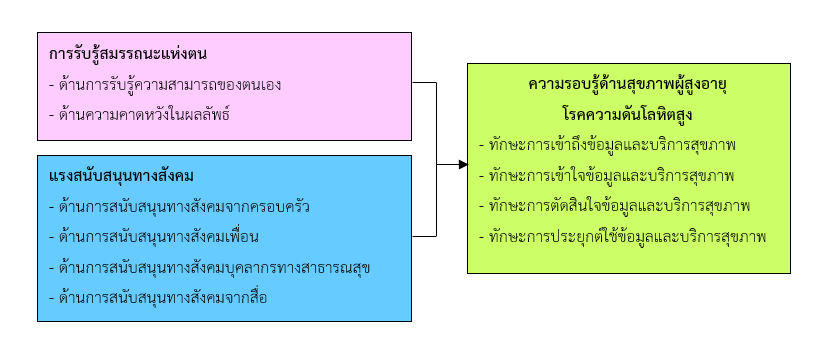
This cross-sectional descriptive study aimed to examine the predictive factors of health literacy among older adults with hypertension. The sample consisted of 410 older adults aged 60 years and above who had been diagnosed with hypertension and were residing in Mueang District, Chaiyaphum Province. A multistage sampling technique was employed. The research instrument was a questionnaire validated by three experts, with item–objective congruence (IOC) values ranging from 0.67 to 1.00. Reliability was assessed using Cronbach’s alpha coefficient, yielding values of 0.81, 0.83, and 0.84 for the respective sections. Data were analyzed using descriptive statistics and stepwise multiple linear regression.
The results revealed that the overall level of health literacy among older adults with hypertension was moderate (M = 50.73, SD = 14.66). Self-efficacy was at a moderate level (M = 3.01, SD = 0.39), and social support was also at a moderate level (M = 3.06, SD = 0.49). The factors that significantly predicted health literacy were self-efficacy (Beta = 0.58), social support from healthcare personnel (Beta = 0.39), outcome expectations (Beta = –0.265), and social support from media (Beta = -0.17). Together, these factors predicted 34.40% of the variance in health literacy (R² = 0.344), with a prediction error of 11.94. Among these predictors, self-efficacy had the greatest influence on health literacy.
Therefore, it is recommended to enhance self-efficacy among older adults in managing their health, together with appropriate social support, particularly from healthcare personnel, and to develop credible health information media to promote health literacy. The findings can be applied to design suitable programs or interventions to improve health literacy among older adults with hypertension within the community context.
References
Bandura, A. (1997). Self-efficacy: The exercise of control. New York: W. H. Freeman.
Bandura, A. (2009). Cultivate self-efficacy for personal and organizational effectiveness. In E. A. Locke (Ed.), Handbook of principles of organizational behavior (pp. 179–200). Oxford: Blackwell.
Best, J. W. (1977). Research in education. New Jersey: Prentice Hall Inc.
Bureau of Risk Communication and Health Behavior Development. (2021). Manual for developing health literacy in disease prevention and health threats control. Nonthaburi: R.N.P.P. Water Co., Ltd. (in Thai)
Chitramontree, N. (2015). Aging population; Trends and issues in elderly care. In W. Thongcharoen (Ed.), Science and art of elderly nursing. Bangkok: NP Press. (in Thai)
Department of Health Service Support (TH), Health Education Division. (2023). Health literacy assessment form. Health behaviors of patients with high blood pressure [Internet]. Retrieved January 20, 2024, from http://www.hed.go.th/linkHed/412. (in Thai)
Gan, L., & He, X. (2020). The interrelationship between health literacy, social support, depression, and frailty among older patients with hypertension and diabetes in China. Frontiers in Public Health, 8, 280.
House, J. S. (1981). Work stress and social support. Reading, MA: Addison-Wesley.
Jandaeng, T. (2024). Factors influencing health literacy in hypertensive patients in Mueang District, Nakhon Phanom Province. Journal of Environmental Health and Community Health, 9(4), 471–477.
Kaewbanchak, N., Chumwangwapee, P., & Suwannaphan, K. (2020). Factors of health literacy associated with health behaviors among older adults with hypertension in Khok Si Subdistrict, Mueang District, Khon Kaen Province. Journal of Public Health and Health Science, 3(3), 1–15.
Kongsaa, A., Boonyamalik, P., & Kerdmongkol, P. (2020). Effects of a health literacy promotion program on blood pressure control behavior among elderly hypertensive patients. Kuakarun Journal, 27(2), 90–102.
Ministry of Public Health. (2023). Annual public health report 2023. Bangkok: Ministry of Public Health. (in Thai)
Naowsuwan, K., Singhasem, P., & Yimyuan, Y. (2016). Relationship and predictive power of social support on self-care behaviors among hypertensive patients. Boromarajonani College of Nursing Uttaradit Journal, 8(1), 1–12.
Nilnate, W., Hengpraprom, S., & Hanvoravongchai, P. (2016). Level of health literacy in thai elders Bangkok, Thailand. Journal of Health Research, 30(5), 315-321.
Nutbeam, D. (2000). Health literacy as a public health goal: A challenge for contemporary health education and communication strategies into the 21st century. Health Promotion International, 15(3), 259–267.
Nutbeam, D. (2008). The evolving concept of health literacy. Social Science & Medicine, 67(12), 2072–2078.
Phuchongchai, T., Phattharasirisomboon, P., Nuansithong, N., Yatniyom, P., & Laokhomphruttajan, J. (2023). The Program for Enhance Health Literacy of the Older People: A Mixed Method. Journal of Nursing and Health Care, 41(2), 1–18.
Ploysuwan, C., Wongprathum, S., Rattanakamonkarn, C., Pantewan, P., & Pheungching, T. (2021). Factors affecting health literacy among elderly hypertensive patients in Nongprue Community, Samut Prakan province. Journal of Nursing Education, 14(2), 52–64.
Polit, D. F., & Beck, C. T. (2017). Nursing research: Generating and assessing evidence for nursing practice (10th ed.). Philadelphia, PA: Wolters Kluwer.
Rattanachankorn, K., Thanapanthiwakul, P., & Rattanachankorn, K. (2023). Developing health literacy among the elderly for quality of life improvement. Christian University Nursing Journal, 10(1), 85–97.
Shi, D., Li, J., Wang, Y., Wang, S., Liu, K., Shi, R., et al. (2017). Association between health literacy and hypertension management in a Chinese community: A retrospective cohort study. Internal and Emergency Medicine, 12, 765–776. https://doi.org/10.1007/s11739-017-1651-7.
Sinsap, N., Chankra, J., & Jaimun, B. (2017). Hypertension in the elderly: The silent killer that should be recognized. Phrapokklao Nursing College Journal, 28(1), 100–109. (in Thai)
Sritani, K. (2017). Relationship between health literacy and quality of life among elderly people in Northeastern Thailand. Journal of Health Systems Research, 11(1), 26–36. (in Thai)
Statistics Division, Chaiyaphum Provincial Public Health Office. (2024). Report on non-communicable diseases (NCD) morbidity. Retrieved January 20, 2024, from https://hdcservice.moph.go.th/hdc/reports/page.php?cat_id=6a1fdf282fd28180eed7d1cfe0155e11. (in Thai)
Thai Hypertension Society. (2019). Thai guidelines on the treatment of hypertension. Chiang Mai: Tri Ting. (in Thai)
Vanichbuncha, K. (2015). Using SPSS for Windows in data analysis (27th ed.). Bangkok: Samlada Printing. (in Thai)
Wayne, W. D. (1995). Sample size calculations in research. Boston, MA: Boston University School of Public Health.
World Health Organization. (2018). World Hypertension League (WHL): World Hypertension Day [Internet]. Retrieved January 25, 2024, from http://www.whleague.org/index.php/features/world-hypertension-day
World Heart Federation. (2024). Hypertension. Retrieved July 16, 2024, from https://world-heart-federation.org/resources/hypertension/.
Downloads
Published
How to Cite
Issue
Section
License
Copyright (c) 2025 Boromarajonani College of Nursing, Nakhon Si Thammarat

This work is licensed under a Creative Commons Attribution-NonCommercial-NoDerivatives 4.0 International License.
บทความที่ได้รับการตีพิมพ์เป็นลิขสิทธิ์ของ วิทยาลัยพยาบาลบรมราชชนนี นครศรีธรรมราช
ข้อความที่ปรากฏในบทความแต่ละเรื่องในวารสารวิชาการเล่มนี้เป็นความคิดเห็นส่วนตัวของผู้เขียนแต่ละท่านไม่เกี่ยวข้องกับวิทยาลัยพยาบาลบรมราชชนนี นครศรีธรรมราช และบุคคลากรท่านอื่น ๆ ในวิทยาลัยฯ แต่อย่างใด ความรับผิดชอบองค์ประกอบทั้งหมดของบทความแต่ละเรื่องเป็นของผู้เขียนแต่ละท่าน หากมีความผิดพลาดใดๆ ผู้เขียนแต่ละท่านจะรับผิดชอบบทความของตนเองแต่ผู้เดียว