ผลของโปรแกรมการดูแลสุขภาพผู้สูงอายุ บนพื้นฐานของวิถีวัฒนธรรมชุมชนต่อการสูงวัยอย่างมีสุขภาวะ
คำสำคัญ:
โปรแกรมการดูแลสุขภาพบนพื้นฐานวิถีวัฒนธรรมชุมชน , ผู้สูงอายุ, การสูงวัยอย่างมีสุขภาวะบทคัดย่อ
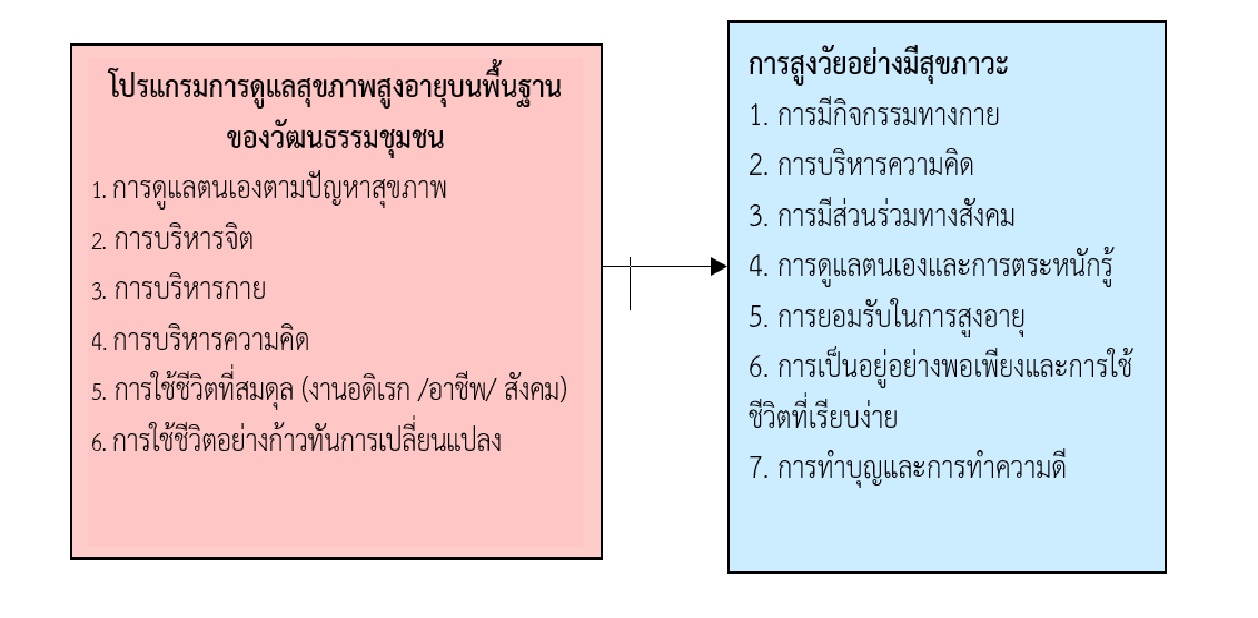
การวิจัยกึ่งทดลองแบบสองกลุ่มวัดก่อนและหลัง มีวัตถุประสงค์เพื่อศึกษาผลของโปรแกรมการดูแลสุขภาพผู้สูงอายุบนพื้นฐานวิถีวัฒนธรรมชุมชนต่อการสูงวัยอย่างมีสุขภาวะ โดยกลุ่มตัวอย่าง คือผู้สูงอายุที่มีอายุ 60 ปีขึ้นไป อาศัยอยู่ในอำเภอป่าพะยอม จังหวัดพัทลุง จำนวน 50 คน สุ่มกลุ่มตัวอย่างด้วยการจับฉลาก แบ่งเป็นกลุ่มทดลอง และกลุ่มควบคุม กลุ่มละ 25 คน เครื่องมือที่ใช้ในการวิจัย คือ 1) โปรแกรมการดูแลสุขภาพผู้สูงอายุบนพื้นฐานวิถีวัฒนธรรมชุมชน ประกอบด้วย 6 องค์ประกอบ คือ การดูแลตนเองตามอาการที่พบบ่อยในผู้สูงอายุ การบริหารจิต การบริหารกาย การบริหารความคิด การใช้ชีวิตที่สมดุล และการใช้ชีวิตอย่างก้าวทันการเปลี่ยนแปลง กำหนดรูปแบบกิจกรรมการเรียนรู้ 16 ครั้ง โดยดำเนินกิจกรรม สัปดาห์ละ 1 ครั้ง ๆ ละ 5 ชั่วโมง รวม 80 ชั่วโมง 2) แบบประเมินสูงวัยอย่างสุขภาวะ เก็บรวบรวมข้อมูล 3 ระยะ คือ ก่อนการทดลอง หลังการทดลอง และเมื่อสิ้นสุดการติดตามผล 1 เดือน วิเคราะห์ข้อมูลด้วยสถิติ ความถี่ ร้อยละ ค่าเฉลี่ย ส่วนเบี่ยงเบนมาตรฐาน เปรียบเทียบความแตกต่างของค่าคะแนนเฉลี่ยการสูงวัยอย่างสุขภาวะด้วย Two way repeated measure และทดสอบความแตกต่างรายคู่ด้วย Bonferroni method ผลการวิจัยพบว่า
- 1. กลุ่มทดลองที่ได้รับโปรแกรมการดูแลสุขภาพบนพื้นฐานวิถีวัฒนธรรมชุมชน มีค่าคะแนนเฉลี่ยการสูงวัยอย่างมีสุขภาวะในระยะก่อนการทดลอง หลังการทดลอง และเมื่อสิ้นสุดการติดตามผล 1 เดือน สูงกว่ากลุ่มควบคุมที่ดำเนินชีวิตตามปกติอย่างมีนัยสำคัญทางสถิติที่ .05 (F = 36795.181; p < .000
- 2 กลุ่มทดลองที่ได้รับโปรแกรมการดูแลสุขภาพบนพื้นฐานของวิถีวัฒนธรรมชุมชน มีค่าคะแนนเฉลี่ยการสูงวัยอย่างมีสุขภาวะ ก่อนการทดลอง หลังการทดลอง และก่อนการทดลอง เมื่อสิ้นสุดการติดตามผล แตกต่างกันอย่างมีนัยสำคัญทางสถิติที่ .05 แต่ในระยะหลังการทดลอง เมื่อสิ้นสุดการติดตามผล 1 เดือน ไม่แตกต่างกัน
โปรแกรมการดูแลสุขภาพผู้สูงอายุบนพื้นฐานของวิถีวัฒนธรรมชุมชนนี้ สามารถเสริมสร้างการสูงวัยอย่างมีสุขภาวะในผู้สูงอายุได้ และบุคลากรทางสุขภาพสามารถเลือกกิจกรรมให้สอดคล้องกับข้อมูลทางสุขภาพเบื้องต้นของผู้สูงอายุแต่ละกลุ่มทั้งในโรงพยาบาลและชุมชน
เอกสารอ้างอิง
Chen, Y., Demnitz, N., Yamamoto, S., Yaffe, K., Lawlor, B., & Leroi, I. (2022). Defining brain health: a concept analysis. International journal of geriatric psychiatry, 37(1). doi:10.1002/gps.5564
Division of Health Education, Departmentof health service support, Ministry of public health. (2020). Health literacy and health behaviorsquestionnaire among working-age people in villages to modify health behaviors. Retrieved November 1, 2025 from
http://www.hed.go.th/linkHed/424 (in thai)
Fırat Kılıç, H., Arifoğlu, B., & Kızılkaya, N. (2023). The relationship between successful aging and health literacy in older adults. Perspectives in Psychiatric Care, 2023(1), 1462914.
Kaeodumkoeng, K., & Thummakul, D. (2015). Health literacy promoting in aging population. Journal of health science research, 9(2), 1-8. (in thai)
McMaughan, D. J., Oloruntoba, O., & Smith, M. L. (2020). Socioeconomic status and access to healthcare: interrelated drivers for healthy aging. Frontiers in public health, 8, 231. doi.org/10.3389/fpubh.2020.00231
National Statistical Office. (2024). Statistical yearbook thailand 2024. Ministry of digital economy and society. Retrieved November 1, 2025 from https://www.nso.go.th/public/ e-book/Statistical-Yearbook.
Nutbeam, D. (2000). Health literacy as a public health goal: a challenge for contemporary health education and communication strategies into the 21st century. Health promotion international, 15(3), 259-267.
Özkan, O., Alp, S., Özer, Ö., & Kambur, E. S. (2024). Health literacy, healthy aging and life satisfaction. Activities, Adaptation & Aging, 48(4), 690-704.
Pengchan, W. (2017). Health literacy in proceedings of the workshop on capacity building for personnel of the department of health: health literacy toward Thailand, Department of Health, Ministry of Public Health. Nonthaburi: Ministry of Public Health.
Sardareh, M., Matlabi, H., Shafiee-Kandjani, A. R., Bahreini, R., Mohammaddokht, S., & Azami-Aghdash, S. (2024). Interventions for improving health literacy among older people: a systematic review. BMC geriatrics, 24(1), 911.
Shin, J., & Cho, E. (2022). Trajectories of depressive symptoms among community-dwelling Korean older adults: findings from the Korean longitudinal study of aging (2006–2016). BMC psychiatry, 22(1), 246.
Stormacq, C., Wosinski, J., Boillat, E., & Van den Broucke, S. (2020). Effects of health literacy interventions on health-related outcomes in socioeconomically disadvantaged adults living in the community: a systematic review. JBI Evidence Synthesis, 18(7), 1389-1469. doi: 10.11124/JBISRIR-D-18-00023
Syed, S., Ashwick, R., Schlosser, M., Jones, R., Rowe, S., & Billings, J. (2020). Global prevalence and risk factors for mental health problems in police personnel: a systematic review and meta-analysis. Occupational and environmental medicine, 77(11), 737-747.
Thiamwong, L., McManus, M. S., & Suwanno, J. (2013). Development of the Thai healthy aging model: A grounded theory study. Nursing & health sciences, 15(2), 256-261. doi.org/10.1111/nhs.12028
Vilawarn, J. Laokhompruttajan, J., Laokhompruttajan, T., Boonnao, Y., & Boonserm, P. (2022). The effect of socio-cultural program for promoting quality of Llife and depression prevention in the elderly, Na Fai Subdistrict, Mueang Chaiyaphum District, Chaiyaphum Province. Research and Development Health System Journal, 15(1), 181 – 195. (in thai)
Wittes, J. (2002). Sample size calculations for randomized controlled trials. Epidemiologic Reviews 24(1), 39-53.
Zhang, K., Kan, C., Luo, Y., Song, H., Tian, Z., Ding, W., et al. (2022). The promotion of active aging through older adult education in the context of population aging. Front Public Health. 10:998710, doi: 10.3389/fpubh.2022.998710
ดาวน์โหลด
เผยแพร่แล้ว
รูปแบบการอ้างอิง
ฉบับ
ประเภทบทความ
สัญญาอนุญาต
ลิขสิทธิ์ (c) 2026 วิทยาลัยพยาบาลบรมราชชนนี นครศรีธรรมราช

อนุญาตภายใต้เงื่อนไข Creative Commons Attribution-NonCommercial-NoDerivatives 4.0 International License.
บทความที่ได้รับการตีพิมพ์เป็นลิขสิทธิ์ของ วิทยาลัยพยาบาลบรมราชชนนี นครศรีธรรมราช
ข้อความที่ปรากฏในบทความแต่ละเรื่องในวารสารวิชาการเล่มนี้เป็นความคิดเห็นส่วนตัวของผู้เขียนแต่ละท่านไม่เกี่ยวข้องกับวิทยาลัยพยาบาลบรมราชชนนี นครศรีธรรมราช และบุคคลากรท่านอื่น ๆ ในวิทยาลัยฯ แต่อย่างใด ความรับผิดชอบองค์ประกอบทั้งหมดของบทความแต่ละเรื่องเป็นของผู้เขียนแต่ละท่าน หากมีความผิดพลาดใดๆ ผู้เขียนแต่ละท่านจะรับผิดชอบบทความของตนเองแต่ผู้เดียว