The effect of health care Program for elderly based on Cultural Community to Healthy ageing
Keywords:
Community Culture–Based Health Care Program, Older Adults, Healthy AgingAbstract
Abstract
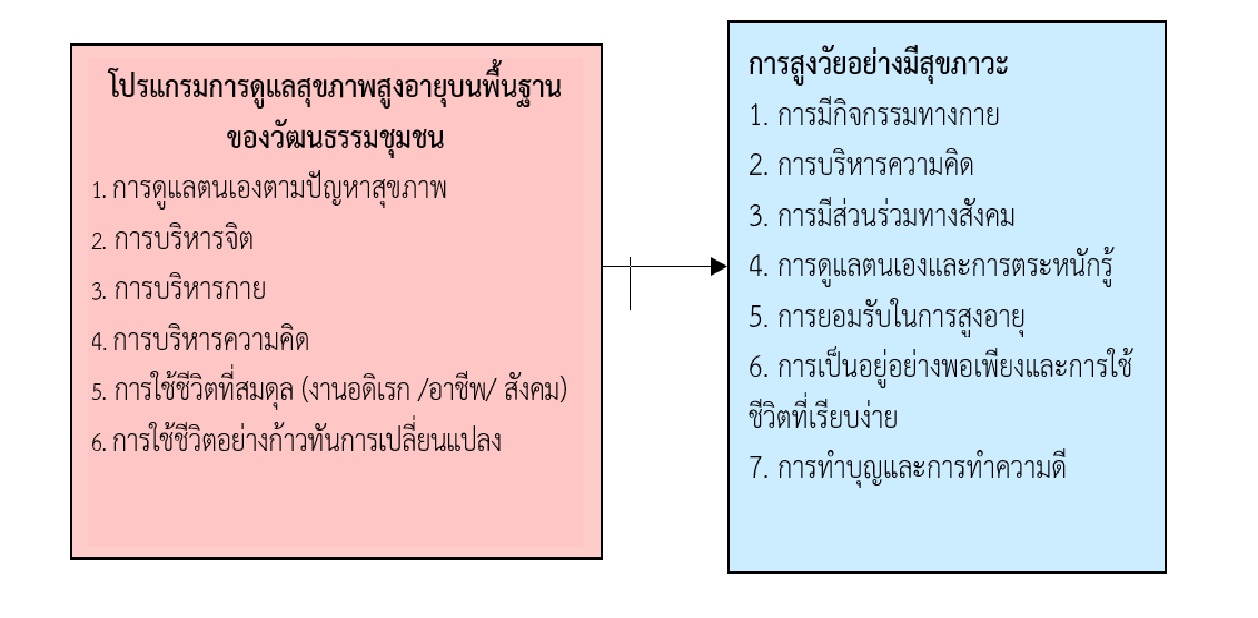
The quasi research was to study effect of Community Cultural-Based Elderly Health Care Program on Healthy Ageing. There were 50 elderly person who live in Pa Phayom District, Phatthalung Province. The inclusion criteria were 1) ADLs > 9 scores 2) no communication impairment and 3) no dementia. The samples were randomly selected by using a matched-pair method based on age and ability to perform activities of daily living (ADL), divided 50 elderly people into an experimental group (n = 25) and a control group (n = 25). The research instrument including 1) Community Cultural-Based Elderly Health Care Program consist of 6 components: self – care according to common symptoms in the elderly, mental exercise, physical exercise, cognitive exercise, balance life and adaptive living to changes These length of this program is 80 hours divined into 16 times, the program runs once a week for 5 hours, 2) The data collection of healthy aging questionnaire was conducted in three phases; pre-experiment, post-experiment, and at the end of the one-month follow-up. Data analysis were frequency, percentage, mean, standard deviation and ANOVA repeated measure. Research results revealed that
- 1. The experimental group that received the Community Cultural-Based Elderly Health Care Program had significantly higher mean scores in healthy aging compared to control group that lived their usual lives at the .05 level (F = 36795.181; p < .000)
- 2. The experimental group had significantly different average mean scores of healthy aging at before the experiment, after intervention, and at the end of the follow-up, at the .05 level.
Keyword: Community Cultural-Based Elderly Health Care Program, Health literacy, Healthy aging
References
Chen, Y., Demnitz, N., Yamamoto, S., Yaffe, K., Lawlor, B., & Leroi, I. (2022). Defining brain health: a concept analysis. International journal of geriatric psychiatry, 37(1). doi:10.1002/gps.5564
Division of Health Education, Departmentof health service support, Ministry of public health. (2020). Health literacy and health behaviorsquestionnaire among working-age people in villages to modify health behaviors. Retrieved November 1, 2025 from
http://www.hed.go.th/linkHed/424 (in thai)
Fırat Kılıç, H., Arifoğlu, B., & Kızılkaya, N. (2023). The relationship between successful aging and health literacy in older adults. Perspectives in Psychiatric Care, 2023(1), 1462914.
Kaeodumkoeng, K., & Thummakul, D. (2015). Health literacy promoting in aging population. Journal of health science research, 9(2), 1-8. (in thai)
McMaughan, D. J., Oloruntoba, O., & Smith, M. L. (2020). Socioeconomic status and access to healthcare: interrelated drivers for healthy aging. Frontiers in public health, 8, 231. doi.org/10.3389/fpubh.2020.00231
National Statistical Office. (2024). Statistical yearbook thailand 2024. Ministry of digital economy and society. Retrieved November 1, 2025 from https://www.nso.go.th/public/ e-book/Statistical-Yearbook.
Nutbeam, D. (2000). Health literacy as a public health goal: a challenge for contemporary health education and communication strategies into the 21st century. Health promotion international, 15(3), 259-267.
Özkan, O., Alp, S., Özer, Ö., & Kambur, E. S. (2024). Health literacy, healthy aging and life satisfaction. Activities, Adaptation & Aging, 48(4), 690-704.
Pengchan, W. (2017). Health literacy in proceedings of the workshop on capacity building for personnel of the department of health: health literacy toward Thailand, Department of Health, Ministry of Public Health. Nonthaburi: Ministry of Public Health.
Sardareh, M., Matlabi, H., Shafiee-Kandjani, A. R., Bahreini, R., Mohammaddokht, S., & Azami-Aghdash, S. (2024). Interventions for improving health literacy among older people: a systematic review. BMC geriatrics, 24(1), 911.
Shin, J., & Cho, E. (2022). Trajectories of depressive symptoms among community-dwelling Korean older adults: findings from the Korean longitudinal study of aging (2006–2016). BMC psychiatry, 22(1), 246.
Stormacq, C., Wosinski, J., Boillat, E., & Van den Broucke, S. (2020). Effects of health literacy interventions on health-related outcomes in socioeconomically disadvantaged adults living in the community: a systematic review. JBI Evidence Synthesis, 18(7), 1389-1469. doi: 10.11124/JBISRIR-D-18-00023
Syed, S., Ashwick, R., Schlosser, M., Jones, R., Rowe, S., & Billings, J. (2020). Global prevalence and risk factors for mental health problems in police personnel: a systematic review and meta-analysis. Occupational and environmental medicine, 77(11), 737-747.
Thiamwong, L., McManus, M. S., & Suwanno, J. (2013). Development of the Thai healthy aging model: A grounded theory study. Nursing & health sciences, 15(2), 256-261. doi.org/10.1111/nhs.12028
Vilawarn, J. Laokhompruttajan, J., Laokhompruttajan, T., Boonnao, Y., & Boonserm, P. (2022). The effect of socio-cultural program for promoting quality of Llife and depression prevention in the elderly, Na Fai Subdistrict, Mueang Chaiyaphum District, Chaiyaphum Province. Research and Development Health System Journal, 15(1), 181 – 195. (in thai)
Wittes, J. (2002). Sample size calculations for randomized controlled trials. Epidemiologic Reviews 24(1), 39-53.
Zhang, K., Kan, C., Luo, Y., Song, H., Tian, Z., Ding, W., et al. (2022). The promotion of active aging through older adult education in the context of population aging. Front Public Health. 10:998710, doi: 10.3389/fpubh.2022.998710
Downloads
Published
How to Cite
Issue
Section
License
Copyright (c) 2026 Boromarajonani College of Nursing, Nakhon Si Thammarat

This work is licensed under a Creative Commons Attribution-NonCommercial-NoDerivatives 4.0 International License.
บทความที่ได้รับการตีพิมพ์เป็นลิขสิทธิ์ของ วิทยาลัยพยาบาลบรมราชชนนี นครศรีธรรมราช
ข้อความที่ปรากฏในบทความแต่ละเรื่องในวารสารวิชาการเล่มนี้เป็นความคิดเห็นส่วนตัวของผู้เขียนแต่ละท่านไม่เกี่ยวข้องกับวิทยาลัยพยาบาลบรมราชชนนี นครศรีธรรมราช และบุคคลากรท่านอื่น ๆ ในวิทยาลัยฯ แต่อย่างใด ความรับผิดชอบองค์ประกอบทั้งหมดของบทความแต่ละเรื่องเป็นของผู้เขียนแต่ละท่าน หากมีความผิดพลาดใดๆ ผู้เขียนแต่ละท่านจะรับผิดชอบบทความของตนเองแต่ผู้เดียว