ผลของโปรแกรมการกำกับตนเองเพื่อชะลอไตเสื่อมต่อความรู้และพฤติกรรมการบริโภคอาหารของผู้ป่วยเบาหวานชนิดที่ 2 ที่มีภาวะไตเสื่อมระยะที่ 2–3a ตำบลไตรตรึงษ์ อำเภอเมืองกำแพงเพชร จังหวัดกำแพงเพชร
คำสำคัญ:
การกำกับตนเอง, โรคเบาหวานชนิดที่ 2, โรคไตเรื้อรังระยะที่ 2–3a, พฤติกรรมการบริโภคอาหารบทคัดย่อ
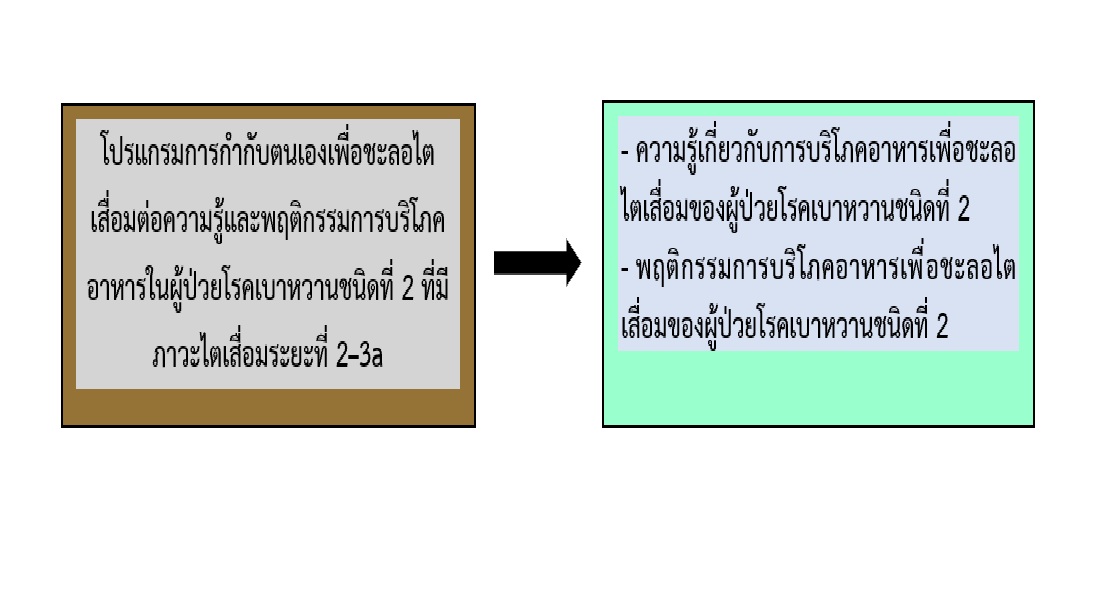
การวิจัยกึ่งทดลองนี้มีวัตถุประสงค์เพื่อ (1) เปรียบเทียบคะแนนเฉลี่ยความรู้และพฤติกรรมการบริโภคอาหารของผู้ป่วยโรคเบาหวานชนิดที่ 2 ที่มีภาวะไตเสื่อมระยะที่ 2–3a ในกลุ่มทดลองก่อนและหลังได้รับโปรแกรมการกำกับตนเองเพื่อชะลอไตเสื่อม และ (2) เปรียบเทียบคะแนนเฉลี่ยความรู้และพฤติกรรมการบริโภคอาหารระหว่างกลุ่มทดลองและกลุ่มควบคุมหลังได้รับโปรแกรมการกำกับตนเองเพื่อชะลอไตเสื่อม กลุ่มตัวอย่างคือผู้ป่วยโรคเบาหวานชนิดที่ 2 ที่มีภาวะไตเสื่อมระยะที่ 2–3a จำนวน 60 คน คัดเลือกแบบเจาะจง แบ่งเป็นกลุ่มทดลองและกลุ่มควบคุม กลุ่มละ 30 คน เครื่องมือวิจัยประกอบด้วย แบบสอบถามข้อมูลทั่วไป แบบประเมินความรู้และแบบประเมินพฤติกรรมการบริโภคอาหารเพื่อชะลอไตเสื่อม รวมทั้งสมุดบันทึกพฤติกรรม โดยเครื่องมือผ่านการตรวจสอบความตรงเชิงเนื้อหาโดยผู้ทรงคุณวุฒิ ได้ค่าดัชนีความตรงเชิงเนื้อหาของแบบสอบถามความรู้และพฤติกรรมการบริโภคอาหารเท่ากับ 0.90 และ 0.91 ตามลำดับ และมีค่าความเชื่อมั่นของแบบสอบถามความรู้เท่ากับ 0.82 (KR-20) และแบบสอบถามพฤติกรรมการบริโภคอาหารเท่ากับ 0.84 (Cronbach’s alpha) วิเคราะห์ข้อมูลด้วยสถิติเชิงพรรณนา และสถิติทีคู่ (paired t-test) และสถิติทีอิสระ (independent t-test)
ผลการวิจัยพบว่า หลังได้รับโปรแกรมกลุ่มทดลองมีคะแนนเฉลี่ยความรู้ในระดับมาก (M = 12.23, SD = 1.57) และคะแนนเฉลี่ยพฤติกรรมการบริโภคอาหารอยู่ในระดับปานกลาง (M = 32.20, SD = 3.29) โดยคะแนนเฉลี่ยความรู้และพฤติกรรมการบริโภคอาหารของกลุ่มทดลองหลังได้รับโปรแกรมสูงกว่าก่อนได้รับโปรแกรมอย่างมีนัยสำคัญทางสถิติ (p < .05) และเมื่อเปรียบเทียบหลังทดลองระหว่างกลุ่ม พบว่ากลุ่มทดลองมีคะแนนเฉลี่ยความรู้และพฤติกรรมการบริโภคอาหารสูงกว่ากลุ่มควบคุมอย่างมีนัยสำคัญทางสถิติ (p < .05)
ผลการวิจัยครั้งนี้แสดงให้เห็นว่า โปรแกรมการกำกับตนเองเพื่อชะลอไตเสื่อมสามารถเพิ่มความรู้และส่งเสริมพฤติกรรมการบริโภคอาหารที่เหมาะสมในโรคผู้ป่วยเบาหวานชนิดที่ 2 ที่มีภาวะไตเสื่อมระยะเริ่มต้นได้อย่างมีประสิทธิภาพ จึงสามารถนำไปประยุกต์ใช้เป็นแนวทางในการส่งเสริมการดูแลตนเองของผู้ป่วยกลุ่มนี้ได้อย่างเหมาะสม
เอกสารอ้างอิง
Bandura, A. (1991). Social cognitive theory of self-regulation. Organizational Behavior and Human Decision Processes, 50(2), 248–287.
Best, J. W. (1980). Research in education (4th ed.). Prentice-Hall.
Bloom, B.S. (1971). Handbook on formative and summative evaluation of student learning. New York : McGraw–Hill.
Chen, Y. Y., Wang, L. H., & Tsai, C. C. (2021). Effects of self-regulation programs on health behaviors in type 2 diabetes patients: A systematic review. Journal of Clinical Nursing, 30(1–2), 98–110.
Chantarat, S., & Wannathat, P. (2025). Effects of a renal deterioration delay program in patients
with diabetes mellitus. Phrae Medical Journal and Clinical Sciences, 33(1), 1–14. (in Thai)
Department of Disease Control. (2024). World Diabetes Day 2024 campaign: Promoting quality
of life and well-being among diabetic patients. Retrieved July 20, 2025 from https://ddc.moph.go.th/index.php (in Thai)
Dok Khamtai Hospital. (2021). Non-communicable diseases patient handbook [Flipbook]. Retrieved July 20, 2025 from https://anyflip.com/njznz/oqbp/basic. (in Thai)
Lee, J. J., Khan, T. A., McGlynn, N., Malik, S. V., Hill, O. J., Leiter, A. L., et al. (2022). Relation of change or substitution of low- and no-calorie sweetened beverages with cardiometabolic outcomes: A systematic review and meta-analysis of prospective cohort studies. Diabetes Care, 45(8), 1917–1930.
Luangsiri, S., Wongnonta, D., Tantong, S. & Thammakhun. N. (2023). Effectiveness of a behavior modification program in slowing kidney deterioration among type 2 diabetic patients in Wiang Khuk Subdistrict, Nong Khai Province. Nong Khai Provincial Public Health Office. (in Thai)
Noipan, S. (2012). Effects of a self-management promotion program on dietary behaviors among elderly patients receiving continuous ambulatory peritoneal dialysis (Master’s thesis, Prince of Songkla University. (in Thai)
Provincial Public Health Office of Kamphaeng Phet. (2025). Percentage of diabetes and/or hypertension patients with CKD stages 3–4 who can delay the decline in eGFR as targeted. Retrieved June 22, 2025 from https://hdc.moph.go.th/kpt/public/standard-report-detail/752f4de6e90d3e41b3cb8f8104b2e8bd (in Thai)
Samrannet, W., Koisranuphap, N. & Promla, W. (2021). Nurses’ roles in slowing kidney
deterioration among uncontrolled type 2 diabetic patients. Journal of Health Center 9, 15(38), 456–468. (in Thai)
Singburan, P., & Phinyoyo, K. (2024). Effects of a self-management support program on knowledge and dietary behaviors among patients with type 2 diabetes and kidney impairment in Non Tan Subdistrict, Nong Ruea District, Khon Kaen Province. Royal Thai Army Nursing Journal, 25(2), 149–158. (in Thai)
Songthummint, S. (2023). Effects of a nutritional therapy program on delaying kidney deterioration among diabetic patients at Ban Saen Phan Health Promoting Hospital, Um Chan Subdistrict, Kusuman District, Sakon Nakhon Province. Khon Kaen University Public Health Research Journal, 16(1), 14–24. (in Thai)
Suphapan, S. (2019). Development of a Model to Delay Renal Impairment in Patients with Diabetes and Hypertension Using Case Management Process in Phusing Hospital, Sisaket Province. Journal of Public Health, 28(5), 857–866. (in Thai)
The Nephrology Society of Thailand. (2022). Clinical practice guidelines for the management of chronic kidney disease prior to renal replacement therapy (Revised 2022). Srimuang Printing. (in Thai)
Thomas, M. C., Brown, F. G., & MacIsaac, R. J. (2023). Nutrition and diabetic kidney disease. Nature Reviews Nephrology, 19, 132–145.
Tungtong, S. (2017). Slowing kidney deterioration in uncontrolled type 2 diabetes mellitus patients. Royal Thai Army Nursing Journal, 18(Special Issue), 17–24. (in Thai)
ดาวน์โหลด
เผยแพร่แล้ว
รูปแบบการอ้างอิง
ฉบับ
ประเภทบทความ
สัญญาอนุญาต
ลิขสิทธิ์ (c) 2026 วิทยาลัยพยาบาลบรมราชชนนี นครศรีธรรมราช

อนุญาตภายใต้เงื่อนไข Creative Commons Attribution-NonCommercial-NoDerivatives 4.0 International License.
บทความที่ได้รับการตีพิมพ์เป็นลิขสิทธิ์ของ วิทยาลัยพยาบาลบรมราชชนนี นครศรีธรรมราช
ข้อความที่ปรากฏในบทความแต่ละเรื่องในวารสารวิชาการเล่มนี้เป็นความคิดเห็นส่วนตัวของผู้เขียนแต่ละท่านไม่เกี่ยวข้องกับวิทยาลัยพยาบาลบรมราชชนนี นครศรีธรรมราช และบุคคลากรท่านอื่น ๆ ในวิทยาลัยฯ แต่อย่างใด ความรับผิดชอบองค์ประกอบทั้งหมดของบทความแต่ละเรื่องเป็นของผู้เขียนแต่ละท่าน หากมีความผิดพลาดใดๆ ผู้เขียนแต่ละท่านจะรับผิดชอบบทความของตนเองแต่ผู้เดียว